Dark Matter Matters
mission
When good companies go bad
A few weeks ago I finished the new Jim Collins book How the Mighty Fall and Why Some Companies Never Give In. If you read this blog much, you’re probably sick of me prattling on about how much I love Jim Collins’ work (here, here, and here). Over the years at Red Hat, we’ve based many projects related to the values, mission, and other corporate-level structural thinking on ideas we got from him.
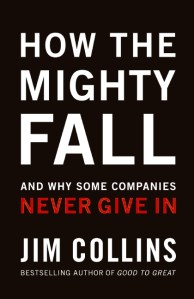 Well, it’s been almost eight years since Collins wrote his last full-length book, Good to Great (which ranked number one on my list of the top ten books behind Dark Matter Matters). How the Mighty Fall is a short book, and in it, Collins is clearly a bit on the defensive about his previous work. The issue? In the economic meltdown last year, some of his Built to Last companies didn’t last, and some of his Good to Great companies are back to good… or gone.
Collins explains it this way:
…the principles in Good to Great were derived primarily from studying specific periods in history when the good-to-great companies showed a substantial transformation into an era of superior performance that lasted fifteen years. The research did not attempt to predict which companies would remain great after their fifteen-year run. Indeed, as this work shows, even the mightiest of companies can self-destruct.
…I’ve come to see institutional decline like a staged disease: harder to detect but easier to cure in the earlier stages, easier to detect but harder to cure in the later stages. An institution can look strong on the outside but already be sick in the inside, dangerously on the cusp of a precipitous fall.
So this book is Collins’ attempt to discover why exactly some very good companies went oh so very bad. If Good to Great was Star Wars, this book is The Empire Strikes Back— a long, hard look into the dark side (even the cover is black).
Collins did extensive research using an interesting approach. He studied these companies, not as history has judged them, but based on what the company was saying, what the press was saying, what financial analysts were saying during the time period being studied– before we knew the outcome. And all of the research was done in historical order, almost like he was following the companies through time.
The results of the research play out like a Greek tragedy. He identified 5 stages of decline in the companies that had gone from great to… not so great:
Red Hat culture tip: default to open
After 10 years at Red Hat, I’ll admit I am a little bit out of touch with what the corporate world looks like everywhere else. But after a recent conversation with someone out there in the non-Red Hat universe, I thought I’d pass on a quick tip they found helpful on how to create a more collaborative culture in your organization.

Tom Petty sez you should go "into the great wide open..."
The tip is simple. Default to open. Everywhere.
What does this mean? It means rather than starting from a point where you choose what to share, you start from a point where you chose what not to share.
You begin sharing by default.
A quick example. Our group was lucky enough to (thanks to our talented global facilities director, Craig Youst) have the opportunity to help design our own office space. As part of the space design, we determined that we wanted no offices– everyone would be in a large, open collaborative space.
Everyone had the same sized cubes, and it didn’t matter how much of a muckety-muck you were or weren’t. If you wanted to have a private conversation, the space design included a series of private alcoves, where you could go talk with your doctor, or yell at your wife, or whatever you didn’t want to do in public. But the key is that you had to actively decide when placing a call, do I want to take this in private? Which is counter than the old-skool office design where you had an office with a door, and all conversations were private by default.
Rebuilding companies as communities

The brilliant Henry Mintzberg. I've got to meet this guy some day.
Holy smokes, Henry Mintzberg is at it again! The guy who predicted the economic collapse in 2006 (why is he not more famous, I don’t get it?) has an article in the July/August issue of the Harvard Business Review suggesting that the cultural framework of the corporation is completely broken.
And, according to Mintzberg, the way to fix it is not by thinking like a corporation, but instead by thinking like a community. From the article:
Beneath the current economic crisis lies another crisis of far greater proportions: the depreciation in companies of community– people’s sense of belonging to and caring for something larger than themselves. Decades of short-term management, in the United States especially, have inflated the importance of CEOs and reduced others in the corporation to fungible commodities…
And it’s is a two way street… When a corporation treats its employees like simple assets to be hired and fired as the share price rises or falls, the employees treat the corporation like… a corporation.
The end result? Disengaged employees who don’t care about the business, and the business (and the shareholders) suffer for it. So for heaven’s sake, Henry, tell us how to fix it!
Just in! A compelling vision for corporate America
In previous posts, I’ve talked about the need for setting a compelling vision for the corporation beyond just making money. Jim Collins writes about this concept extensively in Good to Great and Built to Last.
On June 26, we saw a wonderful example of one of the most respected CEOs in America, Jeffrey Immelt of GE, doing exactly that.
Steve Prokesch at Harvard Business Review gives some of the background in his blog:
A couple of weeks ago I met with GE’s CEO Jeff Immelt and we were talking about the financial meltdown, the deep recession, and what it would take to fix America. He was outspoken about how business and government had let down the American people and the need for radical change.
That’s fine, I said, but if he felt that way, why hadn’t he spoken up publicly? Immelt ran from the room and quickly returned with a speech he was working on–one he delivered last week at the Detroit Economic Club. This was his speech and not something he had fobbed off to a speechwriter, he told me.
After reading this post, I went and watched the speech, which will take you about 25 minutes of your life.
I was blown away. In this very traditional corporate luncheon setting, glasses and sliverware clinking, video cutaways to bored-looking attendees trying to remember where their 1 o’clock meeting is supposed to be, Immelt presented a deeply personal vision for recreating America, and his company in the process.
The top 10 books behind Dark Matter Matters
Books are important to me. Growing up, almost every free wall in my parents’ house was lined with bookshelves, some of them stacked two deep. I spent most of my pre- Red Hat career in book publishing, first working during college at The University of North Carolina Press. After college, I went to work for a literary agent named Rafe Sagalyn in Washington DC. Working for Rafe was a great experience because he built his reputation on big think/idea books and business books.
His first big book was the huge bestseller Megatrends by John Naisbitt back in the early 80s. When I was there, I personally got to work with, among others, Bill Strauss and Neil Howe on their great books about generational patterns in society (check out The Fourth Turning… very prophetic these days) and Don Peppers, author of some books back in the 90s like The 1:1 Future about relationship marketing that were the grandparents of today’s books on social media marketing.
I also got to play agent and author myself too. As an agent, I represented some of Tom Bodett’s work (yes, he is the Motel 6 guy, but was also a commentator on NPR) and sold a wonderful novel called The Frequency of Souls to FSG. As author, I helped Rafe write two “cutting edge” books about getting free and open access to government information (they have not aged well, I’m afraid).
Fast forwarding to today, Rafe actually was the agent for two recent big think books that I love, Authenticity and A Whole New Mind, so he is still making things happen.
After I left book publishing, reading became fun again. I read novels and travel literature for a while, nothing that made me think too much. But when I got to Red Hat, I relapsed and started reading the big think books like the ones I used to work on with Rafe. I thought it might be worth taking a few minutes to try to remember the books that have been the biggest influences on my thinking, and get them all down in one place, so here goes:
Top 10 Dark Matter Matters books
Without these ten books, Dark Matter might not even matter to me.
Why did I just write a post about Viking Longships?
 A great brand can seem from the outside to be an awesome speedboat, like the kind they rode around on Miami Vice… Just grab the wheel, hit the throttle, and send it screaming through the water to wherever you want to go. He who controls the brand has all of the power to steer and go wherever he wants… right?
I’ve always envied those brand managers (kind of…) who have a marketing budget of millions and can go out and “buy” an image for their brand using advertising. They are driving the speedboats. If they want, they can associate their brand with skydivers and bungee jumping (Do the Dew, man!) or whatever they choose.
But the reality is that a brand like Red Hat is more like a Viking longship. Here’s what Wikipedia says about how longships moved:
Markepoetry Part 3: Mission Soup
All this talk of mission statements made me go take a look in the Googleverse to see what other companies are using for mission statements. Thankfully, the nice people at missionstatements.com have pulled together a list of all of the company mission statements they could find.
There are some interesting ones in there (two favorites: Darden Restaurants: “To nourish and delight everyone we serve.” and Harley Davidson: “We fulfill dreams through the experience of motorcycling.”) But once you read a few, it is abundantly clear which companies have put thought and energy into the process and which are simply going through the motions. I’ve taken a selection of the mission statements of Fortune 500 companies from the missionstatements.com site and woven them into today’s markepoem:
—
Mission soup
starts with quality ingredients like:
a friendly, knowledgeable, professional staff,
a dynamic and challenging environment,
teamwork, creativity, and resourcefulness,
a respect for diversity,
an atmosphere of optimism,
and a commitment to create exceptional opportunities for professional growth.
Matt Asay on the Red Hat Mission
Matt Asay just posted about Red Hat’s new mission, which he discovered on a visit to our Westford office in one of our “bathroom briefings” (important aside: we post some internal company news right front and center in the bathroom… if you want people to read something, post it in the bathroom– not everyone reads mailing lists, but everyone pees! Remember, internal communications is a strategic role at Red Hat!).
It’s not a secret, so I don’t mind that he saw the mission or posted about it. In fact, we are pretty happy with the transparent process we employed to get it done. Those of you who have read some previous posts know how strongly I feel about having the entire company aligned on mission and vision and values– the core stuff.
People who get it #2: Marty Neumeier
I ordered 3 copies of Marty Neumeier’s new book, The Designful Company, yesterday for the team. Will let you know what I think once I’ve had a chance to read it. His two previous books, The Brand Gap and Zag, both had a profound influence on the Red Hat  overall brand strategy. I especially love The Brand Gap, which David Burney first introduced to me in 2005.
I’ve probably bought 20-30 copies of The Brand Gap over the last few years, try to keep a few at my desk to hand out to any potential brand converts I meet (why do I never get the copies back?). What’s beautiful about this book is the design and content are one–the message of the book is communicated by its design and its content together. And it is short– any busy executive can read it on a plane up to NYC.
In addition to helping us articulate the overall organizational design of the Brand Communications + Design group within Red Hat, this book has given us many other good ideas to chew on over the years. Probably the most famous quote from the book is:
A brand is not what YOU say it is, it’s what THEY say it is.
which many other people have glommed onto over the last couple of years (including me).
Even if you don’t have time to check out Marty’s books, go check out his great (and beautiful) presentation that explains many of the key concepts of his thinking here.
Rethinking communications in the 21st century company
Last week a colleague told me IBM had reorganized it’s marketing and communications functions. In the new order, the entire marketing organization would report into communications. Typically it has always been the opposite, with brand groups like mine and public relations reporting into a Chief Marketing Officer. Until recently, that’s been the way it worked at Red Hat too– over the years I’ve worked for mostly VP of marketing or CMO-types (although now I work as part of a group called People & Brand, a subject I’ll save for another post).
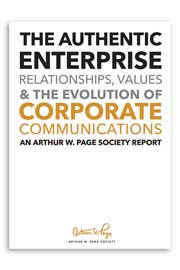 So I spent some time thinking about what this change meant for IBM, why they were doing it, and did a little research online. In the process, I stumbled upon this report from the Arthur W. Page Society entitled “The Authentic Enterprise.” Turns out that one of the co-chairs of the Authentic Enterprise task force was John Iwata, the SVP of Communications for IBM. My guess is that this report, which came out in 2007, had significant impact in making the changes at IBM.
Thought I’d call out a few choice quotes from the report that I loved.
Hey, I Wrote a Book!

Available now in print and electronic versions.
 Dark Matter Matters