Dark Matter Matters
culture
Trying to change a 20th century corporate culture? Where should you start?
 When I talk about the culture that we’ve built at Red Hat over the years around the principles of the open source way, one of the most popular questions I get is something along these lines.
That’s great and all, Chris. But Red Hat built its culture from scratch. My company culture has been the same for over 50 years. Can you change a deeply entrenched 20th century culture?
It’s a great question. Clearly there is a big advantage to being able to organically build a corporate culture from scratch. But, with support from the top levels of management, it is not impossible to change an entrenched culture, too.
Where do you start? Here are three tips:
Jack Welch on transparency, meritocracy, and the death of hierarchy
On Tuesday I’m heading up to New York to share an open source perspective with GE marketing executives at the legendary GE leadership center in Crotonville. I wrote a post a few months ago praising GE Chairman Jeffrey Immelt’s compelling new vision for corporate America, and I have an enormous amount of respect for GE as an innovation engine. I’m excited about the opportunity to exchange ideas with the smart folks there.
 In 2009, Forbes ranked GE as the world’s largest company, so I’ve figured before I went up to Crotonville it’d be a good idea to do some homework and see what elements of what we call the open source way are already in practice within one of the most successful companies in history. I’ve found some interesting stuff in my research.
One piece in particular grabbed me. Sitting on the beach today over the holiday weekend, I finished the 2001 biography of Jack Welch (the legendary predecessor to Immelt as Chairman of GE) entitled Jack: Straight from the Gut. I thought I’d share a Jack Welch prediction (written almost ten years ago) that fits right in with our open source view of what the 21st century organization looks like.
Wait, what if dark energy doesn’t matter?
The horror! A few days ago, in a study released in one of my favorite light reading mags, the Proceedings of the National Academy of Sciences, two mathematicians proposed that dark energy might simply be an illusion we observe from our spot in a massive space-time expansion wave. There’s a nice writeup of the research in National Geographic here.
 Does this mean the entire concept of this website, that brand, culture, and community form the dark matter and dark energy of organizations, breaks down too? That all this hippie brand-building, culture-growing, community-creating stuff is also an illusion, and the traditional visible mechanics of business alone are the stuff of which great companies are made?
I know. I know. It rocked my foundation too. Well, as my favorite fortune cookie fortune once told me, “all is not yet lost.” It is just a theory.
And it turns out that for the theory to be true, for the math to work, we must be at the center of the universe, a caveat that one physicist describes as “unusual.” I’d say so. Didn’t Copernicus have something to say about that in, like, 1543?
If you are still concerned and want to learn more, go read the abstract of the report. I’ll give you a taste to whet your appetite:
We derive a system of three coupled equations that implicitly defines a continuous one-parameter family of expanding wave solutions of the Einstein equations, such that the Friedmann universe associated with the pure radiation phase of the Standard Model of Cosmology is embedded as a single point in this family. By approximating solutions near the center to leading order in the Hubble length, the family reduces to an explicit one-parameter family of expanding spacetimes, given in closed form, that represents a perturbation of the Standard Model.
These guys seem pretty smart, and it sounds like we stand to learn a lot from their findings. And what’s good enough for the National Academy of Sciences is good enough for me.
As for our little Dark Matter Matters website, I’m no mathematician, but I see a lot of prominent mathematicians and physicists calling these results controversial. For now, I’m still thinking dark matter and dark energy might matter, people. Carry on.
The epic FAIL fail
There was an interesting article in the New York Times Magazine this weekend about the metamorphosis of the word fail from verb to interjection. I know, I know, most of the computer-y world has been using the word in this way for quite some time (need some examples? go check out FailBlog). It’s old news.
 But when the New York Times picks up on the meme, it means we have entered a different stage of acceptance altogether. It might be time to start paying attention before things get out of hand.
Anil Dash wrote an interesting post called The End of Fail a few months ago where he articulated some of the reasons why FAIL is such an ummm… FAIL for collaborative cultures.
Fail is over. Fail is dead. Because it marks a lack of human empathy, and signifies an absence of intellectual curiosity, it is an unacceptable response to creative efforts in our culture. “Fail!” is the cry of someone who doesn’t create, doesn’t ship, doesn’t launch, who doesn’t make things. And because these people don’t make things, they don’t understand the context of those who do. They can’t understand that nobody is more self-critical or more aware of the shortcomings of a creation than the person or people who made it.
When attempting to build a collaborative culture where innovation flourishes, the biggest enemy, as Tom Kelly has pointed out, is the Devil’s Advocate. I almost feel like the person who shouts FAIL is a worse member of the same species. At least the Devil’s Advocate brings some opposing ideas to the table. The FAILman delivers only judgment.
Sharing your brand story (and here’s ours)
The most compelling brands in the world tell compelling stories. Whether the brand is Nike (the Greek winged goddess of victory was named Nike, and it all rolls from there) or IBM (Thomas Watson and THINK) or [your favorite brand here], the most interesting brands have great mythologies built up over time. The brand story is deeply ingrained in their actions, voice, look, and culture.
It’s been almost eight years since we created the first Red Hat Brand Book. The original book was an attempt to capture the essence of our Red Hat story, to explain what Red Hat believes, where we came from, and why we do what we do.
It had a secondary mission as an early brand usage guide, explaining what Red Hat should look and sound like at a time when the company was expanding rapidly around the world and brand consistency was becoming harder to achieve.
When most companies create this sort of document, they call it a “Brand Standards Manual”, or something like that. But we were young, foolish, and drunk on the meritocracy of open source, so in the first version of the Brand Book, we emblazoned the words “This is not a manual” on the front cover.
Why? We wanted to be very clear this book was the starting point for an ongoing conversation about what the Red Hat brand stood for, looked like, and sounded like, rather than a prescriptive “Thou shalt not…” kind of standards guide.
I hate brand standards that sound like legal documents. I’ve always felt like the role of our group was to educate and inspire, not to police, and we tried to create a document that embodied that spirit.
This year we launched the biggest update yet to the Brand Book. In doing so, we actually split it into two projects:
Matthew Szulik and the Red Hat vision
The BBC conducted a great interview with Red Hat Chairman Matthew Szulik while he was attending the Ernst & Young World Entrepreneur of the Year awards recently (representing the United States as our winner). You can listen to it here.
This interview is a wonderful reminder of the powerful impact of a corporate vision that extends beyond just making money. And a great reminder for me of how lucky I have been to learn about leadership, community, culture, and brand from the 2008 United States Entrepreneur of the Year.
If you are interested in learning more about Matthew Szulik, his vision, and how it evolved, here is a wonderful oral history of his life that was commissioned a few years ago.
When good companies go bad
A few weeks ago I finished the new Jim Collins book How the Mighty Fall and Why Some Companies Never Give In. If you read this blog much, you’re probably sick of me prattling on about how much I love Jim Collins’ work (here, here, and here). Over the years at Red Hat, we’ve based many projects related to the values, mission, and other corporate-level structural thinking on ideas we got from him.
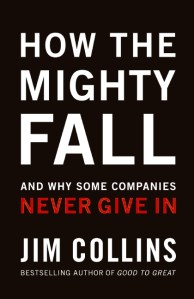 Well, it’s been almost eight years since Collins wrote his last full-length book, Good to Great (which ranked number one on my list of the top ten books behind Dark Matter Matters). How the Mighty Fall is a short book, and in it, Collins is clearly a bit on the defensive about his previous work. The issue? In the economic meltdown last year, some of his Built to Last companies didn’t last, and some of his Good to Great companies are back to good… or gone.
Collins explains it this way:
…the principles in Good to Great were derived primarily from studying specific periods in history when the good-to-great companies showed a substantial transformation into an era of superior performance that lasted fifteen years. The research did not attempt to predict which companies would remain great after their fifteen-year run. Indeed, as this work shows, even the mightiest of companies can self-destruct.
…I’ve come to see institutional decline like a staged disease: harder to detect but easier to cure in the earlier stages, easier to detect but harder to cure in the later stages. An institution can look strong on the outside but already be sick in the inside, dangerously on the cusp of a precipitous fall.
So this book is Collins’ attempt to discover why exactly some very good companies went oh so very bad. If Good to Great was Star Wars, this book is The Empire Strikes Back— a long, hard look into the dark side (even the cover is black).
Collins did extensive research using an interesting approach. He studied these companies, not as history has judged them, but based on what the company was saying, what the press was saying, what financial analysts were saying during the time period being studied– before we knew the outcome. And all of the research was done in historical order, almost like he was following the companies through time.
The results of the research play out like a Greek tragedy. He identified 5 stages of decline in the companies that had gone from great to… not so great:
Red Hat culture tip: default to open
After 10 years at Red Hat, I’ll admit I am a little bit out of touch with what the corporate world looks like everywhere else. But after a recent conversation with someone out there in the non-Red Hat universe, I thought I’d pass on a quick tip they found helpful on how to create a more collaborative culture in your organization.

Tom Petty sez you should go "into the great wide open..."
The tip is simple. Default to open. Everywhere.
What does this mean? It means rather than starting from a point where you choose what to share, you start from a point where you chose what not to share.
You begin sharing by default.
A quick example. Our group was lucky enough to (thanks to our talented global facilities director, Craig Youst) have the opportunity to help design our own office space. As part of the space design, we determined that we wanted no offices– everyone would be in a large, open collaborative space.
Everyone had the same sized cubes, and it didn’t matter how much of a muckety-muck you were or weren’t. If you wanted to have a private conversation, the space design included a series of private alcoves, where you could go talk with your doctor, or yell at your wife, or whatever you didn’t want to do in public. But the key is that you had to actively decide when placing a call, do I want to take this in private? Which is counter than the old-skool office design where you had an office with a door, and all conversations were private by default.
New socialism? Naw, it’s the new individualism.
My friend Jeff Mackanic pointed me to this article from last month’s Wired Magazine where Kevin Kelly makes the assertion that there is a “new socialism” emerging in the form of large-scale collaboration projects online. He discusses contributions to Wikipedia, Flickr, even Red Hat’s own Fedora as examples of village-sized or greater online collective work.
In the context of my recent post regarding what Ayn Rand would think of open source, I think Kevin makes a leap where I might not follow him.The clue is right in the article:
…the leaders of the new socialism are extremely pragmatic. A survey of 2,784 open source developers explored their motivations. The most common was “to learn and develop new skills.” That’s practical. One academic put it this way (paraphrasing): The major reason for working on free stuff is to improve my own damn software. Basically, overt politics is not practical enough.
Where Kevin Kelly reaches the conclusion that contributors working together to “improve [their] own damn software” is a new form of socialism in action, I might take the view instead that this is a new form of individualism.
A form of individualism where people are free to pursue their own self interests, yet do so in such a way that they are still in harmony with those around them. The goal of open source developers is individual pursuit, as the paragraph above from the article makes clear… yet a byproduct of these individual pursuits is a collective good: better software, a better enyclopedia, etc.
If it was socialism, the collective good would be the end goal of everyone. But ultimately, the open source model is based on the individual working for the good of himself in harmony with others, not on being a mindless cog in a much bigger wheel.
But I’m no philosophy expert, what do you think?
Measuring dark matter? We’re working on it.
Those of you who have been following this blog for a while know it is based on the simple premise that there are some things out there in the world that are pretty difficult to see or measure, yet these same things can often be the stuff with the biggest impact. The intro to the blog tells the full story.
In the world of astronomy, two of these things are dark matter and dark energy. Both hard to see and measure.
In the world of business, three of these things are brand, culture, and community. Also tough to see and measure their impact in the business world.
So while we constantly explore ways to better understand the impact of brand, culture, and community here at Dark Matter Matters, the world of astronomy is trying to better understand exactly what the heck dark matter and dark energy are.
Thought it might be worth taking a short break from our regularly scheduled program to give an update on how the astronomers are doing.
Hey, I Wrote a Book!

Available now in print and electronic versions.
 Dark Matter Matters