Dark Matter Matters
culture
An open letter to Seth Godin
Dear Seth,
I just finished reading your new book Tribes. Normally when I read a book that relates to the Dark Matter Matters subjects (and Tribes talks about leadership and community and all kinds of good stuff), I write a review and post it here. I’m not going to do that this time. I think the reviews on Amazon pretty well cover it, so I’ll just point people there.
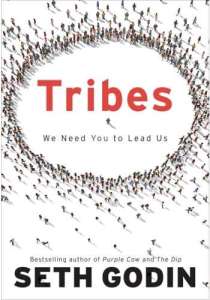 Seth, I have something a bit more personal I’d like to discuss with you. If I may be so bold.
I’ve read most of your books over the years, liars, and purple cows, and dips and whatnot, and I’ve got to tell you, I think you are one smart dude. I’ve learned a lot from you.
I thought the alternative MBA program you just finished was a stroke of genius. I was totally jealous– that would have been a great way to spend six months.
But, honestly, I always get this weird, hollow feeling after reading a book of yours. I couldn’t quite put my finger on it until I finished this one.
OK, let me just spit it out. I think your books can be kind of superficial and tend to preach to the choir a lot.
There. I said it. I’m sorry. I’m not trying to be a hater.
You even call out haters in this book. Said that you shouldn’t let people like that get you down. So please don’t get down, like I said, I really respect your work, it’s just I think you might be limiting your audience. You could be bigger.
So in the hope that I’m being a heretic (in the way you talk about in the book), rather than a hater, I’d humbly suggest some constructive ideas.
Seth, I’d like you to write a book that will do more than rally the tribe that thinks like you. I think you have a book in you that will educate those that don’t think like you. They need your help.
On July 19, 1999, I started at Red Hat
Ten years ago today, I showed up for my first day of work at Red Hat.

A pretty typical view from the Red Hat global HQ circa 1999. this picture appeared in Linux Magazine.
The office was an ugly one-story building in the back of an office park in Durham, NC, a far cry from the monstrous IBM campus I had just left. No longer would I be walking 10 minutes through a parking lot to get to my car, instead we were only a few steps from the front door, which was kind of a big deal for me at the time.
I was 27 years old, and ready to change the world.
At the time, this building was both the only office and the global headquarters for Red Hat, although this would change quickly as we opened offices in Asia and Europe over the next few months. There were about 125 or so people working for the whole company. In the marketing group that I joined, I think there were eight of us, and my first boss was Red Hat employee #1, Lisa Sullivan, who now runs two independent bookstores in Vermont. She had started working for Bob Young in Connecticut, before he joined up with Marc Ewing and moved the company down to North Carolina.
At the time, Marc Ewing and Bob Young still roamed the halls, in fact, Marc sat just a few cubes over from me next to Bascha Harris, who still works with me at Red Hat today. Marc tended to leave his empty drink cans stacked on his desk for weeks, so sometime swarms of fruit flies would descend on my desk after gorging on his leftovers. I’m not sure Marc even knew who I was. To Red Hat folks, I was just another guy coming in from a big company, itching to ruin everything.
The interview process was tough. I distinctly remember being interviewed over the phone by Matthew Szulik. He was Red Hat’s president at the time, and had only been with the company about a year. I still remember him asking me one of his famous interview questions, something like “How will you know if your life has been successful?” I have no idea how I answered that, but I’d really like to hear my answer now.
When good companies go bad
A few weeks ago I finished the new Jim Collins book How the Mighty Fall and Why Some Companies Never Give In. If you read this blog much, you’re probably sick of me prattling on about how much I love Jim Collins’ work (here, here, and here). Over the years at Red Hat, we’ve based many projects related to the values, mission, and other corporate-level structural thinking on ideas we got from him.
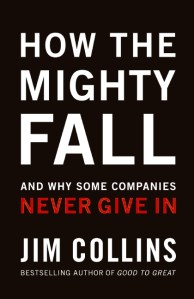 Well, it’s been almost eight years since Collins wrote his last full-length book, Good to Great (which ranked number one on my list of the top ten books behind Dark Matter Matters). How the Mighty Fall is a short book, and in it, Collins is clearly a bit on the defensive about his previous work. The issue? In the economic meltdown last year, some of his Built to Last companies didn’t last, and some of his Good to Great companies are back to good… or gone.
Collins explains it this way:
…the principles in Good to Great were derived primarily from studying specific periods in history when the good-to-great companies showed a substantial transformation into an era of superior performance that lasted fifteen years. The research did not attempt to predict which companies would remain great after their fifteen-year run. Indeed, as this work shows, even the mightiest of companies can self-destruct.
…I’ve come to see institutional decline like a staged disease: harder to detect but easier to cure in the earlier stages, easier to detect but harder to cure in the later stages. An institution can look strong on the outside but already be sick in the inside, dangerously on the cusp of a precipitous fall.
So this book is Collins’ attempt to discover why exactly some very good companies went oh so very bad. If Good to Great was Star Wars, this book is The Empire Strikes Back— a long, hard look into the dark side (even the cover is black).
Collins did extensive research using an interesting approach. He studied these companies, not as history has judged them, but based on what the company was saying, what the press was saying, what financial analysts were saying during the time period being studied– before we knew the outcome. And all of the research was done in historical order, almost like he was following the companies through time.
The results of the research play out like a Greek tragedy. He identified 5 stages of decline in the companies that had gone from great to… not so great:
Red Hat culture tip: default to open
After 10 years at Red Hat, I’ll admit I am a little bit out of touch with what the corporate world looks like everywhere else. But after a recent conversation with someone out there in the non-Red Hat universe, I thought I’d pass on a quick tip they found helpful on how to create a more collaborative culture in your organization.

Tom Petty sez you should go "into the great wide open..."
The tip is simple. Default to open. Everywhere.
What does this mean? It means rather than starting from a point where you choose what to share, you start from a point where you chose what not to share.
You begin sharing by default.
A quick example. Our group was lucky enough to (thanks to our talented global facilities director, Craig Youst) have the opportunity to help design our own office space. As part of the space design, we determined that we wanted no offices– everyone would be in a large, open collaborative space.
Everyone had the same sized cubes, and it didn’t matter how much of a muckety-muck you were or weren’t. If you wanted to have a private conversation, the space design included a series of private alcoves, where you could go talk with your doctor, or yell at your wife, or whatever you didn’t want to do in public. But the key is that you had to actively decide when placing a call, do I want to take this in private? Which is counter than the old-skool office design where you had an office with a door, and all conversations were private by default.
New socialism? Naw, it’s the new individualism.
My friend Jeff Mackanic pointed me to this article from last month’s Wired Magazine where Kevin Kelly makes the assertion that there is a “new socialism” emerging in the form of large-scale collaboration projects online. He discusses contributions to Wikipedia, Flickr, even Red Hat’s own Fedora as examples of village-sized or greater online collective work.
In the context of my recent post regarding what Ayn Rand would think of open source, I think Kevin makes a leap where I might not follow him.The clue is right in the article:
…the leaders of the new socialism are extremely pragmatic. A survey of 2,784 open source developers explored their motivations. The most common was “to learn and develop new skills.” That’s practical. One academic put it this way (paraphrasing): The major reason for working on free stuff is to improve my own damn software. Basically, overt politics is not practical enough.
Where Kevin Kelly reaches the conclusion that contributors working together to “improve [their] own damn software” is a new form of socialism in action, I might take the view instead that this is a new form of individualism.
A form of individualism where people are free to pursue their own self interests, yet do so in such a way that they are still in harmony with those around them. The goal of open source developers is individual pursuit, as the paragraph above from the article makes clear… yet a byproduct of these individual pursuits is a collective good: better software, a better enyclopedia, etc.
If it was socialism, the collective good would be the end goal of everyone. But ultimately, the open source model is based on the individual working for the good of himself in harmony with others, not on being a mindless cog in a much bigger wheel.
But I’m no philosophy expert, what do you think?
What would Ayn Rand think of open source? You can vote!
At the beach over the weekend, I read Anthem by Ayn Rand. Now before you write me off as the kind of guy that would go around telling people he reads Ayn Rand for fun, let me just say in my defense that this is really the first full Ayn Rand book I have read.  And it is only 105 pages long. Having read this, I’d totally read the CliffsNotes for The Fountainhead or Atlas Shrugged (which is like 1200 pages long).
Rand originally titled Anthem as “Ego” and you can definitely tell why. It is about a futuristic world where people are kinda back in the dark ages technologically-speaking, and live in a collective where people have numbers rather than names, are assigned jobs for life, and have forgotten the word “I” (yes, totally annoying… in the first ten chapters, the main character uses the royal “we” to refer to himself).
It seems like Ayn Rand has been back in the news lately, and I’ve seen her name bandied about in political arguments quite a bit, especially regarding healthcare reform. So it made me think, if Ayn Rand’s core philosophy was about maintaining the supremacy of the individual, what she calls “rational self-interest,” and she rejected the idea that the collective good should be put before the good of the individual, what would she think about the open source movement?
After all, I used to remember seeing stories with proprietary companies referring to open source as socialism all the time, although it doesn’t seem to happen as much these days. More and more of the biggest companies are embracing open source software and the concept of open source is more mainstream than ever.
So surely Ayn Rand would hate open source, right? Not so fast. Here are two good reasons why Ayn Rand might totally dig open source:
Summer reading list for Dark Matter Matters
Ah, vacation… the time when the work shuts down for a few days and the Dark Matter Matters blog comes out of hibernation… 3 posts in 3 days!

A few months ago I wrote a post where I highlighted the top ten books behind Dark Matter Matters. In that post I promised to create a list of the books that didn’t make the top 10 cut, but are still pretty awesome.
So here, to celebrate the long holiday weekend, are some more books that have inspired Dark Matter Matters.
Books about how large-scale collaboration is pretty much the deal:
Wikinomics by Don Tapscott and Anthony Williams
The Wisdom of Crowds by James Surowiecki
The Starfish and the Spider by Ori Braffman and Rod Beckstrom
In the open source world, there’s a legendary quote attributed to Linus Torvalds (yes, he is the guy that Linux is named after) “Given enough eyeballs, all bugs are shallow.” The first two of these books are the extended dance remix of this quote. Each has a unique take, but both show how mass collaboration is changing everything about our society and the way we solve problems. The Starfish and the Spider is a interesting look at leaderless organizations and is a nice book for anyone trying to understand how the open source movement (and other leaderless organizations) work, and why open source is so hard to compete against. It is also a nice complement to the Mintzberg article I wrote about in my previous post.
Rebuilding companies as communities

The brilliant Henry Mintzberg. I've got to meet this guy some day.
Holy smokes, Henry Mintzberg is at it again! The guy who predicted the economic collapse in 2006 (why is he not more famous, I don’t get it?) has an article in the July/August issue of the Harvard Business Review suggesting that the cultural framework of the corporation is completely broken.
And, according to Mintzberg, the way to fix it is not by thinking like a corporation, but instead by thinking like a community. From the article:
Beneath the current economic crisis lies another crisis of far greater proportions: the depreciation in companies of community– people’s sense of belonging to and caring for something larger than themselves. Decades of short-term management, in the United States especially, have inflated the importance of CEOs and reduced others in the corporation to fungible commodities…
And it’s is a two way street… When a corporation treats its employees like simple assets to be hired and fired as the share price rises or falls, the employees treat the corporation like… a corporation.
The end result? Disengaged employees who don’t care about the business, and the business (and the shareholders) suffer for it. So for heaven’s sake, Henry, tell us how to fix it!
Just in! A compelling vision for corporate America
In previous posts, I’ve talked about the need for setting a compelling vision for the corporation beyond just making money. Jim Collins writes about this concept extensively in Good to Great and Built to Last.
On June 26, we saw a wonderful example of one of the most respected CEOs in America, Jeffrey Immelt of GE, doing exactly that.
Steve Prokesch at Harvard Business Review gives some of the background in his blog:
A couple of weeks ago I met with GE’s CEO Jeff Immelt and we were talking about the financial meltdown, the deep recession, and what it would take to fix America. He was outspoken about how business and government had let down the American people and the need for radical change.
That’s fine, I said, but if he felt that way, why hadn’t he spoken up publicly? Immelt ran from the room and quickly returned with a speech he was working on–one he delivered last week at the Detroit Economic Club. This was his speech and not something he had fobbed off to a speechwriter, he told me.
After reading this post, I went and watched the speech, which will take you about 25 minutes of your life.
I was blown away. In this very traditional corporate luncheon setting, glasses and sliverware clinking, video cutaways to bored-looking attendees trying to remember where their 1 o’clock meeting is supposed to be, Immelt presented a deeply personal vision for recreating America, and his company in the process.
Red Hat brand/culture link featured on brandchannel.com
There’s a nice article out today on brandchannel.com called Build Your Brand from the Inside Out, interviewing me and Ashley Stockwell from Virgin Media on the role of employees in building a brand. Even Dark Matter Matters gets a plug. Thanks Morgan!
Hey, I Wrote a Book!

Available now in print and electronic versions.
 Dark Matter Matters