Dark Matter Matters
Chris Grams
Jim Whitehurst: How to create jobs the open source way
Fantastic blog post by Jim Whitehurst today on redhat.com called Creating jobs the open source way. As Matt Asay reported yesterday, Jim Whitehurst was one of only two technology CEOs present at President Obama’s Jobs and Economic Forum (the other was Eric Schmidt of Google) at the White House.

Red Hat CEO and President Jim Whitehurst
In his post, Jim makes a clear link from the open source way to innovation to jobs. I love the closing paragraph, which I’ve included below:
“Red Hat has built a successful, growing S&P 500 business on the power of open source, not just as a development model, but as a business and organizational model. While ours isn’t the only solution, I do believe business, government and society can unlock the value of information and create good, long-term jobs by sharing and working together.”
The White House has streaming video of all of yesterday’s events here.
I also found this article, which provides further information on a few of Jim’s points about national broadband infrastructure development, very interesting.
More proof that sharing is good, von Hippel style
Our video called the Red Hat Way starts:
“Your mother was right. It’s better to share.”
There’s more proof that your mom was right in the business world every day. Today in Orlando, experts from around the world are gathering for the inaugural Open Innovation Summit, highlighting companies like Proctor & Gamble, Mozilla, Xerox, and Johnson & Johnson who have seen success with collaborative innovation. My company, Red Hat, has also done pretty well with this approach.
Now, in a new working paper released yesterday entitled Modeling a Paradigm Shift: From Producer Innovation to User and Open Collaborative Innovation, Eric von Hippel and Carliss Baldwin examine the body of research to draw some conclusions about why more people are moving away from simple producer/consumer models to open collaborative innovation models.
You may have heard of Eric von Hippel, one of the world’s leading experts on open innovation. I like that he’s written about open source many times before, including in his 2005 book Democratizing Innovation and in his 2002 HBR paper Customers as Innovators.
In this paper, von Hippel and Baldwin argue that the number of places where traditional 20th century “producer” innovation (companies making products for users without collaborating with them) makes sense is rapidly shrinking. Why? From the paper:
Five ways to strengthen your company’s immune system
I’m not usually a germophobe, but the last few months I’ve been walking around opening doors with my elbows and washing my hands constantly. I’ve been freaked out by the constant updates on Facebook about what my friends/friends’ kids have come down with now. So far, my immune system has held up pretty well, but I always worry that H1N1 is only a doorknob away.
 These are trying times for corporate immune systems too. The economic meltdown has exposed corporations to all sorts of risks they don’t deal with in the regular course of business. Many corporate immune systems have failed, putting millions of people out of work. It begs the question: how resilient is your company? And how can you make your corporate immune system stronger?
I got to thinking about this corporate immune system concept after reading the new book The Age of the Unthinkable: Why the New World Disorder Constantly Surprises Us And What We Can Do About It by Joshua Cooper Ramo. In this fantastic book, Ramo (former foreign editor of Time Magazine, now a foreign policy/strategy consultant at Kissinger Associates) offers his thoughts on what we as a society need to do to adapt to a rapidly changing world.
Ramo talks a lot about the idea of creating a stronger global immune system. Here’s what he means:
“What we need now, both for our world and in each of our lives, is a way of living that resembles nothing so much as a global immune system: always ready, capable of dealing with the unexpected, as dynamic as the world itself. An immune system can’t prevent the existence of a disease, but without one even the slightest of germs have deadly implications.”
Ramo presents this in idea in the context of how we protect ourselves from a scary world– terrorists, rogue nations, nuclear proliferation, and all that, but the concept applies well to the corporate world as well– tough competitors, fickle customers, shrinking budgets– we corporate folks have our own demons.
So how do we shore up the ol’ immune system? Ramo refers to the philosophy of building resilience or “deep security” into the organization. Continue reading
Can mass collaboration save our beloved Pabst Blue Ribbon?
At the beginning of November, news sources reported that Pabst (maker of Pabst Blue Ribbon, the official beer of our little honky-tonk band) was up for sale. Apparently, Pabst is owned by a non-profit foundation and the IRS has been trying to get the foundation to sell it for years.
 Problem is, last time Pabst was on the market in 2005 there were no buyers, and the IRS gave them a reprieve until 2010 before they had to try again.
The selling price? $300 million. Which doesn’t sound too bad until you hear that Pabst doesn’t even have any breweries– the last one closed in 2001. They are now essentially a marketing vehicle for a bunch of beer brands, including PBR, but also Old Milwaukee, Schlitz, Stroh’s and about 25-30 others (check out the full list here).
Well now two enterprising advertising agencies have banded together to see if they can create a mass collaboration movement to buy Pabst. They’ve created a website called Buy A Beer Company where you can actually pitch in to purchase a piece of Pabst for yourself. Once they get to $300 million in crowd-sourced funds, they make a formal offer to buy the company.
Sound like a marketing stunt? It is… but it has only been going on for two weeks, and they have already raised almost $10 million!
That’s pretty impressive for a stunt.
Who knows were this will lead? Perhaps a rival crowd-sourced movement will appear and make an aggressive counter-offer? Or maybe some rich investor will swoop in and buy Pabst, the two ad agencies, and their list of donors all at one time. One way or another, it’ll be interesting to watch what happens next. If you want to stay tuned in, you can follow the Buy a Beer Company Twitter feed here.
Catalyst or controller of the brand message? Here’s some new data.
A key theme we’ve returned to over and over in this blog is the idea that the corporate model for communications is rapidly changing from one where communications leaders keep tight control of the message their company is putting out to a model where these same folks are instead the catalyst for the ensuring the brand message is delivered well– whether by them, by other employees, or by brand evangelists.

This communicator has the right idea. Conduct a symphony of communications rather than trying to play every instrument yourself.
Control to catalyst.
It’s happening whether we like it or not. So it is a good time to heed my friend Tom Rabon‘s advice: “the train can’t run you over if you’re on it.”
How do you get on board? I keep coming back to the fabulous report by the Arthur W. Page Society, The Authentic Enterprise, which lays out this change in great detail. If you are in the communications field and haven’t read it, please do. It’ll help.
As formal communications channels like advertising and press releases become less relevant and things like social media and reputational capital become more relevant, marketing folks are simply going to have to make changes to where they put their money and effort if they want to continue to be successful.
A new study out today from The CMO Club and Hill & Knowlton (and reported on CMO.com) suggests Chief Marketing Officers are still running behind in moving their marketing dollars from the old model to the new one. According to the study, 84% of these folks spend less than 10% of their budgets on social media and non-traditional communications channels, and over 1/2 of them spend 5% or less.
That means they are still spending a lot of money on the old tools of the trade.
A quote from the CMO.com story:
Help! Who the heck are you? (a poll)
When I first started this blog, my hope was to create a home for an open source perspective on brand, culture, and community issues in communications and business.
I figured there might be some people out there in business-land who don’t really understand all this open source stuff too well, and would like to hear more about how the open source way might apply to the issues they face in their work. After all, lots of folks are writing about open source in the macro business context (Chris Anderson, Malcolm Gladwell, Gary Hamel, Tom Peters among many others), but not too many of them work inside an open source business.
I have a sense from the comments I get that there are quite a few readers who have already drank the open source kool-aid too (thank you, friends!). I may not always have as much to offer you, but I love getting your comments and ideas because they make me work harder, give me new ideas, and they often force me to challenge my thinking about open source.
I definitely want to understand who is coming here a bit better. So today, a simple question– who are you?
Thanks for responding, hopefully it’ll help me make this a more interesting place!
The Adaptable Company: Gary Hamel’s new book that isn’t
Over the past few weeks, Gary Hamel has written two posts on his Wall Street Journal blog about his next book (the posts are here and here). The catch? He’s decided that he isn’t going to write another book. So instead, he published the CliffsNotes version of what he’d write if he was going to write a book, and started what he refers to as an “open source project” about the ideas, inviting people to add their thoughts and comments.

Management guru Gary Hamel
I thought I’d share some of my favorite bits that fit in really well with a Dark Matter Matters world view.
On what it means to be an adaptable company:
An adaptable company is one that captures more than its fair share of new opportunities… An enterprise that is constantly exploring new horizons is likely to have a competitive advantage in attracting and retaining talent. When a once successful company runs aground and starts to list, its most talented employees usually don’t stick around to bail water, they jump ship. A dynamic company will have employees who are more engaged, more excited to show up to work every day, and thus more productive… Adaptability didn’t rate very highly as a design criteria when those early pioneers set out to invent Management 1.0 a hundred years ago. But it’s essential now…
On the problems with big organizations:
Big things aren’t nimble. That’s why there aren’t any 200-pound gymnasts or jumbo-sized fighter jets… In a company comprised of a few, large organizational units, there tends to be a lack of intellectual diversity—since people within the same unit tend to think alike. Within any single organizational unit, a dominant set of business assumptions is likely to emerge over time. One way of counteracting the homogenizing effects of this groupthink is to break big units into little ones. Big units also tend to have more management layers—which makes it more difficult to get new ideas through the approval gauntlet. In addition, elephantine organizations tend to erode personal accountability.
Howard Schultz of Starbucks: The role of culture in a crisis
This week I was lucky enough to attend the Ernst & Young Strategic Growth Forum in Palm Desert, CA. As you may recall, last year Red Hat Chairman Matthew Szulik was the national Ernst & Young Entrepreneur of the Year, and later this week, he’ll hand over his title to the next entrepreneur in waiting. One of the most exciting things about the Strategic Growth Forum is that it brings together some of the smartest entrepreneurial minds in the world in one place, and this morning, I had an opportunity to hear from one of the best.
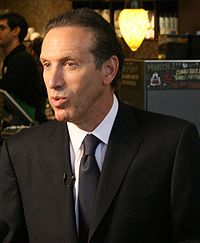
Howard Schultz: Chairmain, CEO, and President of Starbucks
Howard Schultz, Chairman, President, and CEO of Starbucks, who won an Entrepreneur of the Year award in 1993, spoke about his experience leading Starbucks through the economic crisis. As Starbucks began going through hard times, Schultz, who had given up the CEO role in 2001 (while remaining Chariman), decided it was time to take back the CEO responsibilities himself in early 2008.
Why? He was worried that the distinct culture, mission, and values that had brought the company great success were eroding.
According to Schultz, he came back into an operational role because he felt that the way out of crisis was not a simple change in business strategy, but instead– in his words– “love and nurturing.” His key to turning things around was revitalizing the investment in his people, recommitting to the core purpose of the organization and providing employees with hope and inspiration.
He says the transformation of Starbucks since this revitalization has been key to a tremendous amount of new innovation happening inside the company. People have even commented to him that it reminds them of what the early days at Starbucks must have been like.
Schultz took 10,000 of his best people and brought them together in New Orleans in late 2008 for a leadership conference where they spent 50,000 volunteer hours helping communities re-build after Hurricane Katrina. Below is a documentary that was filmed about this event.
What can community leaders learn from dancing Sasquatch guy?
Earlier this summer at the Sasquatch Music Festival, someone captured the three minute video I’ve pasted below. One guy dancing to M.I.A. (we love her!) starts what becomes a massive dance mob by the end of the song. The video became an YouTube sensation, with over 2,000,000 views.
Many folks have written interesting posts analyzing the event (here are a few of my favorites) and at some point you’ve gotta stop analyzing and realize this man just needed to DANCE and maybe the rest of us do too. But before we do that, a couple of observations from the place where open source community-building intersects with Sasquatch guy dance mob-building.
10 more people from Red Hat you should follow
A few weeks ago, I posted a list of ten people from Red Hat you should be following, and promised there were more people to come. For today’s list, the rule is that they must be on Twitter, and I’ve split them into two groups: The first group is all Red Hat executives and the second group is what I’m going to call Red Hat catalysts– people inside of Red Hat who make things happen because of their ideas and passion.
First, here are five Red Hat executives on Twitter:
1. Jim Whitehurst, CEO
Yes, Jim Whitehurst is on Twitter and has been for almost a year. Sure he’s not saying much yet, but he has a pretty impressive list of followers (almost 400 at last count). Perhaps if a bunch of you go follow him right now, he’ll feel the need to start tweeting more often. Make sure to send him a message saying Chris Grams told you to say he’s not posting enough.
2. Iain Gray, Vice President of Customer Engagement
Iain Gray, who I just wrote about earlier this week here, is starting to become a regular Twitterer, which is a good thing for Red Hat, because he has some of the best ideas in the company. The only bummer about following Iain on Twitter is you lose the killer Scottish accent. Find him here.
3. DeLisa Alexander, Senior Vice President of People & Brand
DeLisa Alexander is the executive who spearheaded the combination of HR and brand communications into one group at Red Hat, a subject I wrote about here. She is just getting started on Twitter, but that doesn’t mean you should go easy on her. Ask her some tough questions, like “how much transparency is too much?” or “do job titles matter?”. Oh yeah, she is also a great boss. I’m such a suck up.
4. Rachel Cassidy, Vice President of Global Professional Services
Rachel Cassidy is one of those smart executives who perfectly balances professional experience, diplomatic savvy, and fun. She also manages some of the smartest and best Red Hat employees, the ones that spend their days in the customers’ worlds making them happy. I’d love to see her sharing more of her ideas and experiences on Twitter. Please tell her I said so.
5. Marco Bill-Peter, Vice President of Global Support
You know, I think I have only met Marco Bill-Peter once or twice in person (he works out of our Westford, MA office), but I still feel like I know him well. He’s just one of those people. Workwise, he’s a Red Hat superstar who is in charge of Red Hat support globally. Which doesn’t mean he will fix your server issue via Twitter, so don’t go there. But you can find his tweets here.
Ok, now on to the Red Hat catalysts:
Hey, I Wrote a Book!

Available now in print and electronic versions.
 Dark Matter Matters