Dark Matter Matters
open source
Customer-driven innovation in the White House?
This week, the White House is holding a two day experiment at www.whitehouse.gov where Americans can ask Barack Obama any question they have regarding the economy. People can enter their own questions or vote on the questions of others. Later this week, Obama will address many of the most popular questions in a national town hall meeting.

In the video on the site, Barack Obama says:
One of my goals as president is opening up the White House to the American people so that folks can understand what we’re up to and have a chance to participate themselves.
In the open source world, we often talk about the idea of user or customer-driven innovation. We make the process of creating open source software transparent and collaborative. Customers can easily contribute their ideas, and we both share in the value that is created– we make better software faster, our customers get better, more relevant software faster. Everybody wins.
How cool is it to see the same principle applied to government? By opening the feedback loop to us regular Americans– the “customers” of our government– might we be able to create a better government faster? Could the old open source adage, “Given enough eyes, all bugs are shallow” apply to governing the American people as well?
As of when I wrote this post, about 40,000 people had voted 1.5 million times times on over 40,000 questions. The site is open through Thursday morning at 9.30 AM, so go ask your questions and vote!
One note… the people from the “Legalize it!” lobby and the “show us your birth certificate” lobby both found this site before you… But don’t worry, in the meritocracy of whitehouse.gov, the best ideas seem to still be winning:)
Conversational Capital: I’m totally not wearing any pants
On a recommendation from Michael Tiemann, I got the book Conversational Capital: How to Create Stuff People Love to Talk About by the folks at Sid Lee, who have done work for brands like Cirque du Soleil, Adidas, and Red Bull.
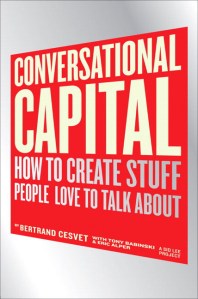 Michael had sent a note at Red Hat a few months back where he said this book helped him understand the “x-factors” that had allowed Red Hat to create a strong brand position at such a small, young company. Thought I should check it out.
In case you were wondering, that headline above is an example of Relevant Sensory Oddity, one of the topics they cover in the book. I thought I’d try it and see if it works:) I actually am wearing pants. Today.
The main thesis of Conversational Capital is that there is a more powerful way to get consumers engaged with your brand by “making your story part of their story,” creating stories or experiences that are meaningful to them. The authors turn their noses up at “buzz marketing,” equating it to style over substance, with no depth or continuity, all sizzle and no steak.
Fedora, Red Hat, and open brands
A Twitter friend asked me the other day if I had been doing any more thinking about open brands. Turns out I have. Two weeks ago, she and I had a conversation where we discussed how Red Hat had opened up the Fedora brand and the positives (tons!) and negatives (some) of doing so.
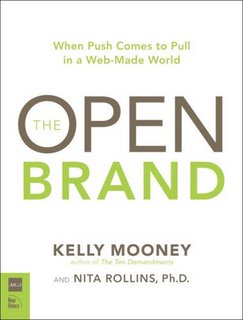 This week, on an plane ride up to Boston, I read the book The Open Brand by Kelly Mooney, which another friend had handed to me a while back.
The book is a eulogy for brands that are not willing to open themselves up, and an instruction manual for those that are considering becoming more open.
It was particularly interesting to read as a Red Hat guy, because the book is based on the idea that today’s single most powerful technology is “a mashup of the World Wide Web and the open source movement.”
The book opens with the question… “are you dangerously CLOSED?”
Whew… passed that one. But the book did make me think some about where the Red Hat brands fall on the spectrum of closed to open.
David Burney in BusinessWeek, Obama the first design thinking president?
David Burney’s blog post about Obama being the first “design thinking” president just got picked up by Bruce Nussbaum of BusinessWeek. Nussbaum is another one of those guys who gets it– he’s been writing about design thinking and innovation in business for quite some time.
Read the full text of Nussbaum’s article, entitled President Obama Goes Optimistic: Obama Is The Design President.
How to successfully compete with open source software
Found an interesting post via a Twitter friend today with ideas on how proprietary software companies can compete with open source software. The guy who wrote it isn’t an open source hater, in fact he says he uses plenty of open source software for his own websites. His post also covers open source applications catering to consumers rather than businesses, so it’s not exactly Red Hat that he’s talking about here, but I still thought the ideas were worth taking to heart.
The first three ways he says you can successfully compete with open source software are, in this order 1) marketing 2) design 3) user experience. His reasoning? From the post:
OSS concentrates on the software, not the problems the software can solve: Take a look at an OSS site, any OSS site. You’ll see a whole lot of talking about the software, the implementation of the software, the source code for the software, how you can contribute to the software, etc. You’ll almost never see anything about the problem domain — the assumption is that, if you’ve stumbled upon the site, you already know you have a software problem.
I think he is on to something here. We open source software people do tend to sometimes fall in love with our software and how it is made and works, rather than falling in love with our customers and how we can understand and solve their problems. It is easy to agree with this in theory I’ve found, but in reality, it is a lot harder to stay focused on the customer’s needs when there is all this cool software to be made:)
David Burney’s New Kind of gig
My good friend, former boss, and Swingin’ Johnsons bandmate, David Burney, has revealed his new venture, a company called New Kind. He’s partnering with Matt Munoz, an extremely talented designer who created the original Fedora logo (an interesting open, collaborative process to be discussed in another blog) among other things.
Both David and Matt come from graphic design backgrounds, but their firm intends to explore the role of design in business from a “new kind” of perspective. According to their website:
New Kind helps organizations solve complex problems and build competitive brands. We do so by combining the problem-solving principles of design thinking with the collaborative power of open source. We help our clients create authentic customer communities, build and nurture innovative cultures and tell meaningful, memorable stories through the most relevant media choices.
David is actively blogging on some interesting stuff, including Barack Obama and MBAs, Gary Hamel, and orange juice. Do it. Click on the orange juice link. You know you want to.
Fedora fails… and that’s a good thing!
Great post by Red Hat’s Karsten Wade on the role of failure in Fedora (and in life). One of the key tenets of both the open source and design thinking movements is the  idea of “failing fast.” To innovate, we need to overcome the fear of failure, and learn how, as Karsten notes, failure is a sign that we have pushed things to their limits. Because that’s where you have to be if you want to innovate:)
One of the gurus of the failing fast mentality is David Kelley of IDEO— the guy who started the Stanford “d-school” and a leader of the design thinking movement. Here’s a Fast Company article from a couple of years ago where he talks some more about how to suceed by failing fast.
Matt Asay on the Red Hat Mission
Matt Asay just posted about Red Hat’s new mission, which he discovered on a visit to our Westford office in one of our “bathroom briefings” (important aside: we post some internal company news right front and center in the bathroom… if you want people to read something, post it in the bathroom– not everyone reads mailing lists, but everyone pees! Remember, internal communications is a strategic role at Red Hat!).
It’s not a secret, so I don’t mind that he saw the mission or posted about it. In fact, we are pretty happy with the transparent process we employed to get it done. Those of you who have read some previous posts know how strongly I feel about having the entire company aligned on mission and vision and values– the core stuff.
Red Hat Nation
I was emailing back and forth with my friend Todd Barr the other day. Catching up with him reminded me of an idea we used to talk about quite a bit that I still think is the best idea that we haven’t made good on: Red Hat Nation.
 The basic idea is that a company like Red Hat, based on open source, has an opportunity to completely redefine what a business looks like in the 21st century. The traditional 20th century business is often very black and white: either you work for the company or you don’t. You are inside it’s walls, or you are not. There are clear distinctions between employees, partners, and customers. The most common way of depicting a company in this 20th century model is by showing its building.
In the traditional model, if I was to say I work for Red Hat, you would assume it means I am a Red Hat employee, and that they give me a paycheck, benefits, a desk, all the normal stuff.
But imagine for a second that the image used to illustrate the 21st century company is not a building, but instead a flag.
A flag is often a rallying point for nations, a symbol that represents a common set of beliefs. You see flags at the front lines of troops in battle. You see flags hanging outside the door of homes. You see flags on clothing, at sporting events, in many places where people who share common traits gather.
Communicating a message through design
Earlier this week, Red Hat announced an agreement with Microsoft. I’m not planning on commenting on that agreement, as that’s not the point of this blog. Plus there are lots of smart Red Hat people who can do stuff like that.
 But I did find this article from InformationWeek interesting. It points out the design work that went into the homepage promo we put on redhat.com, and shows how important design can be to the communication of an important message. From the article:
“A banner graphic atop the page detailing the reciprocal agreements announces in bold, all capital letters that “customer demand has spoken.” The banner also features a prominent road sign with a double-headed arrow pointed in opposite directions that sometimes signifies interoperability. Translation: You made us do it.”
So I am a “no comment” on this interpretation:) But I am excited that the work of Josh Gajownik from the Red Hat Brand Communications + Design team was noticed.
Hey, I Wrote a Book!

Available now in print and electronic versions.
 Dark Matter Matters