Dark Matter Matters
leadership
Three tips for escaping the creativity peloton without giving up on collaboration
If you’ve ever watched a road bike race like the Tour de France, you know the peloton is the big group of riders that cluster together during the race to reduce drag. It’s a great example of collaboration in action. But let’s face it: the people in the middle of the peloton may go faster than they would otherwise, but they don’t win the race.
 When it comes to creating and innovating, most companies (and employees) are in the peloton. They are doing enough to survive, but they are stuck in the pack. And if they stay in the pack too long, they lose.
Escaping the peloton is tough. Often, you see a cyclist break away, sprint for a while, only to get sucked back into the main group over time as the pressures of making a go independently prove too much.
You’ve probably felt this way at work. You come up with an amazing idea, one that will change the company forever. But little by little, people—even the well-meaning ones—chip away at its soul, until the idea goes from being amazing to, well, average. You end up being sucked back into the peloton.
After this happens one too many times, you may feel like you want to stop collaborating and try to make things happen on your own. Don’t do it. Even Lance Armstrong could rarely break away from the peloton without his teammates’ help.
Instead, here are three tips to help you escape the creativity peloton without giving up on collaboration.
[Read the rest of this post on opensource.com]
Save us, General Zinni! Teach us corporate folks some 21st century leadership skills
I happened to catch General Tony Zinni on The Daily Show a few weeks ago. This was the first time I’d seen him talk, and I found him to be an incredibly creative, thoughtful man. So this weekend, I sat down and read his recently published leadership book Leading the Charge: Leadership Lessons from the Battlefield to the Boardroom. If you want to learn more about General Zinni’s long list of accomplishments, both inside and outside the military, there is a really good Wikipedia profile of him here.
 In this book, General Zinni describes an introspective, creative, and rapidly changing American military mindset. After reading, I’m convinced the subtitle should have been something like “Lessons from the New Military for a Corporate America Totally Blowing It.”
This book provides a crisp analysis of the failures of the 20th century leadership model still prevalent in most businesses today. It is an indictment of the post-economic-meltdown-state of American business, which he believes was caused in large part by a systemic failure of this traditional leadership model.
Like a true man of action, General Zinni brings his own ideas and experience of leadership methods that work in the high-pressure, high-risk world of the military to the table. He provides a vision for how we can fix what is broken, and shows what the leadership model for the 21st century organization could be.
Matthew Szulik and the Red Hat vision
The BBC conducted a great interview with Red Hat Chairman Matthew Szulik while he was attending the Ernst & Young World Entrepreneur of the Year awards recently (representing the United States as our winner). You can listen to it here.
This interview is a wonderful reminder of the powerful impact of a corporate vision that extends beyond just making money. And a great reminder for me of how lucky I have been to learn about leadership, community, culture, and brand from the 2008 United States Entrepreneur of the Year.
If you are interested in learning more about Matthew Szulik, his vision, and how it evolved, here is a wonderful oral history of his life that was commissioned a few years ago.
An open letter to Seth Godin
Dear Seth,
I just finished reading your new book Tribes. Normally when I read a book that relates to the Dark Matter Matters subjects (and Tribes talks about leadership and community and all kinds of good stuff), I write a review and post it here. I’m not going to do that this time. I think the reviews on Amazon pretty well cover it, so I’ll just point people there.
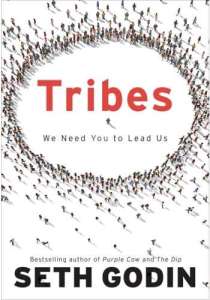 Seth, I have something a bit more personal I’d like to discuss with you. If I may be so bold.
I’ve read most of your books over the years, liars, and purple cows, and dips and whatnot, and I’ve got to tell you, I think you are one smart dude. I’ve learned a lot from you.
I thought the alternative MBA program you just finished was a stroke of genius. I was totally jealous– that would have been a great way to spend six months.
But, honestly, I always get this weird, hollow feeling after reading a book of yours. I couldn’t quite put my finger on it until I finished this one.
OK, let me just spit it out. I think your books can be kind of superficial and tend to preach to the choir a lot.
There. I said it. I’m sorry. I’m not trying to be a hater.
You even call out haters in this book. Said that you shouldn’t let people like that get you down. So please don’t get down, like I said, I really respect your work, it’s just I think you might be limiting your audience. You could be bigger.
So in the hope that I’m being a heretic (in the way you talk about in the book), rather than a hater, I’d humbly suggest some constructive ideas.
Seth, I’d like you to write a book that will do more than rally the tribe that thinks like you. I think you have a book in you that will educate those that don’t think like you. They need your help.
When good companies go bad
A few weeks ago I finished the new Jim Collins book How the Mighty Fall and Why Some Companies Never Give In. If you read this blog much, you’re probably sick of me prattling on about how much I love Jim Collins’ work (here, here, and here). Over the years at Red Hat, we’ve based many projects related to the values, mission, and other corporate-level structural thinking on ideas we got from him.
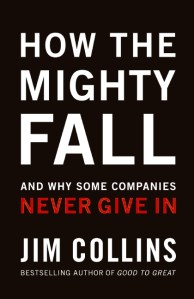 Well, it’s been almost eight years since Collins wrote his last full-length book, Good to Great (which ranked number one on my list of the top ten books behind Dark Matter Matters). How the Mighty Fall is a short book, and in it, Collins is clearly a bit on the defensive about his previous work. The issue? In the economic meltdown last year, some of his Built to Last companies didn’t last, and some of his Good to Great companies are back to good… or gone.
Collins explains it this way:
…the principles in Good to Great were derived primarily from studying specific periods in history when the good-to-great companies showed a substantial transformation into an era of superior performance that lasted fifteen years. The research did not attempt to predict which companies would remain great after their fifteen-year run. Indeed, as this work shows, even the mightiest of companies can self-destruct.
…I’ve come to see institutional decline like a staged disease: harder to detect but easier to cure in the earlier stages, easier to detect but harder to cure in the later stages. An institution can look strong on the outside but already be sick in the inside, dangerously on the cusp of a precipitous fall.
So this book is Collins’ attempt to discover why exactly some very good companies went oh so very bad. If Good to Great was Star Wars, this book is The Empire Strikes Back— a long, hard look into the dark side (even the cover is black).
Collins did extensive research using an interesting approach. He studied these companies, not as history has judged them, but based on what the company was saying, what the press was saying, what financial analysts were saying during the time period being studied– before we knew the outcome. And all of the research was done in historical order, almost like he was following the companies through time.
The results of the research play out like a Greek tragedy. He identified 5 stages of decline in the companies that had gone from great to… not so great:
Rebuilding companies as communities

The brilliant Henry Mintzberg. I've got to meet this guy some day.
Holy smokes, Henry Mintzberg is at it again! The guy who predicted the economic collapse in 2006 (why is he not more famous, I don’t get it?) has an article in the July/August issue of the Harvard Business Review suggesting that the cultural framework of the corporation is completely broken.
And, according to Mintzberg, the way to fix it is not by thinking like a corporation, but instead by thinking like a community. From the article:
Beneath the current economic crisis lies another crisis of far greater proportions: the depreciation in companies of community– people’s sense of belonging to and caring for something larger than themselves. Decades of short-term management, in the United States especially, have inflated the importance of CEOs and reduced others in the corporation to fungible commodities…
And it’s is a two way street… When a corporation treats its employees like simple assets to be hired and fired as the share price rises or falls, the employees treat the corporation like… a corporation.
The end result? Disengaged employees who don’t care about the business, and the business (and the shareholders) suffer for it. So for heaven’s sake, Henry, tell us how to fix it!
Just in! A compelling vision for corporate America
In previous posts, I’ve talked about the need for setting a compelling vision for the corporation beyond just making money. Jim Collins writes about this concept extensively in Good to Great and Built to Last.
On June 26, we saw a wonderful example of one of the most respected CEOs in America, Jeffrey Immelt of GE, doing exactly that.
Steve Prokesch at Harvard Business Review gives some of the background in his blog:
A couple of weeks ago I met with GE’s CEO Jeff Immelt and we were talking about the financial meltdown, the deep recession, and what it would take to fix America. He was outspoken about how business and government had let down the American people and the need for radical change.
That’s fine, I said, but if he felt that way, why hadn’t he spoken up publicly? Immelt ran from the room and quickly returned with a speech he was working on–one he delivered last week at the Detroit Economic Club. This was his speech and not something he had fobbed off to a speechwriter, he told me.
After reading this post, I went and watched the speech, which will take you about 25 minutes of your life.
I was blown away. In this very traditional corporate luncheon setting, glasses and sliverware clinking, video cutaways to bored-looking attendees trying to remember where their 1 o’clock meeting is supposed to be, Immelt presented a deeply personal vision for recreating America, and his company in the process.
The top 10 books behind Dark Matter Matters
Books are important to me. Growing up, almost every free wall in my parents’ house was lined with bookshelves, some of them stacked two deep. I spent most of my pre- Red Hat career in book publishing, first working during college at The University of North Carolina Press. After college, I went to work for a literary agent named Rafe Sagalyn in Washington DC. Working for Rafe was a great experience because he built his reputation on big think/idea books and business books.
His first big book was the huge bestseller Megatrends by John Naisbitt back in the early 80s. When I was there, I personally got to work with, among others, Bill Strauss and Neil Howe on their great books about generational patterns in society (check out The Fourth Turning… very prophetic these days) and Don Peppers, author of some books back in the 90s like The 1:1 Future about relationship marketing that were the grandparents of today’s books on social media marketing.
I also got to play agent and author myself too. As an agent, I represented some of Tom Bodett’s work (yes, he is the Motel 6 guy, but was also a commentator on NPR) and sold a wonderful novel called The Frequency of Souls to FSG. As author, I helped Rafe write two “cutting edge” books about getting free and open access to government information (they have not aged well, I’m afraid).
Fast forwarding to today, Rafe actually was the agent for two recent big think books that I love, Authenticity and A Whole New Mind, so he is still making things happen.
After I left book publishing, reading became fun again. I read novels and travel literature for a while, nothing that made me think too much. But when I got to Red Hat, I relapsed and started reading the big think books like the ones I used to work on with Rafe. I thought it might be worth taking a few minutes to try to remember the books that have been the biggest influences on my thinking, and get them all down in one place, so here goes:
Top 10 Dark Matter Matters books
Without these ten books, Dark Matter might not even matter to me.
Brand and human resources in one department? Are you nuts?
A few months back, Red Hat rearranged a few organizational boxes, as companies tend to do from time to time. One result of this was the creation of a new department called People & Brand, a combination of the existing Red Hat Human Capital team and our Brand Communications + Design team.
When some folks hear that, their faces crinkle all up in confusion and they say something akin to “That doesn’t make any sense… brand is a marketing function, not an HR function!”
It’s true that brand is traditionally thought of as a tool of marketing, but in the 21st century company, we are going to have to rethink some things. One thing the 21st century company is going to have to do is resist the urge to put things into silos so quickly. One former boss of mine who loved to do this called it “bucketizing”– a beautiful markepoetry term.
Look at the statement above again: “Brand is a marketing function, not an HR function.”
I disagree.
Brand is an HR function. And a marketing function. And a sales function. And a service and support function. And a finance function. Brand should be deeply embedded in everything a company does.
The organizational structures of the 20th century “bucketize” by default. One box at the top. A bunch of boxes connected to that one. And each of those boxes has a bunch of boxes connected to it. We tend to spend most of our time worrying about which box is connected above us rather than which boxes might be connected beside us.
Rahm and the art of positioning
Was watching Rahm Emanuel on Meet the Nation this morning. No matter where you fall politically, you’ve got to be amazed at what a  master of positioning he is. Republicans have been winning the positioning war for years, with Democrats not even understanding the game, let alone playing it well.
So what is positioning? According to Wikipedia, positioning is:
the process by which marketers try to create an image or identity in the minds of their target market for their product, brand, or organization.
The name “positioning” was coined by Jack Trout and Al Ries and introduced in their book Positioning: The Battle for Your Mind, but the concepts they called positioning have been used to influence people throughout history.
Matthew Szulik gave me a copy of a positioning book by Jack Trout about 2 years after I joined Red Hat, and it was my first real exposure to the idea. Now, the art of positioning rules everything I do at work.
Hey, I Wrote a Book!

Available now in print and electronic versions.
 Dark Matter Matters