Dark Matter Matters
community
Tom Sawyer, whitewashing fences, and building communities online
I spoke on a panel at GE today with Chris Brogan, author of the book Trust Agents (almost finished with it, more comments in a later post…).

Tom Sawyer sez everyone's fence gets whitewashed today, people!
After hearing Chris talk about building trust in online communities, it hit me that one of the biggest mistakes I’ve seen people make when trying to build communities online, even in the open source world, is that they think like Tom Sawyer.
Here’s how Wikipedia retells the story of Tom Sawyer and the fence:
After playing hooky from school on Friday and dirtying his clothes in a fight, Tom is made to whitewash the fence as punishment on Saturday. At first, Tom is disappointed by having to forfeit his day off. However, he soon cleverly persuades his friends to trade him small treasures for the privilege of doing his work.
When thinking about building communities online, are you thinking like Tom Sawyer? Why are you building a community in the first place? When it comes right down to it, do you really just want people to whitewash your fence for you and give you small treasures in return for the privilege?
If you are looking to ideas like open source or social media as simple means to get what you want for your company, it’s time to rethink your community strategy.
Wait, what if dark energy doesn’t matter?
The horror! A few days ago, in a study released in one of my favorite light reading mags, the Proceedings of the National Academy of Sciences, two mathematicians proposed that dark energy might simply be an illusion we observe from our spot in a massive space-time expansion wave. There’s a nice writeup of the research in National Geographic here.
 Does this mean the entire concept of this website, that brand, culture, and community form the dark matter and dark energy of organizations, breaks down too? That all this hippie brand-building, culture-growing, community-creating stuff is also an illusion, and the traditional visible mechanics of business alone are the stuff of which great companies are made?
I know. I know. It rocked my foundation too. Well, as my favorite fortune cookie fortune once told me, “all is not yet lost.” It is just a theory.
And it turns out that for the theory to be true, for the math to work, we must be at the center of the universe, a caveat that one physicist describes as “unusual.” I’d say so. Didn’t Copernicus have something to say about that in, like, 1543?
If you are still concerned and want to learn more, go read the abstract of the report. I’ll give you a taste to whet your appetite:
We derive a system of three coupled equations that implicitly defines a continuous one-parameter family of expanding wave solutions of the Einstein equations, such that the Friedmann universe associated with the pure radiation phase of the Standard Model of Cosmology is embedded as a single point in this family. By approximating solutions near the center to leading order in the Hubble length, the family reduces to an explicit one-parameter family of expanding spacetimes, given in closed form, that represents a perturbation of the Standard Model.
These guys seem pretty smart, and it sounds like we stand to learn a lot from their findings. And what’s good enough for the National Academy of Sciences is good enough for me.
As for our little Dark Matter Matters website, I’m no mathematician, but I see a lot of prominent mathematicians and physicists calling these results controversial. For now, I’m still thinking dark matter and dark energy might matter, people. Carry on.
Sharing wins in recessionary times
Last week, I wrote a post about our newest version of the Red Hat brand story, which starts with two simple lines:
Your mother was right. It’s better to share.

Share Bear sez: Let's get on the sharing train, people!
Over the weekend, I stumbled across an interesting piece originally written for the Washington Post, entitled Recession Lesson: Share and Swap Replaces Grab and Buy.
According to the article, sharing is in again. Which is happy news for us open source folks. Here’s how the article starts:
The recession is reminding Americans of a lesson they first learned in childhood: Share and share alike. They are sharing or swapping tools and books, cars and handbags, time and talent.
The article goes on to cover examples of sharing in everyday life brought on by recessionary times: sharing gardens, sharing chores, sharing clothes– just like the old days, perhaps?
The sharing mind-set is not new to the American culture, but many Americans abandoned it when the nation shifted from an agricultural society to an industrial one, said Rosemary Hornak, a psychology professor at Meredith College in Raleigh, N.C. They moved farther from their families and did not have time to connect with new neighbors because they worked so much, she said. Now that people are experiencing financial distress, they don’t want to be alone.
So give your mom credit. She not only predicted where the future of the software industry is headed, but also gave you some great ideas for surviving this tough economy.
Well played, mom. Well played.
An open letter to Seth Godin
Dear Seth,
I just finished reading your new book Tribes. Normally when I read a book that relates to the Dark Matter Matters subjects (and Tribes talks about leadership and community and all kinds of good stuff), I write a review and post it here. I’m not going to do that this time. I think the reviews on Amazon pretty well cover it, so I’ll just point people there.
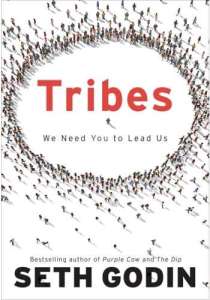 Seth, I have something a bit more personal I’d like to discuss with you. If I may be so bold.
I’ve read most of your books over the years, liars, and purple cows, and dips and whatnot, and I’ve got to tell you, I think you are one smart dude. I’ve learned a lot from you.
I thought the alternative MBA program you just finished was a stroke of genius. I was totally jealous– that would have been a great way to spend six months.
But, honestly, I always get this weird, hollow feeling after reading a book of yours. I couldn’t quite put my finger on it until I finished this one.
OK, let me just spit it out. I think your books can be kind of superficial and tend to preach to the choir a lot.
There. I said it. I’m sorry. I’m not trying to be a hater.
You even call out haters in this book. Said that you shouldn’t let people like that get you down. So please don’t get down, like I said, I really respect your work, it’s just I think you might be limiting your audience. You could be bigger.
So in the hope that I’m being a heretic (in the way you talk about in the book), rather than a hater, I’d humbly suggest some constructive ideas.
Seth, I’d like you to write a book that will do more than rally the tribe that thinks like you. I think you have a book in you that will educate those that don’t think like you. They need your help.
Washington Monthly on healthcare reform and open source
There’s a powerful cover story in the July/August issue of Washington Monthly entitled Code Red: How software companies could screw up Obama’s health care reform (Thanks to Maria Moore for the link).
 In the article, Phillip Longman describes a few horrifying experiences hospitals have had trying to “go digital” using proprietary software. Here’s a particularly scary quote:
According to a study conducted by [the Children’s Hospital of Pittsburgh] and published in the journal Pediatrics, mortality rates for one vulnerable patient population—those brought by emergency transport from other facilities—more than doubled, from 2.8 percent before the installation to almost 6.6 percent afterward.
In the context of Dark Matter Matters, this story is interesting because it shows how an open source, community-driven effort led by the Veterans Health Administration has been able to not only innovate faster than its proprietary competitors, but also more deeply involve the end customers– the doctors, nurses, and other folks who actually use the software– in development of tools that work in real world situations.
New socialism? Naw, it’s the new individualism.
My friend Jeff Mackanic pointed me to this article from last month’s Wired Magazine where Kevin Kelly makes the assertion that there is a “new socialism” emerging in the form of large-scale collaboration projects online. He discusses contributions to Wikipedia, Flickr, even Red Hat’s own Fedora as examples of village-sized or greater online collective work.
In the context of my recent post regarding what Ayn Rand would think of open source, I think Kevin makes a leap where I might not follow him.The clue is right in the article:
…the leaders of the new socialism are extremely pragmatic. A survey of 2,784 open source developers explored their motivations. The most common was “to learn and develop new skills.” That’s practical. One academic put it this way (paraphrasing): The major reason for working on free stuff is to improve my own damn software. Basically, overt politics is not practical enough.
Where Kevin Kelly reaches the conclusion that contributors working together to “improve [their] own damn software” is a new form of socialism in action, I might take the view instead that this is a new form of individualism.
A form of individualism where people are free to pursue their own self interests, yet do so in such a way that they are still in harmony with those around them. The goal of open source developers is individual pursuit, as the paragraph above from the article makes clear… yet a byproduct of these individual pursuits is a collective good: better software, a better enyclopedia, etc.
If it was socialism, the collective good would be the end goal of everyone. But ultimately, the open source model is based on the individual working for the good of himself in harmony with others, not on being a mindless cog in a much bigger wheel.
But I’m no philosophy expert, what do you think?
Measuring dark matter? We’re working on it.
Those of you who have been following this blog for a while know it is based on the simple premise that there are some things out there in the world that are pretty difficult to see or measure, yet these same things can often be the stuff with the biggest impact. The intro to the blog tells the full story.
In the world of astronomy, two of these things are dark matter and dark energy. Both hard to see and measure.
In the world of business, three of these things are brand, culture, and community. Also tough to see and measure their impact in the business world.
So while we constantly explore ways to better understand the impact of brand, culture, and community here at Dark Matter Matters, the world of astronomy is trying to better understand exactly what the heck dark matter and dark energy are.
Thought it might be worth taking a short break from our regularly scheduled program to give an update on how the astronomers are doing.
What would Ayn Rand think of open source? You can vote!
At the beach over the weekend, I read Anthem by Ayn Rand. Now before you write me off as the kind of guy that would go around telling people he reads Ayn Rand for fun, let me just say in my defense that this is really the first full Ayn Rand book I have read.  And it is only 105 pages long. Having read this, I’d totally read the CliffsNotes for The Fountainhead or Atlas Shrugged (which is like 1200 pages long).
Rand originally titled Anthem as “Ego” and you can definitely tell why. It is about a futuristic world where people are kinda back in the dark ages technologically-speaking, and live in a collective where people have numbers rather than names, are assigned jobs for life, and have forgotten the word “I” (yes, totally annoying… in the first ten chapters, the main character uses the royal “we” to refer to himself).
It seems like Ayn Rand has been back in the news lately, and I’ve seen her name bandied about in political arguments quite a bit, especially regarding healthcare reform. So it made me think, if Ayn Rand’s core philosophy was about maintaining the supremacy of the individual, what she calls “rational self-interest,” and she rejected the idea that the collective good should be put before the good of the individual, what would she think about the open source movement?
After all, I used to remember seeing stories with proprietary companies referring to open source as socialism all the time, although it doesn’t seem to happen as much these days. More and more of the biggest companies are embracing open source software and the concept of open source is more mainstream than ever.
So surely Ayn Rand would hate open source, right? Not so fast. Here are two good reasons why Ayn Rand might totally dig open source:
Summer reading list for Dark Matter Matters
Ah, vacation… the time when the work shuts down for a few days and the Dark Matter Matters blog comes out of hibernation… 3 posts in 3 days!

A few months ago I wrote a post where I highlighted the top ten books behind Dark Matter Matters. In that post I promised to create a list of the books that didn’t make the top 10 cut, but are still pretty awesome.
So here, to celebrate the long holiday weekend, are some more books that have inspired Dark Matter Matters.
Books about how large-scale collaboration is pretty much the deal:
Wikinomics by Don Tapscott and Anthony Williams
The Wisdom of Crowds by James Surowiecki
The Starfish and the Spider by Ori Braffman and Rod Beckstrom
In the open source world, there’s a legendary quote attributed to Linus Torvalds (yes, he is the guy that Linux is named after) “Given enough eyeballs, all bugs are shallow.” The first two of these books are the extended dance remix of this quote. Each has a unique take, but both show how mass collaboration is changing everything about our society and the way we solve problems. The Starfish and the Spider is a interesting look at leaderless organizations and is a nice book for anyone trying to understand how the open source movement (and other leaderless organizations) work, and why open source is so hard to compete against. It is also a nice complement to the Mintzberg article I wrote about in my previous post.
Rebuilding companies as communities

The brilliant Henry Mintzberg. I've got to meet this guy some day.
Holy smokes, Henry Mintzberg is at it again! The guy who predicted the economic collapse in 2006 (why is he not more famous, I don’t get it?) has an article in the July/August issue of the Harvard Business Review suggesting that the cultural framework of the corporation is completely broken.
And, according to Mintzberg, the way to fix it is not by thinking like a corporation, but instead by thinking like a community. From the article:
Beneath the current economic crisis lies another crisis of far greater proportions: the depreciation in companies of community– people’s sense of belonging to and caring for something larger than themselves. Decades of short-term management, in the United States especially, have inflated the importance of CEOs and reduced others in the corporation to fungible commodities…
And it’s is a two way street… When a corporation treats its employees like simple assets to be hired and fired as the share price rises or falls, the employees treat the corporation like… a corporation.
The end result? Disengaged employees who don’t care about the business, and the business (and the shareholders) suffer for it. So for heaven’s sake, Henry, tell us how to fix it!
Hey, I Wrote a Book!

Available now in print and electronic versions.
 Dark Matter Matters