Dark Matter Matters
community
Top 10 Dark Matter Matters posts of 2009

Benjamin sez you all deserve some props!
Ah, late December. The time when bloggers get lazy and start reposting their old crap rather than writing new material. We here at Dark Matter Matters are no exception. For the Dark Matter Matters top 10 posts of 2009, I’ve split the list into two categories. First we have 5 posts that were popular with readers, followed by 5 posts that were popular with, well, me.
Five posts popular with readers:
- Brand positioning tip #1: points of parity and points of difference: Perhaps it’s the combination of analyzing Mexican food and brand positioning, but this post, the first in a series of tips that I wrote starting in June, is the most read post I’ve done yet on the blog.
- Tom Sawyer, whitewashing fences, and building communities online: Written in September, this post was the first in a series about community-building where I talk about the difference between creating communities to do your work for you and being a humble member of a community larger than just you.
- Brand positioning tip #3: the brand mantra: A short post explaining Scott Bedbury’s concept of a brand mantra.
- Maslow’s hierarchy of (community) needs: Comparing a company’s community motivations to Maslow’s hierarchy of needs, introduces the Iain Gray hierarchy of community needs.
- The top 10 books behind Dark Matter Matters: Exactly what it says it is. Books that inspire me.
Five posts that hardly anyone read. Give them a chance, people:
- Tom Sawyer Part 2: where can your company pitch in?: As usual, the sequel isn’t as good as the original, but I still like this post, which has really helped me focus some of my ideas on corporate humility.
- How to conduct a symphony of communications: Compares the role of a 21st century communications professional to a conductor in a symphony.
- Sharing your brand story (and here’s ours): Introduced the Red Hat Story book (including a downloadable copy).
- Why did I just write a post about Viking longships: Compares the job of brand manager to the guy at the front of a Viking longship. Yeah, I wouldn’t read it from that bobo article title either, but this is the kind of post that makes me happy.
- Markepoetry Part 2: It turns out I have needs: Talking about making (only) myself happy, no list of the Dark Matter Matters posts that no one reads would be complete without including one of my pieces of markepoetry– the language of marketing, made beautiful. Basically, I take real statements that I find in marketing copy and transform them from ugly marketing-ese into poetry. I thought this one was nice.
So as we close out 2009, I just want to say thanks for everything.
I’m approaching one one year of writing this blog, and it sure has been a lot of fun. I still can’t believe I’ve written over 100 posts. What has made it the most fun for me is getting to meet lots of new people, while also becoming closer to people I already know.
I’m looking forward to 2010. I’m sure we’ll have lots to talk about.
Five ways to strengthen your company’s immune system
I’m not usually a germophobe, but the last few months I’ve been walking around opening doors with my elbows and washing my hands constantly. I’ve been freaked out by the constant updates on Facebook about what my friends/friends’ kids have come down with now. So far, my immune system has held up pretty well, but I always worry that H1N1 is only a doorknob away.
 These are trying times for corporate immune systems too. The economic meltdown has exposed corporations to all sorts of risks they don’t deal with in the regular course of business. Many corporate immune systems have failed, putting millions of people out of work. It begs the question: how resilient is your company? And how can you make your corporate immune system stronger?
I got to thinking about this corporate immune system concept after reading the new book The Age of the Unthinkable: Why the New World Disorder Constantly Surprises Us And What We Can Do About It by Joshua Cooper Ramo. In this fantastic book, Ramo (former foreign editor of Time Magazine, now a foreign policy/strategy consultant at Kissinger Associates) offers his thoughts on what we as a society need to do to adapt to a rapidly changing world.
Ramo talks a lot about the idea of creating a stronger global immune system. Here’s what he means:
“What we need now, both for our world and in each of our lives, is a way of living that resembles nothing so much as a global immune system: always ready, capable of dealing with the unexpected, as dynamic as the world itself. An immune system can’t prevent the existence of a disease, but without one even the slightest of germs have deadly implications.”
Ramo presents this in idea in the context of how we protect ourselves from a scary world– terrorists, rogue nations, nuclear proliferation, and all that, but the concept applies well to the corporate world as well– tough competitors, fickle customers, shrinking budgets– we corporate folks have our own demons.
So how do we shore up the ol’ immune system? Ramo refers to the philosophy of building resilience or “deep security” into the organization. Continue reading
Help! Who the heck are you? (a poll)
When I first started this blog, my hope was to create a home for an open source perspective on brand, culture, and community issues in communications and business.
I figured there might be some people out there in business-land who don’t really understand all this open source stuff too well, and would like to hear more about how the open source way might apply to the issues they face in their work. After all, lots of folks are writing about open source in the macro business context (Chris Anderson, Malcolm Gladwell, Gary Hamel, Tom Peters among many others), but not too many of them work inside an open source business.
I have a sense from the comments I get that there are quite a few readers who have already drank the open source kool-aid too (thank you, friends!). I may not always have as much to offer you, but I love getting your comments and ideas because they make me work harder, give me new ideas, and they often force me to challenge my thinking about open source.
I definitely want to understand who is coming here a bit better. So today, a simple question– who are you?
Thanks for responding, hopefully it’ll help me make this a more interesting place!
The Adaptable Company: Gary Hamel’s new book that isn’t
Over the past few weeks, Gary Hamel has written two posts on his Wall Street Journal blog about his next book (the posts are here and here). The catch? He’s decided that he isn’t going to write another book. So instead, he published the CliffsNotes version of what he’d write if he was going to write a book, and started what he refers to as an “open source project” about the ideas, inviting people to add their thoughts and comments.

Management guru Gary Hamel
I thought I’d share some of my favorite bits that fit in really well with a Dark Matter Matters world view.
On what it means to be an adaptable company:
An adaptable company is one that captures more than its fair share of new opportunities… An enterprise that is constantly exploring new horizons is likely to have a competitive advantage in attracting and retaining talent. When a once successful company runs aground and starts to list, its most talented employees usually don’t stick around to bail water, they jump ship. A dynamic company will have employees who are more engaged, more excited to show up to work every day, and thus more productive… Adaptability didn’t rate very highly as a design criteria when those early pioneers set out to invent Management 1.0 a hundred years ago. But it’s essential now…
On the problems with big organizations:
Big things aren’t nimble. That’s why there aren’t any 200-pound gymnasts or jumbo-sized fighter jets… In a company comprised of a few, large organizational units, there tends to be a lack of intellectual diversity—since people within the same unit tend to think alike. Within any single organizational unit, a dominant set of business assumptions is likely to emerge over time. One way of counteracting the homogenizing effects of this groupthink is to break big units into little ones. Big units also tend to have more management layers—which makes it more difficult to get new ideas through the approval gauntlet. In addition, elephantine organizations tend to erode personal accountability.
What can community leaders learn from dancing Sasquatch guy?
Earlier this summer at the Sasquatch Music Festival, someone captured the three minute video I’ve pasted below. One guy dancing to M.I.A. (we love her!) starts what becomes a massive dance mob by the end of the song. The video became an YouTube sensation, with over 2,000,000 views.
Many folks have written interesting posts analyzing the event (here are a few of my favorites) and at some point you’ve gotta stop analyzing and realize this man just needed to DANCE and maybe the rest of us do too. But before we do that, a couple of observations from the place where open source community-building intersects with Sasquatch guy dance mob-building.
Maslow’s hierarchy of (community) needs
Over the past month or so, I’ve been having a conversation with Iain Gray, Red Hat Vice President of Customer Engagement, about the ways companies engage with communities. I’ve also written a lot lately about common mistakes folks make in developing corporate community strategies (see my two posts about Tom Sawyer community-building here and here and Chris Brogan’s writeup here).
One idea we bounced around for a while was a mashup of community thinking and Maslow’s hierarchy of needs. For those of you who slept in with a bad hangover the day you were supposed to learn about Maslow in your intro psych class (damn you, Jagermeister!), here is the Wikipedia summary:
“[Maslow’s hierarchy of needs] is often depicted as a pyramid consisting of five levels: the lowest level is associated with physiological needs, while the uppermost level is associated with self-actualization needs, particularly those related to identity and purpose. The higher needs in this hierarchy only come into focus when the lower needs in the pyramid are met. Once an individual has moved upwards to the next level, needs in the lower level will no longer be prioritized. If a lower set of needs is no longer being met, the individual will temporarily re-prioritize those needs by focusing attention on the unfulfilled needs, but will not permanently regress to the lower level.”

Maslow's hierarchy of needs
Now granted, the needs of a company are very different than the needs of a human being. At its very basic level, a company has a “physiological” need to make money. If that need is not being met, little else will matter. But in an ironic twist, this basic need to make money can actually hinder the company’s ability to make money if it is not wrapped in a more self-actualized strategy.
To explain what I mean, think about the last annoying salesperson who called or emailed you. Why were you annoyed? Probably because it was very clear to you that the salesperson was badly hiding his basic motivation to make money. He wasn’t talking to you because he valued you– he was talking to your wallet.
Now think about the best recent sales experience you’ve had. Mostly likely, this salesperson was being motivated by a higher purpose, perhaps something as simple as a desire to make you happy. Sometimes the most effective salespeople aren’t even in sales at all– like a friend who tells you about a new album you should buy, for example. Or sites like Trip Advisor, where you can learn about where to go on vacation from other folks like you.
When it comes to community strategy, most companies have trouble finding motivation beyond the simple need to make money– and the communities they interact with can tell.
Yet if you look at the greatest companies out there, you’ll find that they usually have a strong sense of identity and purpose– just like Maslow’s self-actualized people. Read anything by Jim Collins and you’ll see what I mean.
For a recent presentation, Iain developed a chart that looks a lot like the one below. And to embarrass Iain, let’s call it the Gray hierarchy of community needs.
The latest in the search for dark matter
As people who’ve been reading this blog for a while know, it’s called Dark Matter Matters because I see some similarities between the struggle that physicists and astrophysicists are going through attempting to find and measure dark matter and dark energy in the universe and the struggle among marketing and communications professionals trying to quantify and measure the value of their investments in brand, culture, and community. Read more in my intro article here.

A picture from the Hubble Space Telescope. The fuzzy stuff might be evidence of dark matter.
From time to time I like to keep all the marketing folks up to date on how their colleagues in physics are doing on the whole dark matter thing, and there’s been some interesting news over the past week.
First, there was an article in the New York Times on Saturday saying that scientists have discovered a mysterious haze of high-energy particles at the center of the Milky Way. Some think these particles may be the decayed remains of dark matter. From the article:
At issue is the origin of a haze of gamma rays surrounding the center of our galaxy, which does not appear connected to any normal astrophysical cause but matches up with a puzzling cloud of radio waves, a “microwave haze,” discovered previously by NASA’s WMAP satellite around the center. Both the gamma rays and the microwaves, Dr. Dobler and his colleagues argue, could be caused by the same thing: a cloud of energetic electrons.
The electrons could, in turn, be the result of decaying dark matter, but that, they said, is an argument they will make in a future paper.
Clearly the authors of the research are still hedging their bets, and other scientists apparently believe the findings are inconclusive. There will need to be still more research before anything gets proven for sure.

The Large Hadron Collider: ready for action!
Meanwhile, our good friends in charge of the Large Hadron Collider, which has been out of commission for the last year, are about ready to roll again after the massive failure last September that caused catastrophic damage. The Large Hadron Collider is an enormous, multi-billion dollar supercollider built underground beneath France and Switzerland by physicists trying to prove, among other things, the existence of dark matter (funny side note, read this article about how the collider might be being sabotaged from The Future). Good article in The Guardian yesterday here on the current status. From the article:
Cern scientists have begun firing protons round one small section of the collider as they prepare for its re-opening. Over the next few weeks, more and more bunches of protons will be put into the machine until, by Christmas, beams will be in full flight and can be collided.
The LHC will then start producing results – 13 years after work on its construction began.
So stay tuned. The physicists are getting closer– if only we marketing folks were doing as well!
Banking your community karma for a rainy day

Ms. Piggy Bank sez: community karma no longer requires a deposit slip.
At lunch today, I sat in on a presentation by Red Hat community architect Karsten Wade about open source community-building best practices. Karsten referenced a concept he attributed to Greg DeKoenigsberg, who I believe may be the most talented community architect on the planet. The idea was crazy simple, and it was the first time I’d heard it:
Think of good community work as money you’d put in a bank.
Do really helpful things in the communities you participate in, things that make those communities more successful. If you continue to make these positive karma deposits for a long period of time, the balance in your community karma account will go up. Why do you want a lot of good karma in your account?
For a rainy day, of course!
Every company has times when, for one reason or another, they can’t (or don’t) put their best foot forward. Even the best community citizens (and Red Hat is one of the best, according to Matt Asay “Red Hat is considered the paragon of open-source virtue.”) have bad days.
That is precisely when you make a withdrawal from your community karma account.
If your balance is high, you are more likely to get the benefit of the doubt when trouble arises. If your balance is low or you have a negative balance, well, not so much. If you start making too many withdrawals (i.e. doing a lot of dumb stuff) and don’t make enough deposits, you will start having problems effectively engaging in that community.
I don’t know how that could be any simpler. Or more true. Nice one, Greg.
Tom Sawyer Part 2: where can your company pitch in?
A few weeks ago I wrote a post called Tom Sawyer, whitewashing fences, and building communities online, where I outlined one of the biggest mistakes I see companies make when figuring out their community strategy– they expect a mythical “community” will paint their fence for them. But not everyone is Tom Sawyer.
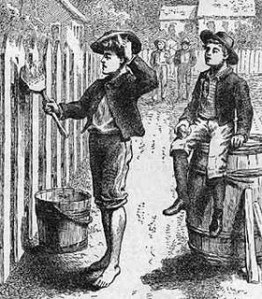 If your community strategy starts with the question, “how can I make the community work for me?” you may still find success if there are a bunch of people out there willing to paint your fence for free, but you definitely are not taking advantage of all of the benefits you can get from participating in communities.
One of the most often used examples of customer/community-driven innovation (perhaps because it is simple to understand) is the My Starbucks Idea site. This is a place where customers can tell Starbucks what they want, people vote on each others’ ideas, and Starbucks takes the best ideas and uses them to make their products, services, and experience better.
A recent example of a service that was launched through the site is a mini Starbucks drink card that can fit on your key chain. Sweet. It looks like they’ve had at least 5-10 innovations like this that have come from customer ideas, maybe more. And Starbucks is not alone– many companies have built similar sites, as has The White House. You’ve seen them.
But this approach is still simple Tom Sawyer-style community-building. People just helping Starbucks paint their fence for free. So why is it working for Starbucks? Because there are people out there willing to spend their time and energy helping Starbucks make their products, services, and experience better. Not every brand can command this sort of attention and loyalty. Most can’t, in fact.
My view? I do think these sort of public idea generation efforts are smart 21st century thinking when they work. But why stop there?
I get excited when I see big companies focused not only on what they take from the table, but what they bring to the table. I love to see companies that aren’t afraid to be humble members of communities, rather than building the community around themselves.
Test my theory… when it comes to community, are the words “monetize” and “kill” interchangeable?
I was reading an article online the other day discussing how to “monetize” community. For those of you who don’t speak marketing, monetize means “to convert into money.”

Hey babe! Wanna monetize this community with me?
Am I the only one who gets a creepy feeling when I see the words monetize and community used closely together?
Bringing up the idea of monetizing stuff at the beginning of a conversation about community is akin to a guy going up to a girl he’s never met and asking her to sleep with him straight out.
Nothing kills community mojo like bad intentions. And when you lead with bad intentions in a community setting, best case people will turn their backs on you, worst case they’ll pour a drink on your head or get their boyfriend to beat you up. Metaphorically speaking.
Look, people, I’m not saying it is wrong to make a living off of good community work. Just like it’s not wrong to date in the hope of finding someone to love you forever. There are just some ways of going about it that are gonna work better than others. And if your own happiness/success is your only goal, you will fail. To be successful in creating community you must take pleasure in sharing something.
So here’s my theory. Next time you hear someone in a meeting use the words “monetize” and “community” closely together (or see someone doing it online), think of me. Try substituting the word “kill” for monetize, and see if it fits. Feel free to post your examples here, send them to me via Twitter, whatever.
Here are a couple of examples I found online to get you started:
Hey, I Wrote a Book!

Available now in print and electronic versions.
 Dark Matter Matters