Dark Matter Matters
collaboration
Two tips for meeting survival in an entrenched bureaucracy
It might be a better world if we all worked in open, collaborative organizations where the best ideas win. But unfortunately, the reality is that bureaucracy still rules in all but the most progressive companies. We have a long way to go. The reality doesn’t always match the dream.
 In the real world, we generate great ideas, propose elegant solutions, and then force them to run the bureaucratic gauntlet. “the best ideas win” becomes “the safest ideas win” (and then lose eventually) as they travel through the bureaucracy and its meetings.
These meetings are the favorite hiding place of two species of people I dread encountering. Learn to identify, manage, or avoid these bureaucrats, as they are the enemies of meritocracy.
Devil’s Advocates
The devil’s advocate was wonderfully defined by Tom Kelley in his book The Ten Faces of Innovation. Devil’s advocates make a habit of shooting down the ideas of others or offering critiques by starting with the phrase “Let me play devil’s advocate” (or something similar).
This phrase allows the bureaucrat to avoid taking personal accountability for the comments they are about to make. Because they are speaking for the devil rather than themselves, they can crush someone else’s idea without feeling guilty about it.
Professional Meeting Attendees
It is easy to spot the professional meeting attendee because they usually look or sound hurried and exhausted, complaining about how many meetings they have that day and how much they have to get done. Woe is them, for sure.
The reality is they often don’t actually do the hard work of creating and building, but instead sit in meetings all day long. They are happy to offer sage advice and wisdom, but usually avoid taking on work.
In small organizations and startups, the professional meeting attendee species is rare. But it breeds rapidly in large organizations where meetings are plentiful and there is always someone else to do the work.
So what should good open source-minded workers do to improve things when they can’t escape these meeting bureaucrats? A few tips from me:
[Read the rest of this post on opensource.com]
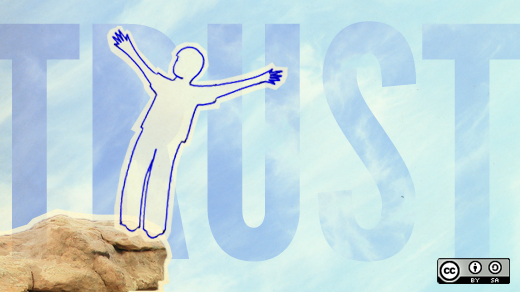
Trust: the catalyst of the open source way
Let’s face it. There are tons of projects out there in the world being run the open source way today. While the great ones can accomplish unbelievable things, the bad ones, even the average ones, often fail to achieve their goals.
 In many cases, the failed projects still used many of the tenets of the open source way, transparency, collaboration, meritocracy, etc. So why did they fail?
Some projects fail because the contributors just aren’t skilled enough at what they are trying to do. Projects also fail because people don’t have the dedication to see them through—folks give up when the going gets tough.
But in many cases, the contributors have the skills and the dedication, yet the projects still don’t work out. My view? Many of these projects fail because they are missing one simple thing.
Trust.
Collaboration works better when you trust the people with whom you are collaborating. Transparency is more believable when you trust those who are opening up to you. And it is much easier for the best ideas to win when there is a base level of trust in the community that everyone is competent and has the best interests of the project at heart.
A successful open source project needs a culture of trust much more than a project not being run the open source way. Why?
[Read the rest of this post on opensource.com]
Five questions about authenticity and the open source way with Jim Gilmore
A few months ago, I had the opportunity to meet Jim Gilmore, co-author (with Joseph Pine) of the book Authenticity: What Consumers Really Want. I first read the book a few years ago, and it really struck a nerve for me—these guys were on to something.
 So I convinced Jim to subject himself to a Five Questions interview about the place where authenticity and the open source way intersect.
CHRIS: After joining the open source world ten years ago, it didn’t take me long to figure out that most open source folks despise marketing as it is traditionally practiced. Is there something inherently inauthentic about the language of marketing? Perhaps open source folks have a low tolerance for inauthenticity?
JIM: I often quote from a letter-to-the-editor that appeared in the Harvard Business Review following the publication of our article, “Welcome to the Experience Economy.” In this letter, Robert Jones of Wolf-Olins shared his definition of a brand as “the promise of an experience.”
Joe Pine and I responded by saying Amen to that, but added that so often the actual experience fails to fulfill against the promise. Indeed, marketing in general, and advertising in particular, has become a giant phoniness-generating machine. And not just the language of marketing, but the very practice of marketing so often serves to erode the perception of authenticity among consumers—by making promises that bear little resemblance to the actual experience encountered.
So much creative talent today is engaged in making promises as marketing instead of being employed to create compelling experiences as actual output. The experience itself should be the marketing.
My friend Robert Stephens, founder of the Geek Squad, is fond of saying, “Advertising is the tax you pay for being unremarkable.” I feel that way about most marketing. I’d like to see creative talent diverted from making messages about goods and services and used instead to help create truly remarkable experiences, ones so compelling that they command a fee as product.
[Read the rest of this post on opensource.com]
BusinessWeek turns an eye to open source beyond technology
On opensource.com, we aspire to take principles the open source software movement has applied to building better software faster and find more uses for them in business, education, government, the law, and generally in our lives.
 So a few weeks back, I was excited to see that BusinessWeek (now Bloomberg BusinessWeek) ran a special report called Eye on: Open Source that also embraced the wider usage of open source principles in technology and beyond.
My personal opinion? I think a few of the articles in the special report confuse true community-driven open source innovation with concepts like user-driven product design, crowdsourcing, and design competitions. But it was still neat to see BusinessWeek recognize the applicability of open source principles beyond software.
[Read the rest of this post on opensource.com]
Is the word “community” losing its meaning?
Poor words. As they get more popular, as we give them more love, we also keep trying to shove in new meaning to see if they can take it.
 In the technology industry, this happens over and over. Take “cloud computing,” which used to mean something pretty specific and now means essentially “on the Internet” as far as I can tell. Outside the technology industry, take “news,” which also used to mean something, and now is a muddy mess of news/editorial/advertising.
We’ve even been accused of muddying the term “open source” here on opensource.com (a debate I love to have—there are smart opinions on both sides: protect the core vs. extend the audience).
So when I read a recent post by Gartner analyst Brian Prentice entitled Defining & Defending The Meaning Of “Community” – An Open Source Imperative, I was familiar with the lens he was looking through already.
Brian’s argument? According to his post, community used to mean “a collection of people whose defining characteristic is shared participation.” I might add “and a common purpose or vision.”
But now the word community is often being used to refer to any ol’ collection of people. From the article:
[Read the rest of this article on opensource.com]
Why the open source way trumps the crowdsourcing way
A while back, I wrote an article about why the term crowdsourcing bugs me. Another thing that drives me nuts? When people confuse crowdsourcing and open source. My friend David Burney wrote an interesting post on this subject a while back highlighting the differences.
 It finally hit me the other day just why the open source way seems so much more elegantly designed (and less wasteful) to me than what I’ll call “the crowdsourcing way.”
1. Typical projects run the open source way have many contributors and many beneficiaries.
2. Typical projects run the crowdsourcing way have many contributors and few beneficiaries.

It’s such a simple concept, it seems obvious. Let’s look at a few examples to illustrate why this simple difference means so much.
[Read the rest of this post on opensource.com]
Can truly great design be done the open source way?
A few weeks ago, I wrote an article about Apple and open innovation. The discussion in the comments about Apple’s success, despite their non-openness, was pretty interesting. Greg DeKoenigsberg started things off with this salvo:
“No community could build something as gorgeous as the iPhone; it requires the singular vision of a beautiful fascist, and the resources of a gigantic company, and a world full of users who would happily trade simplicity and certainty for the ability to tinker.”
 I think few people would argue that one of Apple’s greatest strengths is their amazingly consistent, and consistently beautiful, design work. And when I say design, I mean both “little d design” (their stuff looks awesome) and “big D Design” (their systems, processes, and experiences are expertly rendered).
From a design perspective, Apple has figured out how to make lightning strike in the same place over and over again.
Today, I want to ask a question that I’ve been thinking about for a long time:
Can truly great design be done the open source way?
Meaning, can a group of people designing collaboratively, out in the open, ever do the kind of consistently beautiful design work that Apple does? Or is Greg right, that “no community could build something as gorgeous as the iPhone”?
Both of my partners at New Kind, David Burney and Matt Muñoz, are designers by background. Both of them have significant open source experience (David spent almost 5 years as the VP of Communications at Red Hat, Matt worked on many Red Hat projects, including designing the Fedora logo), so the three of us have talked about this subject many times before.
[Read the rest of this post on opensource.com]
The Wikimedia Foundation: doing strategic planning the open source way
Earlier this week I wrote a post about some of the cultural challenges Wikipedia is facing as its contribution rate has slowed. The comments you made were fantastic, including one by Dr. Ed H Chi (the PARC scientist who published the study I referred to in the post) linking to a prototype dashboard his team created to showcase who is editing each Wikipedia page (totally fascinating—you have to go try it!)
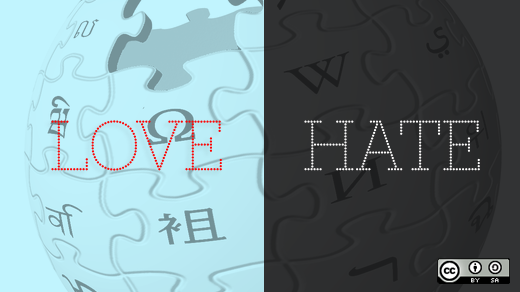 Another interesting comment was made by my good friend Paul Salazar, who pointed us to this page where the Wikimedia Foundation (the parent organization that runs Wikipedia, among other projects) is showcasing their exhaustive, happening-as-we-speak strategic planning process in all of its transparent, open glory.
From the main page, you can read the entire strategy memo that was presented to the Wikimedia Foundation board just last month. The memo itself is stunningly smart. Google must have thought so too, because they made a $2 million donation to the Wikimedia Foundation, announced a few weeks ago.
But it doesn’t stop at high-level strategy for the eyes of muckety-mucks. From this page you can find proposals (hundreds were submitted, and just like on Wikipedia, anyone could contribute), background research, and task forces that have come together to discuss some of the major strategic challenges outlined in the initial strategic plan.
[Read the rest of this post on opensource.com]
Five questions about the future of music with David Pakman
Traditional media companies are in big trouble. You may have noticed. You know who else has noticed? David Pakman, currently a partner at the prestigious Venrock venture capital firm. You may also know David as the former CEO of eMusic—a fairly disruptive media company in its own right. David has over 300,000 Twitter followers and regularly blogs here about the “undoing of big media.”
 Today, we ask him five questions about where the future of music intersects with the open source way.
1. One of the beautiful things about the open source software revolution is it lowered the barrier to entry for developers who wanted to create useful software. Meaning, without going to fancy schools or working for big Silicon Valley tech companies, people in any part of the world with any level of experience could contribute, and if their code was good, they were in. Is the barrier to entry for artists trying to make it in the music industry getting lower too? It sure doesn’t feel like it sometimes.
I think the barrier to entry to write or make music has always been pretty low. Provided you can learn how to play an instrument, you can write songs. The encroachment of technology into every facet of music making has lowered this barrier even further. An entire album can be recorded at great quality in a basement with a Mac and some bundled software. DJ equipment isn’t even needed anymore — you can do it all on your Mac.
The challenges have always been around marketing and distribution, and the internet changed all that. Anyone can launch a site or a myspace page and offer downloads of their music. In 2008, more than 38,000 new records were released. This was the most ever.
Becoming commercially successful by selling music or touring has never been harder, and that is because fewer people are buying music and consumers have more entertainment choices than ever before. So while it’s easier to make music, it’s harder to make a living making music.
[read the rest of this post on opensource.com]
Three tips for escaping the creativity peloton without giving up on collaboration
If you’ve ever watched a road bike race like the Tour de France, you know the peloton is the big group of riders that cluster together during the race to reduce drag. It’s a great example of collaboration in action. But let’s face it: the people in the middle of the peloton may go faster than they would otherwise, but they don’t win the race.
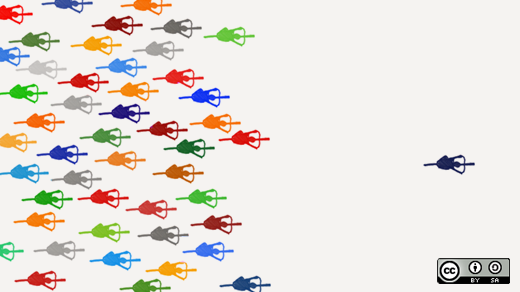 When it comes to creating and innovating, most companies (and employees) are in the peloton. They are doing enough to survive, but they are stuck in the pack. And if they stay in the pack too long, they lose.
Escaping the peloton is tough. Often, you see a cyclist break away, sprint for a while, only to get sucked back into the main group over time as the pressures of making a go independently prove too much.
You’ve probably felt this way at work. You come up with an amazing idea, one that will change the company forever. But little by little, people—even the well-meaning ones—chip away at its soul, until the idea goes from being amazing to, well, average. You end up being sucked back into the peloton.
After this happens one too many times, you may feel like you want to stop collaborating and try to make things happen on your own. Don’t do it. Even Lance Armstrong could rarely break away from the peloton without his teammates’ help.
Instead, here are three tips to help you escape the creativity peloton without giving up on collaboration.
[Read the rest of this post on opensource.com]
Hey, I Wrote a Book!

Available now in print and electronic versions.
 Dark Matter Matters