Dark Matter Matters
brand
First post! New chief Yahoo speaks
 Jeff Mackanic passed on an interesting post from new Yahoo CEO Carol Bartz. The money quote:
Finally, a note about our brand. It’s one of our biggest assets. Mention Yahoo! practically anywhere in the world, and people yodel. But in the past few years, we haven’t been as clear in showing the world what the Yahoo! brand stands for. We’re going to change that. Look for this company’s brand to kick ass again.
Wow. Even I wouldn’t use the word “ass” in my blog (or would I???). But clearly she feels strongly– Yahoo’s brand has fallen a long way since its heyday. Our internal brand survey data shows that even little ol’ Red Hat has surpassed Yahoo, at least among business audiences, as a defining technology company.
So what happened? She’s right– Yahoo lost its way. But I still have a soft spot for Yahoo, one of the first big Internet brands, and wish Bartz the best of luck with the rehabilitation. The Rx? One dose of Jack Trout & Al Ries, followed by Jim Collins & Jerry Porras, taken with a 12 oz glass of water on a full stomach. Call me in the morning, let me know how you feel.
Rahm and the art of positioning
Was watching Rahm Emanuel on Meet the Nation this morning. No matter where you fall politically, you’ve got to be amazed at what a  master of positioning he is. Republicans have been winning the positioning war for years, with Democrats not even understanding the game, let alone playing it well.
So what is positioning? According to Wikipedia, positioning is:
the process by which marketers try to create an image or identity in the minds of their target market for their product, brand, or organization.
The name “positioning” was coined by Jack Trout and Al Ries and introduced in their book Positioning: The Battle for Your Mind, but the concepts they called positioning have been used to influence people throughout history.
Matthew Szulik gave me a copy of a positioning book by Jack Trout about 2 years after I joined Red Hat, and it was my first real exposure to the idea. Now, the art of positioning rules everything I do at work.
People who get it #2: Marty Neumeier
I ordered 3 copies of Marty Neumeier’s new book, The Designful Company, yesterday for the team. Will let you know what I think once I’ve had a chance to read it. His two previous books, The Brand Gap and Zag, both had a profound influence on the Red Hat 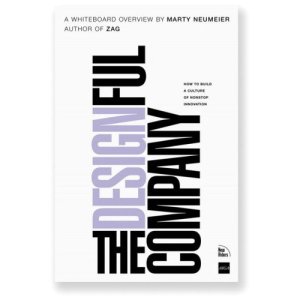 overall brand strategy. I especially love The Brand Gap, which David Burney first introduced to me in 2005.
I’ve probably bought 20-30 copies of The Brand Gap over the last few years, try to keep a few at my desk to hand out to any potential brand converts I meet (why do I never get the copies back?). What’s beautiful about this book is the design and content are one–the message of the book is communicated by its design and its content together. And it is short– any busy executive can read it on a plane up to NYC.
In addition to helping us articulate the overall organizational design of the Brand Communications + Design group within Red Hat, this book has given us many other good ideas to chew on over the years. Probably the most famous quote from the book is:
A brand is not what YOU say it is, it’s what THEY say it is.
which many other people have glommed onto over the last couple of years (including me).
Even if you don’t have time to check out Marty’s books, go check out his great (and beautiful) presentation that explains many of the key concepts of his thinking here.
Rethinking communications in the 21st century company
Last week a colleague told me IBM had reorganized it’s marketing and communications functions. In the new order, the entire marketing organization would report into communications. Typically it has always been the opposite, with brand groups like mine and public relations reporting into a Chief Marketing Officer. Until recently, that’s been the way it worked at Red Hat too– over the years I’ve worked for mostly VP of marketing or CMO-types (although now I work as part of a group called People & Brand, a subject I’ll save for another post).
 So I spent some time thinking about what this change meant for IBM, why they were doing it, and did a little research online. In the process, I stumbled upon this report from the Arthur W. Page Society entitled “The Authentic Enterprise.” Turns out that one of the co-chairs of the Authentic Enterprise task force was John Iwata, the SVP of Communications for IBM. My guess is that this report, which came out in 2007, had significant impact in making the changes at IBM.
Thought I’d call out a few choice quotes from the report that I loved.
Red Hat Nation
I was emailing back and forth with my friend Todd Barr the other day. Catching up with him reminded me of an idea we used to talk about quite a bit that I still think is the best idea that we haven’t made good on: Red Hat Nation.
 The basic idea is that a company like Red Hat, based on open source, has an opportunity to completely redefine what a business looks like in the 21st century. The traditional 20th century business is often very black and white: either you work for the company or you don’t. You are inside it’s walls, or you are not. There are clear distinctions between employees, partners, and customers. The most common way of depicting a company in this 20th century model is by showing its building.
In the traditional model, if I was to say I work for Red Hat, you would assume it means I am a Red Hat employee, and that they give me a paycheck, benefits, a desk, all the normal stuff.
But imagine for a second that the image used to illustrate the 21st century company is not a building, but instead a flag.
A flag is often a rallying point for nations, a symbol that represents a common set of beliefs. You see flags at the front lines of troops in battle. You see flags hanging outside the door of homes. You see flags on clothing, at sporting events, in many places where people who share common traits gather.
Communicating a message through design
Earlier this week, Red Hat announced an agreement with Microsoft. I’m not planning on commenting on that agreement, as that’s not the point of this blog. Plus there are lots of smart Red Hat people who can do stuff like that.
 But I did find this article from InformationWeek interesting. It points out the design work that went into the homepage promo we put on redhat.com, and shows how important design can be to the communication of an important message. From the article:
“A banner graphic atop the page detailing the reciprocal agreements announces in bold, all capital letters that “customer demand has spoken.” The banner also features a prominent road sign with a double-headed arrow pointed in opposite directions that sometimes signifies interoperability. Translation: You made us do it.”
So I am a “no comment” on this interpretation:) But I am excited that the work of Josh Gajownik from the Red Hat Brand Communications + Design team was noticed.
Pepsi ads blur the line
Was watching Saturday Night Live last night and saw some Pepsi ads that were based off of what was previously an SNL skit starring Will Forte. There were three ads, all based on the “MacGruber” parody of MacGyver SNL has been running for a while.
The first one had product placement for Pepsi in a small way, by the third one, every word that came out of Will Forte’s mouth was Pepsi. It was totally over the top, completely transparent product placement. And pretty damn funny by the end. I loved it.
My view? A huge win for Pepsi, breaking new product placement ground by co-opting an existing (and funny) Saturday Night Live skit, and being extremely self-aware about product placement and people’s feelings about it. Blew it wide open. Freakin’ hilarious.
For Saturday Night Live? I’m pretty sure the SNL folks woke up on Sunday morning with a bad hangover. Wondering what exactly they’d done, and hoping that no one else remembered either. Maybe Robert Redford was right. Make an indecent proposal with enough money attached, and someone will do anything.
Coke Classic goes bye bye… finally!
After almost 25 years, Coca-Cola has decided to drop the “Classic” label from its Coke cans. See the Wall Street Journal article here.
 This is a perfect example of one of my favorite quotes about building brands, from Amazon.com’s Jeff Bezos:
“A brand for a company is like a reputation for a person. You earn reputation by trying to do hard things well. People notice that over time. I don’t think there are any shortcuts.” – BusinessWeek, August, 2004
In 1985, Coca-Cola made one of the most famous brand “mistakes” of all time, introducing New Coke to replace their classic formula. It took them 25 years to make the conversion back to where they started.
Now I’m not saying you need this much time to make any brand transition, but it does make you think. Are you moving too quickly with a branding change? Do you risk throwing some of your existing brand equity away? Or could you harvest that equity and move it with you if you just took some more time?
After all, there are no short cuts. Might as well take the time to do it right.
Metrics that matter
 Have you ever been zooming in on a Google map, and eventually you zoom so far in that Google apologizes and tells you that it doesn’t have an image showing stuff that close? What do you do? You zoom back out so that you can see again.
When it comes to running campaigns, I tend to take metrics with a few grains of salt. How many times have you seen someone report metrics on how their campaign did, and they show that it drove zillions of leads and that converted to zillions of $$ in sales and was a huge success… but then you look around and can’t find anyone who saw the campaign, or heard of it. And the sales guys couldn’t ever even tell it happened.
In command and out of control as marketing strategy
In my last post, I talked about the idea that General Paul Van Riper called being “in command and out of control” as a corporate leadership strategy. But can you also apply the same principle as a marketing strategy?
A traditional marketing campaign usually looks something like this:
1. Build a campaign plan
2. Create campaign messages
3. Execute campaign
4. Track ROI, leads, sales directly driven by campaign
But what might an out of control marketing campaign look like? Continue reading
Hey, I Wrote a Book!

Available now in print and electronic versions.
 Dark Matter Matters