Dark Matter Matters
culture
What if politicians innovated the open source way?
In the discussions around some of my previous articles, I’ve noticed a trend: we seem to be focusing on cultural changes that need to be made for the open source way to be effective in contexts beyond technology. One cultural context I think could really use some help is politics.
 I read an interesting post last week by Morton Hansen (author of Collaboration: How Leaders Avoid the Traps, Create Unity, and Reap Big Results) entitled Obama’s Five Collaboration Mistakes. In the comments below the post, some folks interpreted his words as an attack on the Obama administration. Me? I’d probably interpret Hansen’s words more broadly. Perhaps something like:
Politicians are pretty darned bad at collaborating a lot of the time.
I think many folks would agree with this statement no matter where they sit politically. No matter where they live around the world.
In fact, the word “political” has become almost synonymous with anti-collaborative behavior in many contexts. Certainly in the business world.
But there is a lot a stake here. The economic downturn has hurt our businesses badly. And this has affected many of us in even more personal ways. Jobs. Homes. Security.
We need innovation in the political world to help solve the problems of the business world. Which means we are going to need better collaboration across political boundaries, both inside and between our countries.
Could we open source folks help?
[Read the rest of this article on opensource.com]
Is the traditional business world at war with creativity?
Earlier this week some colleagues and I attended a fantastic gathering of business and political leaders called the Emerging Issues Forum. The theme of the forum—interestingly enough for a bunch of business folks—was creativity, and speakers included some of my favorite thinkers/authors who analyze the future of business: 
- Roger Martin, Dean of the Rottman School of Management at the University of Toronto, and author of The Responsibility Virus, The Opposable Mind, and a new book on design thinking called The Design of Business.
- Tom Kelley, General Manager of legendary design firm IDEO, and author of The Art of Innovation and The Ten Faces of Innovation. IDEO’s CEO Tim Brown also has a book out on the subject on Design Thinking, called Change by Design, which my friend Jonathan Opp wrote a nice review of here.
- Daniel Pink, bestselling author of A Whole New Mind, a book that has been extremely influential in my thinking about how the left brain and right brain can play nice in the business world. Pink also has a new book out, called Drive: The Surprising Truth About What Motivates Us.
During their talks, I couldn’t help but notice all three touched on a similar thematic: the crucial role that inspiring creativity plays in driving innovation.
[Read the rest of this post over at opensource.com]
Three signs your corporate culture isn’t ready for the open source way
It’s a good bet that the next generation of defining companies will have corporate cultures built the open source way– around openness and collaboration, while fostering community and culture that extend outside the company walls.
 In fact many of the defining companies of the first decade of this century show these characteristics (with one very notable exception we discussed earlier).
It kind of makes you want to rush in and see if you can change your old style corporate culture and get in on the action. But try to change too fast and your efforts may backfire.
So here are three signs that your corporate culture may not quite be ready for the open source way– and some tips to help you move closer.
[Read the rest of this post over at opensource.com]
Reporting live from the front lines of the war on creativity
Today I spent a great day at the Emerging Issues Forum, where I’m proud to say my home state of North Carolina attracted some of the top business minds in the world (the Twitter stream is going crazy here). This morning featured two Dark Matter Matters all stars, Roger Martin and Tom Kelley (who I have written about previously here and here), but there was also an incredible lunch session where Charlie Rose interviewed husband and wife creative geniuses Nnenna Freelon (the 5-time Grammy nominated jazz vocalist) and Philip Freelon (architect extraordinaire), and plenty of other enlightening stuff.
 The theme of the conference is Creativity, Inc., and from what I can tell from many of the attendee and host comments, the theme of this year’s event is very different than years past. But the undercurrent of many of the comments from this morning seemed to take a clear point of view on this theme.
My interpretation? For years the business world has been waging a war against creativity… and creativity is beginning to fight back.
It’s about damn time.
Roger Martin is one of the most eloquent speakers in the world on the need for change in business. Some key points from his talk today:
Martin talked about two types of industries– clustered industries (where much of the industry is in one part of the world, Silicon Valley for high tech being one good example) and distributed industries (where the industry is dispersed all over, hair salons and pizza places being two examples).
Martin’s research shows that clustered industries have a higher percentage of the creative class of workers. The average salary for a creative worker in a clustered industry? About $70,000 per year. But for a creative worker in a dispersed industry? Only about $56,500 a year. Pretty big difference.
So what does it mean? According to Martin, income disparities will continue to grow unless we can figure out what to do with routine jobs in dispersed industries.
He calls this one of the greatest policy challenges of the 21st century: How can we increase the percentage of creativity we use in all jobs? How can we make use of the whole human being in work environments?
I love this thought of us figuring out how to use the whole human being– how many jobs do we see that leave tons of creative potential on the table, at the expense of not only innovation, but also employee happiness? Too many, in my experience. And at all levels in business, from executive on down.
Roger Martin and the new liberal arts MBA
This morning’s New York Times had a great article entitled Multicultural Critical Theory. At Business School? highlighting the changes many business schools are making in the way they teach their students. Probably the most visible leader of this movement has been Roger Martin, Dean of the Rotman School of Management at the University of Toronto, who is prominently featured in the article (and will be speaking here in Raleigh next month at the Institute for Emerging Issues Forum).
(VIDEO: a recent Roger Martin talk)
What kind of changes are the schools making? From the article:
“While few [business schools] talk explicitly about taking a liberal arts approach to business, many of the changes are moving business schools into territory more traditionally associated with the liberal arts; multi-disciplinary approaches, an understanding of global and historical context and perspectives, a great focus on leadership and social responsibility and, yes, learning how to think critically.”
Why? Look around you. In business, we are currently experiencing a double crisis of ethics and innovation. Take the results of a recent Gallup poll on Honesty and Ethics of Professions. Americans now trust the ethics and honesty of businessmen less than lawyers. Ouch.
The story of how we uncovered the Red Hat values
One of the first things many new employees notice when they step inside Red Hat is how deeply held our corporate values are within our walls and how much they impact behavior within the company. The values aren’t just words to most Red Hat folks, and they show up in conversations and in actions on a daily basis. Today we probably take for granted that it has always been that way.
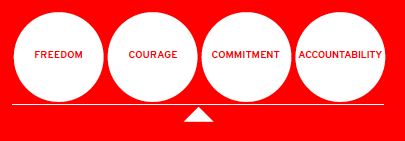
The four Red Hat values, in balance.
But it wasn’t. Back in 2002, I was one member of a team tasked with figuring out Red Hat’s corporate values. At that time, the company was still pretty small– about 500-600 employees.
I must admit at first I was pretty jaded about the whole corporate values business. The concept of corporate values made me think of those Successories motivational posters with a photo of a bear in the middle of a stream with a fish in his mouth and a word like “ACHIEVEMENT” in all caps at the bottom. Or whatever. Most corporate values systems didn’t seem authentic to me or were just plain lame.
The values team was made up of a cross section of folks from across Red Hat: Sean Witty, who did biz dev and M&A; Mark Cox, a security guru who is still at Red Hat; Jeremy Hogan, one of the original Red Hat community managers but who at the time was working in support; Paul Salazar, who I’ve written about before in this blog here; Jonathan Opp, who is still in the Red Hat brand team and did a lot of the original writing of the values descriptions; and myself.
We quickly decided we didn’t want Red Hat to end up with just some lame words to put on posters. We wanted to do this values stuff right.
Paul Salazar knew Jim Collins from Stanford, and encouraged each of us to read Collins’s book Built to Last (which is one of the Top 10 Books behind Dark Matter Matters). In it, Collins talks about the characteristics common to great, enduring corporations. According to him, the most important thing great companies shared was having deeply held values and core purpose. From the book:
Jim Whitehurst video: Competing as a 21st century enterprise among 20th century giants

The Duke Fuqua School of Business just posted Jim Whitehurst’s presentation from their Coach K Leadership Conference entitled “Competing as a 21st Century Enterprise Among 20th Century Giants.” I referred to it a while back in a post entitled Jim Whitehurst: 5 tips for competing in the 21st century.
Watch a stream of the whole talk here or click on the image above.
I think it is fantastic, but would love to hear what you think.
Five ways to strengthen your company’s immune system
I’m not usually a germophobe, but the last few months I’ve been walking around opening doors with my elbows and washing my hands constantly. I’ve been freaked out by the constant updates on Facebook about what my friends/friends’ kids have come down with now. So far, my immune system has held up pretty well, but I always worry that H1N1 is only a doorknob away.
 These are trying times for corporate immune systems too. The economic meltdown has exposed corporations to all sorts of risks they don’t deal with in the regular course of business. Many corporate immune systems have failed, putting millions of people out of work. It begs the question: how resilient is your company? And how can you make your corporate immune system stronger?
I got to thinking about this corporate immune system concept after reading the new book The Age of the Unthinkable: Why the New World Disorder Constantly Surprises Us And What We Can Do About It by Joshua Cooper Ramo. In this fantastic book, Ramo (former foreign editor of Time Magazine, now a foreign policy/strategy consultant at Kissinger Associates) offers his thoughts on what we as a society need to do to adapt to a rapidly changing world.
Ramo talks a lot about the idea of creating a stronger global immune system. Here’s what he means:
“What we need now, both for our world and in each of our lives, is a way of living that resembles nothing so much as a global immune system: always ready, capable of dealing with the unexpected, as dynamic as the world itself. An immune system can’t prevent the existence of a disease, but without one even the slightest of germs have deadly implications.”
Ramo presents this in idea in the context of how we protect ourselves from a scary world– terrorists, rogue nations, nuclear proliferation, and all that, but the concept applies well to the corporate world as well– tough competitors, fickle customers, shrinking budgets– we corporate folks have our own demons.
So how do we shore up the ol’ immune system? Ramo refers to the philosophy of building resilience or “deep security” into the organization. Continue reading
The Adaptable Company: Gary Hamel’s new book that isn’t
Over the past few weeks, Gary Hamel has written two posts on his Wall Street Journal blog about his next book (the posts are here and here). The catch? He’s decided that he isn’t going to write another book. So instead, he published the CliffsNotes version of what he’d write if he was going to write a book, and started what he refers to as an “open source project” about the ideas, inviting people to add their thoughts and comments.

Management guru Gary Hamel
I thought I’d share some of my favorite bits that fit in really well with a Dark Matter Matters world view.
On what it means to be an adaptable company:
An adaptable company is one that captures more than its fair share of new opportunities… An enterprise that is constantly exploring new horizons is likely to have a competitive advantage in attracting and retaining talent. When a once successful company runs aground and starts to list, its most talented employees usually don’t stick around to bail water, they jump ship. A dynamic company will have employees who are more engaged, more excited to show up to work every day, and thus more productive… Adaptability didn’t rate very highly as a design criteria when those early pioneers set out to invent Management 1.0 a hundred years ago. But it’s essential now…
On the problems with big organizations:
Big things aren’t nimble. That’s why there aren’t any 200-pound gymnasts or jumbo-sized fighter jets… In a company comprised of a few, large organizational units, there tends to be a lack of intellectual diversity—since people within the same unit tend to think alike. Within any single organizational unit, a dominant set of business assumptions is likely to emerge over time. One way of counteracting the homogenizing effects of this groupthink is to break big units into little ones. Big units also tend to have more management layers—which makes it more difficult to get new ideas through the approval gauntlet. In addition, elephantine organizations tend to erode personal accountability.
Howard Schultz of Starbucks: The role of culture in a crisis
This week I was lucky enough to attend the Ernst & Young Strategic Growth Forum in Palm Desert, CA. As you may recall, last year Red Hat Chairman Matthew Szulik was the national Ernst & Young Entrepreneur of the Year, and later this week, he’ll hand over his title to the next entrepreneur in waiting. One of the most exciting things about the Strategic Growth Forum is that it brings together some of the smartest entrepreneurial minds in the world in one place, and this morning, I had an opportunity to hear from one of the best.

Howard Schultz: Chairmain, CEO, and President of Starbucks
Howard Schultz, Chairman, President, and CEO of Starbucks, who won an Entrepreneur of the Year award in 1993, spoke about his experience leading Starbucks through the economic crisis. As Starbucks began going through hard times, Schultz, who had given up the CEO role in 2001 (while remaining Chariman), decided it was time to take back the CEO responsibilities himself in early 2008.
Why? He was worried that the distinct culture, mission, and values that had brought the company great success were eroding.
According to Schultz, he came back into an operational role because he felt that the way out of crisis was not a simple change in business strategy, but instead– in his words– “love and nurturing.” His key to turning things around was revitalizing the investment in his people, recommitting to the core purpose of the organization and providing employees with hope and inspiration.
He says the transformation of Starbucks since this revitalization has been key to a tremendous amount of new innovation happening inside the company. People have even commented to him that it reminds them of what the early days at Starbucks must have been like.
Schultz took 10,000 of his best people and brought them together in New Orleans in late 2008 for a leadership conference where they spent 50,000 volunteer hours helping communities re-build after Hurricane Katrina. Below is a documentary that was filmed about this event.
Hey, I Wrote a Book!

Available now in print and electronic versions.
 Dark Matter Matters