Dark Matter Matters
brand
Sharing your brand story (and here’s ours)
The most compelling brands in the world tell compelling stories. Whether the brand is Nike (the Greek winged goddess of victory was named Nike, and it all rolls from there) or IBM (Thomas Watson and THINK) or [your favorite brand here], the most interesting brands have great mythologies built up over time. The brand story is deeply ingrained in their actions, voice, look, and culture.
It’s been almost eight years since we created the first Red Hat Brand Book. The original book was an attempt to capture the essence of our Red Hat story, to explain what Red Hat believes, where we came from, and why we do what we do.
It had a secondary mission as an early brand usage guide, explaining what Red Hat should look and sound like at a time when the company was expanding rapidly around the world and brand consistency was becoming harder to achieve.
When most companies create this sort of document, they call it a “Brand Standards Manual”, or something like that. But we were young, foolish, and drunk on the meritocracy of open source, so in the first version of the Brand Book, we emblazoned the words “This is not a manual” on the front cover.
Why? We wanted to be very clear this book was the starting point for an ongoing conversation about what the Red Hat brand stood for, looked like, and sounded like, rather than a prescriptive “Thou shalt not…” kind of standards guide.
I hate brand standards that sound like legal documents. I’ve always felt like the role of our group was to educate and inspire, not to police, and we tried to create a document that embodied that spirit.
This year we launched the biggest update yet to the Brand Book. In doing so, we actually split it into two projects:
Matthew Szulik and the Red Hat vision
The BBC conducted a great interview with Red Hat Chairman Matthew Szulik while he was attending the Ernst & Young World Entrepreneur of the Year awards recently (representing the United States as our winner). You can listen to it here.
This interview is a wonderful reminder of the powerful impact of a corporate vision that extends beyond just making money. And a great reminder for me of how lucky I have been to learn about leadership, community, culture, and brand from the 2008 United States Entrepreneur of the Year.
If you are interested in learning more about Matthew Szulik, his vision, and how it evolved, here is a wonderful oral history of his life that was commissioned a few years ago.
Brand positioning tip #4: brand permission
In brand positioning tips 1-3, we discussed the 4 elements of good brand positioning: points of difference, points of parity, the competitive frame of reference, and the brand mantra. In this post, we are going to switch gears and talk about a subject called brand permission.
 When attempting to position your brand in a new competitive frame of reference (or, in non-marketing-ese, when you want to start selling stuff in a new market), consider whether your brand has earned permission to enter that market.
How do you know if you have permission? And who do you need permission from? Well, let’s look at a few examples.
Back in the early 1990s, Clorox underwent a failed experiment in extending the Clorox brand into detergent. There is a nice short writeup of it here. Why did the detergent product fail?
Brand positioning tip #3: the brand mantra
In previous posts, we’ve covered three of the four elements of good brand positioning as I learned them from Dr. Kevin Keller, 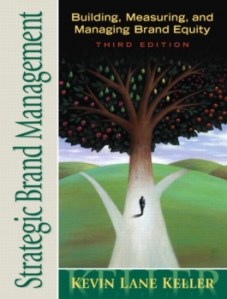 author of the classic branding textbook Strategic Brand Management:
- Points of difference: the things that make you different from your competition (and that your customers value)
- Points of parity: the places where you may be weaker than the competition and need to ensure you are “good enough” so you can still win on the merits of your points of difference
- Competitive frame of reference: the market or competitive landscape in which you are positioning yourself
Today we will be covering the 4th element of good brand positioning: the brand mantra.
What is a brand mantra?
A brand mantra is a 3-5 word shorthand encapsulation of your brand position. It is not an advertising slogan, and, in most cases, it won’t be something you use publicly.
According to Scott Bedbury, author of A New Brand World (one the of top 10 books behind Dark Matter Matters), the term brand mantra was coined during his time at Nike.
When good companies go bad
A few weeks ago I finished the new Jim Collins book How the Mighty Fall and Why Some Companies Never Give In. If you read this blog much, you’re probably sick of me prattling on about how much I love Jim Collins’ work (here, here, and here). Over the years at Red Hat, we’ve based many projects related to the values, mission, and other corporate-level structural thinking on ideas we got from him.
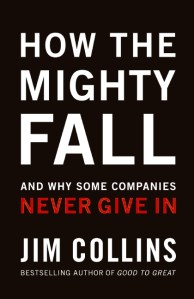 Well, it’s been almost eight years since Collins wrote his last full-length book, Good to Great (which ranked number one on my list of the top ten books behind Dark Matter Matters). How the Mighty Fall is a short book, and in it, Collins is clearly a bit on the defensive about his previous work. The issue? In the economic meltdown last year, some of his Built to Last companies didn’t last, and some of his Good to Great companies are back to good… or gone.
Collins explains it this way:
…the principles in Good to Great were derived primarily from studying specific periods in history when the good-to-great companies showed a substantial transformation into an era of superior performance that lasted fifteen years. The research did not attempt to predict which companies would remain great after their fifteen-year run. Indeed, as this work shows, even the mightiest of companies can self-destruct.
…I’ve come to see institutional decline like a staged disease: harder to detect but easier to cure in the earlier stages, easier to detect but harder to cure in the later stages. An institution can look strong on the outside but already be sick in the inside, dangerously on the cusp of a precipitous fall.
So this book is Collins’ attempt to discover why exactly some very good companies went oh so very bad. If Good to Great was Star Wars, this book is The Empire Strikes Back— a long, hard look into the dark side (even the cover is black).
Collins did extensive research using an interesting approach. He studied these companies, not as history has judged them, but based on what the company was saying, what the press was saying, what financial analysts were saying during the time period being studied– before we knew the outcome. And all of the research was done in historical order, almost like he was following the companies through time.
The results of the research play out like a Greek tragedy. He identified 5 stages of decline in the companies that had gone from great to… not so great:
Brand positioning tip #2: the competitive frame of reference
In Brand Positioning Tip #1, we covered 2 of the 4 key elements of successful brand positioning done the way Dr. Kevin Keller taught me: points of parity and points of difference. Today, I’d like to highlight the third key element of good brand positioning– understanding your competitive frame of reference.
Competitive frame of reference is a fancy way of saying “the market you compete in.”
This sounds pretty simple, huh? It can be… If you run a furniture store, your competitive frame of reference would probably be the furniture market. If you run a tattoo parlor, your competitive frame of reference would probably be the tattoo market.
Those are pretty cut and dry cases. But have you ever stopped and wondered to yourself, “exactly what market am I competing in?” and realized that you are really competing in a market that is not initially obvious? Or that you are actually competing in multiple markets? If either of these situations are true, you may discover you need to create points of parity and points of difference for each market where you compete.
Here is an common example of a less-than-obvious competitive frame of reference.
What market do you think Starbucks is in? The coffee market? Maybe. In the coffee market, Starbucks competes with grocery stores, fast food restaurants, other coffee shops, and home brewers. Tough market… they aren’t competitive in the coffee market on price, there are probably options that (arguably) taste better, maybe have shorter lines. It’s hard to believe that Starbucks would have grown as big as they are by simply competing in the existing coffee market.
Summer reading list for Dark Matter Matters
Ah, vacation… the time when the work shuts down for a few days and the Dark Matter Matters blog comes out of hibernation… 3 posts in 3 days!

A few months ago I wrote a post where I highlighted the top ten books behind Dark Matter Matters. In that post I promised to create a list of the books that didn’t make the top 10 cut, but are still pretty awesome.
So here, to celebrate the long holiday weekend, are some more books that have inspired Dark Matter Matters.
Books about how large-scale collaboration is pretty much the deal:
Wikinomics by Don Tapscott and Anthony Williams
The Wisdom of Crowds by James Surowiecki
The Starfish and the Spider by Ori Braffman and Rod Beckstrom
In the open source world, there’s a legendary quote attributed to Linus Torvalds (yes, he is the guy that Linux is named after) “Given enough eyeballs, all bugs are shallow.” The first two of these books are the extended dance remix of this quote. Each has a unique take, but both show how mass collaboration is changing everything about our society and the way we solve problems. The Starfish and the Spider is a interesting look at leaderless organizations and is a nice book for anyone trying to understand how the open source movement (and other leaderless organizations) work, and why open source is so hard to compete against. It is also a nice complement to the Mintzberg article I wrote about in my previous post.
Just in! A compelling vision for corporate America
In previous posts, I’ve talked about the need for setting a compelling vision for the corporation beyond just making money. Jim Collins writes about this concept extensively in Good to Great and Built to Last.
On June 26, we saw a wonderful example of one of the most respected CEOs in America, Jeffrey Immelt of GE, doing exactly that.
Steve Prokesch at Harvard Business Review gives some of the background in his blog:
A couple of weeks ago I met with GE’s CEO Jeff Immelt and we were talking about the financial meltdown, the deep recession, and what it would take to fix America. He was outspoken about how business and government had let down the American people and the need for radical change.
That’s fine, I said, but if he felt that way, why hadn’t he spoken up publicly? Immelt ran from the room and quickly returned with a speech he was working on–one he delivered last week at the Detroit Economic Club. This was his speech and not something he had fobbed off to a speechwriter, he told me.
After reading this post, I went and watched the speech, which will take you about 25 minutes of your life.
I was blown away. In this very traditional corporate luncheon setting, glasses and sliverware clinking, video cutaways to bored-looking attendees trying to remember where their 1 o’clock meeting is supposed to be, Immelt presented a deeply personal vision for recreating America, and his company in the process.
The role of film at Red Hat
Yesterday, Red Hat launched a new series of short films called Red Hat Stories. These films are a key element in our effort to document “the Red Hat way” of doing things. We’ve started with sixteen films covering everything from an overview of what makes Red Hat useful, to our technology leadership, even a set about our perspective on how to liberate innovation. The piece below is a short, sweet distillation of the Red Hat way, and it speaks for itself.
I use the word “film” rather than video on purpose because it better captures the spirit of what we are trying to do with digital media at Red Hat. Films are what you make when you are captuing stories. Videos are what you make when you are selling your stuff. So we aspire to film, certainly with our most strategic work, but sometimes settle for video when the project demands it.
Red Hat’s first attempt at using film as a medium for storytelling was Truth Happens, which we created almost seven years ago. I’ve told that story in an earlier blog post. Since Truth Happens, we’ve expanded our efforts to use film, video, and other digital media tools in many ways.
Red Hat brand/culture link featured on brandchannel.com
There’s a nice article out today on brandchannel.com called Build Your Brand from the Inside Out, interviewing me and Ashley Stockwell from Virgin Media on the role of employees in building a brand. Even Dark Matter Matters gets a plug. Thanks Morgan!
Hey, I Wrote a Book!

Available now in print and electronic versions.
 Dark Matter Matters