Dark Matter Matters
Chris Grams
Test my theory… when it comes to community, are the words “monetize” and “kill” interchangeable?
I was reading an article online the other day discussing how to “monetize” community. For those of you who don’t speak marketing, monetize means “to convert into money.”

Hey babe! Wanna monetize this community with me?
Am I the only one who gets a creepy feeling when I see the words monetize and community used closely together?
Bringing up the idea of monetizing stuff at the beginning of a conversation about community is akin to a guy going up to a girl he’s never met and asking her to sleep with him straight out.
Nothing kills community mojo like bad intentions. And when you lead with bad intentions in a community setting, best case people will turn their backs on you, worst case they’ll pour a drink on your head or get their boyfriend to beat you up. Metaphorically speaking.
Look, people, I’m not saying it is wrong to make a living off of good community work. Just like it’s not wrong to date in the hope of finding someone to love you forever. There are just some ways of going about it that are gonna work better than others. And if your own happiness/success is your only goal, you will fail. To be successful in creating community you must take pleasure in sharing something.
So here’s my theory. Next time you hear someone in a meeting use the words “monetize” and “community” closely together (or see someone doing it online), think of me. Try substituting the word “kill” for monetize, and see if it fits. Feel free to post your examples here, send them to me via Twitter, whatever.
Here are a couple of examples I found online to get you started:
Tom Sawyer, whitewashing fences, and building communities online
I spoke on a panel at GE today with Chris Brogan, author of the book Trust Agents (almost finished with it, more comments in a later post…).

Tom Sawyer sez everyone's fence gets whitewashed today, people!
After hearing Chris talk about building trust in online communities, it hit me that one of the biggest mistakes I’ve seen people make when trying to build communities online, even in the open source world, is that they think like Tom Sawyer.
Here’s how Wikipedia retells the story of Tom Sawyer and the fence:
After playing hooky from school on Friday and dirtying his clothes in a fight, Tom is made to whitewash the fence as punishment on Saturday. At first, Tom is disappointed by having to forfeit his day off. However, he soon cleverly persuades his friends to trade him small treasures for the privilege of doing his work.
When thinking about building communities online, are you thinking like Tom Sawyer? Why are you building a community in the first place? When it comes right down to it, do you really just want people to whitewash your fence for you and give you small treasures in return for the privilege?
If you are looking to ideas like open source or social media as simple means to get what you want for your company, it’s time to rethink your community strategy.
Jack Welch on transparency, meritocracy, and the death of hierarchy
On Tuesday I’m heading up to New York to share an open source perspective with GE marketing executives at the legendary GE leadership center in Crotonville. I wrote a post a few months ago praising GE Chairman Jeffrey Immelt’s compelling new vision for corporate America, and I have an enormous amount of respect for GE as an innovation engine. I’m excited about the opportunity to exchange ideas with the smart folks there.
 In 2009, Forbes ranked GE as the world’s largest company, so I’ve figured before I went up to Crotonville it’d be a good idea to do some homework and see what elements of what we call the open source way are already in practice within one of the most successful companies in history. I’ve found some interesting stuff in my research.
One piece in particular grabbed me. Sitting on the beach today over the holiday weekend, I finished the 2001 biography of Jack Welch (the legendary predecessor to Immelt as Chairman of GE) entitled Jack: Straight from the Gut. I thought I’d share a Jack Welch prediction (written almost ten years ago) that fits right in with our open source view of what the 21st century organization looks like.
Coming soon…three new design thinking books for your bookshelf
At Red Hat, we’ve been using the design thinking methodology as a catalyst for innovation since David Burney introduced us to the concept about five years ago. Here’s an interview with Burney from 2006 on the subject that appeared in Red Hat Magazine.
The design thinking conversation has been getting more and more mainstream, especially since BusinessWeek editor Bruce Nussbaum became one of it’s greatest advocates. Here’s a starting point for all of the BusinessWeek coverage of the past few years. So it comes as no surprise that the book publishing industry is now on the case, with three design thinking books coming out this fall.
 The one I’m most looking forward to is Roger Martin’s The Design of Business: Why Design Thinking is the Next Competitive Advantage, to be published on November 9. Dark Matter Matters has discussed Roger Martin‘s work extensively here, here, and here, and I think he is one of the most relevant minds in business today. Can’t wait to see where he is taking this book, here’s what the preview copy says:
To innovate and win, companies need design thinking. This form of thinking is rooted in how knowledge advances from one stage to another-from mystery (something we can’t explain) to heuristic (a rule of thumb that guides us toward solution) to algorithm (a predictable formula for producing an answer) to code (when the formula becomes so predictable it can be fully automated). As knowledge advances across the stages, productivity grows and costs drop-creating massive value for companies.
Martin shows how leading companies such as Procter & Gamble, Cirque du Soleil, RIM, and others use design thinking to push knowledge through the stages in ways that produce breakthrough innovations and competitive advantage.
 Tim Brown, CEO of IDEO (the company often credited with defining design thinking) also has a design thinking book coming out this fall. His book is entitled Change by Design: How Design Thinking Transforms Organizations and Inspires Innovation and is billed this way:
This is not a book by designers for designers; this is a blueprint for creative leaders seeking to infuse design thinking—an approach for creative problem solving—into all facets of their organizations, products, or services to discover new alternatives for business and society as a whole.
Tim Brown’s book comes out on September 29.
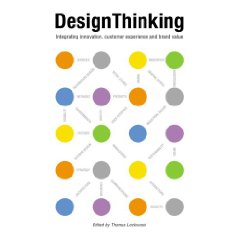 Finally, Thomas Lockwood, President of the Design Management Institute has a book called Design Thinking: Integrating Innovation, Customer Experience, and Brand Value coming out on November 10. It sounds like he is serving as an editor for a bunch of experts writing on the subject. From the preview copy:
Featuring 30 articles, written by industry experts, that show how to build a solid brand foundation, solve problems with simplified thinking, anticipate and capitalize on trends, figure out what consumers want before they do, and align mission, vision, and strategy with a corporate brand, this is a must-have reference for anyone wanting to increase their businesses productivity.
I’ll bring the reviews as soon as the books come out!
Do you have 10,000 hours in yet? The 21st century is waiting…

Baby Mozart sez I got my 10,000 hours of practice in before I was five years old, suckers!
Finally got around to reading Malcolm Gladwell’s new book Outliers. I’m late to the game on this one, so I’ll skip the full review and instead point to some good summaries about the book here, here, and here. I have other fun stuff I want to cover today.
For me, this book was his best yet. Gladwell’s gift is he is an amazing storyteller, and in this book he once again takes semi-boring academic research and makes it deeply relevant and interesting by crafting a beautiful story around it.
Here’s a short synopsis of Outliers. I decided to write it in the form of a limerick. I have no idea why.
Some folks become world-class Outliers,
Achieving success we can’t help but admire,
But smarts and ambition,
Aren’t the only pre-conditions,
Great timing and practice are required.
Basically, Gladwell is saying you can be the smartest guy on Earth and achieve nothing worth mentioning. But incredible, world-class success (think Bill Gates, Mozart, the Beatles) is a mashup of being born at the right time in the right place to the right people with the right genetic makeup while having the right things occur to you at exactly the right times in your life.
Oh, and you need to get in 10,000 hours of practice to become an expert at your craft.
This last concept really got to me. The idea that in order to become an expert in your field, you need to put in 10,000 hours of practice has been covered extensively. In fact there are two other books out describing the research behind this assertion, The Talent Code by Daniel Coyle and Talent is Overrated by Geoff Colvin.
Hearing the Bill Gates and Steve Jobs stories of perfect timing and early practice in Gladwell’s book started me thinking about a few things.
Save us, General Zinni! Teach us corporate folks some 21st century leadership skills
I happened to catch General Tony Zinni on The Daily Show a few weeks ago. This was the first time I’d seen him talk, and I found him to be an incredibly creative, thoughtful man. So this weekend, I sat down and read his recently published leadership book Leading the Charge: Leadership Lessons from the Battlefield to the Boardroom. If you want to learn more about General Zinni’s long list of accomplishments, both inside and outside the military, there is a really good Wikipedia profile of him here.
 In this book, General Zinni describes an introspective, creative, and rapidly changing American military mindset. After reading, I’m convinced the subtitle should have been something like “Lessons from the New Military for a Corporate America Totally Blowing It.”
This book provides a crisp analysis of the failures of the 20th century leadership model still prevalent in most businesses today. It is an indictment of the post-economic-meltdown-state of American business, which he believes was caused in large part by a systemic failure of this traditional leadership model.
Like a true man of action, General Zinni brings his own ideas and experience of leadership methods that work in the high-pressure, high-risk world of the military to the table. He provides a vision for how we can fix what is broken, and shows what the leadership model for the 21st century organization could be.
Charlie Rose interviews Jim Collins on why good companies fail
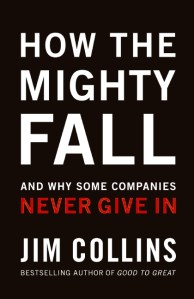 Thanks to my friend Jason for pointing out the great Charlie Rose interview with Jim Collins about his new book How the Mighty Fall and Why Some Companies Never Give In (I wrote a review of the book a while back here). Those of you who have followed this blog for a while know I am a big fan of Jim Collins (I like Charlie Rose a lot too, by the way).
If you aren’t much of a business book reader, take a few minutes and watch this, it’s worth the time investment, and is a pretty good greatest hits compilation of the concepts Collins covers in the book.
Wait, what if dark energy doesn’t matter?
The horror! A few days ago, in a study released in one of my favorite light reading mags, the Proceedings of the National Academy of Sciences, two mathematicians proposed that dark energy might simply be an illusion we observe from our spot in a massive space-time expansion wave. There’s a nice writeup of the research in National Geographic here.
 Does this mean the entire concept of this website, that brand, culture, and community form the dark matter and dark energy of organizations, breaks down too? That all this hippie brand-building, culture-growing, community-creating stuff is also an illusion, and the traditional visible mechanics of business alone are the stuff of which great companies are made?
I know. I know. It rocked my foundation too. Well, as my favorite fortune cookie fortune once told me, “all is not yet lost.” It is just a theory.
And it turns out that for the theory to be true, for the math to work, we must be at the center of the universe, a caveat that one physicist describes as “unusual.” I’d say so. Didn’t Copernicus have something to say about that in, like, 1543?
If you are still concerned and want to learn more, go read the abstract of the report. I’ll give you a taste to whet your appetite:
We derive a system of three coupled equations that implicitly defines a continuous one-parameter family of expanding wave solutions of the Einstein equations, such that the Friedmann universe associated with the pure radiation phase of the Standard Model of Cosmology is embedded as a single point in this family. By approximating solutions near the center to leading order in the Hubble length, the family reduces to an explicit one-parameter family of expanding spacetimes, given in closed form, that represents a perturbation of the Standard Model.
These guys seem pretty smart, and it sounds like we stand to learn a lot from their findings. And what’s good enough for the National Academy of Sciences is good enough for me.
As for our little Dark Matter Matters website, I’m no mathematician, but I see a lot of prominent mathematicians and physicists calling these results controversial. For now, I’m still thinking dark matter and dark energy might matter, people. Carry on.
Brand positioning tip #5: the brand audit
Oh no! An audit? That can’t be good, right?
Actually, if you are a brand manager, a brand audit is an incredibly useful tool (I’m sure the IRS feels the same way about their audits).
What is a brand audit?
There are plenty of people out there who’d be happy to tell you about brand audits (here are a few interesting links). But as you found out in previous brand positioning tips, I’ve learned a lot about brand positioning from Dr. Kevin Keller, author of Strategic Brand Management and professor at Dartmouth (plug: buy the book, great section on brand audits). When we did our most recent brand audit at Red Hat, we used Dr. Keller’s approach.
A brand audit is a deep introspective look at your brand from inside and out. Done the Kevin Keller way, the audit is made up of two pieces: 1) the brand inventory and 2) the brand exploratory.
I think of them this way:
Free and the economics of Woodstock
1) In case you’ve been under a rock for the past week, this weekend marks the 40th anniversary of the original Woodstock Festival. 2) I recently finished reading Chris Anderson’s new book Free (which I covered in a post here). Listening to the Woodstock album again (on LP, I’m totally old skool) and thinking about Woodstock in the context of Free made me remember the announcement that changed the concert completely:
It’s a free concert from now on. That doesn’t mean that anything goes, what that means is we’re going to put the music up here for free. What it means is that the people who’re put — backing this thing, who put up the money for it, are going to take a bit of a bath. A big bath. That’s no hype, that’s true, they’re going to get hurt.
According to the New York Post, the initial budget for the festival was $500,000. The promoters’ goal was to host a three-day concert for about 100,000 people paying 5 bucks each. Although they met the goal of selling 100,000 tickets, the promoters never finished the ticket booths or fences (due to a late change in venue), and the crowd quickly became overwhelming. To avoid making a dangerous situation worse, they made the decision to turn Woodstock into a free concert.
Although great for the spirit of Woodstock, this was a devastating financial decision for the festival organizers. The Telegraph did an interesting interview with the Woodstock promoters where they explained the financial mess this way:
Hey, I Wrote a Book!

Available now in print and electronic versions.
 Dark Matter Matters