Dark Matter Matters
Chris Grams
Does WikiLeaks damage the brand image of wikis?
Over the past few weeks, the world has been consuming the newest set of revelations via WikiLeaks. The uproar caused by the release of the first set of diplomatic cables from a batch of 251,000 in WikiLeaks’ possession is enough to take your breath away.
 A disclaimer: in this post it is not my intention to analyze the positive or negative consequences of the actions of the WikiLeaks organization—there is plenty of that coverage, just check your favorite news reader every five minutes or so to see the latest.
Instead, I want to explore the impact that the WikiLeaks brand name is having/will have on brands closely identifying with the word “wiki”, and analyze whether WikiLeaks will impact the acceptance of collaboration and transparency initiatives within corporations.
My feeling? These are potentially dangerous days for wikis, collaboration, and transparency in the corporate world.
What makes this case particularly interesting is that, according to Wikipedia (of course), as of this month the WikiLeaks website isn’t even based on a wiki anymore.
[Read more of this post on opensource.com]
De-bucketizing the org chart
Over the years, I’ve picked up an unhealthy understanding of the language of business. Years of sitting in big corporate meetings will do that to you, unfortunately.
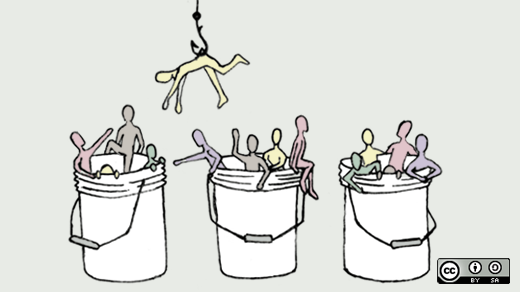 Here at New Kind, my business partners will still call me out for talking about “action items,” saying something is in our “wheelhouse,” or jumping straight to the “net-net.”
But perhaps the business term I love to hate the most is the word bucketize, which I’d translate as “to organize into broad categories.” Common usage might include statements like the following:
“I’m going to bucketize these requirements.”
or
“We’ve bucketized the skillsets we need for this project.”
It’s not just the word that I dislike either, but the entire concept of bucketizing things, which often means taking complex relationships and oversimplifying them in order to fit into broad buckets designed to hold everything except much meaning. Bucketizing often puts things into silos (another favorite business word), destroying valuable connections between ideas, tasks, or people ending up in, well, different buckets.
Perhaps the most egregious example of corporate bucketizing for me is the typical corporate org chart, which looks something like this.

In most organizations, each person sitting at the executive table has their own employee bucket. As an executive, you are often motivated to fill your bucket with as many people as possible, because the more people you have working for you, the more power you control in the organization.
The problem? The org chart is an oversimplified, semi-fictional construct.
It rarely represents an accurate view of the complex web of working relationships found within an organization where people in different buckets communicate and work with each other all of the time. Yet, even though it is mostly fiction, the org chart often creates real power for executives to wield.
[Read the rest of this post on opensource.com]
Avoid the tool trap when building communities
 Over the last few years, I’ve had the opportunity to work with many different organizations attempting to build successful communities inside and outside the open source world.
Many of them quickly fall into something I call the tool trap.
Meaning, they immediately jump into a conversation about what tool or technology they will use to support the community:
“Where are we going to put the wiki?”
“Should we build the website using Drupal?”
“What should we call the mailing list?”
“We should starting playing around with [new technology X].”
This is no huge surprise. Great community-building tools are now available to us that never existed before and it is very hard to resist the urge to start nerding out on new technology.
And tools are important. But tools alone do not create community.
People create community.
[Read the rest of this post on opensource.com]
BetterMeans: a new app for running your organization the open source way
Last week I received a heads up about a new web application launching today from a company called BetterMeans with an impressive goal: to build the infrastructure (processes, technology, governance, etc.) to make an open organizational structure like we talk about here on opensouce.com a reality.
 From their website:
BetterMeans.com is a web platform where people can start and run companies in a new decentralized way.
– Teams self-form, self-organize, and self-manage using an issue-tracking tool
– There is no management class, only natural hierarchies.
– Leadership emerges organically by users earning other users’ confidence
– Compensation is based on contribution
– Strategy and ideas are crowd-sourced
– There’s full accountability and transparency. Relationships are built on trust.
– Ownership is distributed
– Capital allocation and decision-making are decentralizedIf a traditional company was a network architecture, it would be client-server.
We’re building a platform for peer-to-peer companies that are more agile, resilient, and innovative.
The video below explains what they are doing and why.
[Read the rest of this post on opensource.com]
Open innovation and open source innovation: what do they share and where do they differ?
Recently, Stefan Lindegaard, open innovation expert and author of the new book The Open Innovation Revolution, joined opensource.com for a webcast about open innovation.
 Based on the positive feedback from this webcast, we decided to host a conversation between Stefan and regular opensource.com contributor Chris Grams regarding the ways open source and open innovation are different and the things they share.
To learn more about open innovation, visit Stefan’s 15inno blog.
Collaboration & Sharing
CHRIS: In the open source world, we always come back to collaboration and sharing as key principles. These days, many organizations would say they have collaborative cultures (or aspire to, at least), but where the open source way really shines is in its ability to inspire people to collaborate beyond the boundaries of their own organization.
It strikes me that the open innovation world also encourages people to reach beyond the walls of their organization as well, but if I were to point out one key difference, it would be that in the open innovation world, collaboration is clearly transactional or even contractual. You give on the promise of receiving in return.
STEFAN: You are right about this. Big companies engage with open innovation because the combination of their internal resources and the external resources provides more innovation opportunities that they can feed their corporate engines with. They want to increase revenues and profits, and they definitely put this focus first rather than “just” trying to do good things.
[Read the rest of this post on opensource.com]
My newest hobby: hacking management
My first blog post went up today on the Management Innovation Exchange (MIX).
 The MIX is the brainchild of Gary Hamel, author of one of my favorite management books of the last 10 years, The Future of Management, and the guy who the Wall Street Journal ranked as the most influential business thinker in the world.
The thesis of the MIX is that management itself has been a fantastic innovation— the “technology of human accomplishment” to use Hamel’s words. Yet for all management has done to improve the world we live in, it is technology invented over 100 years ago, and old skool management practices are becoming increasingly outdated in the modern world (Gary Hamel explains this all better than I do, watch his short introduction to the MIX below).
The MIX is an open, collaborative effort to reinvent management built around 25 management “moonshots” (see the full list here). In addition to Hamel, there are some amazing folks contributing to the site, including famous visionaries like Terri Kelly of W.L. Gore & Associates and John Mackey of Whole Foods.
But perhaps the most exciting part of the site for me has been to see that it is built as a meritocracy of ideas, where anyone can add a story, a hack, or a barrier. And many do. I’ve seen some amazing ideas as I’ve begun to participate in the MIX over the last few months and can’t wait to point some of them out in my role as a Moonshot Guide.
In particular, I’ll be tackling the moonshot “Enable communities of passion” building on my experiences at Red Hat and here at New Kind as we continue to build a company around the concept of being community catalysts.
So if you have ideas for things you think I should cover, drop me a line, I’d love to hear them.
Apple, Google, and the open vs. closed positioning war
Over the last few months, the battle to define the meaning of the word “open” has intensified into one of the more interesting brand positioning exercises I’ve seen in the technology industry (if you aren’t familiar with brand positioning and would like to learn more, consider starting here).
 I thought I’d do a quick report from the front lines, diving in specifically to examine the battle for smartphone leadership, and looking at things from a brand positioning strategy perspective.
Google Goes on Offense
Think back to 2009 and the state of the smartphone industry. The iPhone had completely redefined the entire market, while Google was just beginning to see traction with Android and looking at a long struggle to catch up with Apple.
While most other smartphone makers were attempting to catch up playing by Apple’s rules in the market Apple defined (usually a losing strategy in the long term when the leader has a solid head start), Google took a different approach—they tried what now looks to me looks like a classic repositioning strategy.
[Read the rest of this post on opensource.com]
A community-building perspective on the Gap logo controversy
Over the last week, a handful of folks have reached out and asked me what I think about the events surrounding the launch, then crowdsourcing, then full repeal of the new Gap logo (if you haven’t already heard the story, catch up here).
 Honestly, I’d been hesitant to comment at length, partially because so many articles were hitting the best angles already (take your pick of this one, this one, this one, this one, or this one for starters), and partly because somewhere inside I secretly wondered whether the geniuses behind the Gap brand are simply playing us as pawns in a New Coke-esque scheme of diabolical marketing genius (on that point, I still don’t think I know the answer).
While most articles have focused on the aesthetics of the logo itself or on issues surrounding crowdsourcing a logo effort (note to self: must… avoid… commenting… on… crowdsourcing… so… tempting), I’ve been wondering more about the strong reaction of the Gap community.
Specifically, why did the community of customers surrounding the Gap brand have such a visceral negative reaction to the logo change? Is it really that bad? The firm in charge of the redesign has a great reputation and deep understanding of the Gap brand. How did a project run by experienced brand professionals working with one of the largest consumer brands in the world go so wrong so quickly?
For me, the answer can be found in a quote I really love from outgoing Mozilla CEO John Lilly:
“Surprise is the opposite of engagement.”
[Read the rest of this post on opensource.com]
Five questions about open innovation, open source, and NASA with Molly Dix of RTI
A few weeks ago, I had the opportunity to meet Molly Dix and Jeff Cope, who run the Open Innovation Advisory Services group at RTI. For those not familiar with RTI, it is one of the world’s preeminent research institutes, founded by a group of scientists in 1958 and now employing almost 3000 people helping businesses and governments in more than 40 countries around the world.
 I thought it was pretty cool to learn that an organization of RTI’s size and position in the research world has a group dedicated to open innovation. I asked Molly if she’d be willing to let me ask her a few questions about the way she and RTI see open innovation.
My questions, and her answers, below.
CHRIS: Open innovation is one of those terms that everyone seems to see a bit differently. How would you define open innovation?
MOLLY: We see open innovation as a perspective whereby an organization is open to building on thinking, research, and intellectual property (IP) from outside their organization, as well as being open to partnerships with outside organizations related to their own research and IP.
Thus, open innovation is a 360-degree mindset that includes both technology pull and push as avenues to improve the speed and quality of research, development, and product launch. Successful partnerships are at the core of successful open innovation.
[Read the rest of this interview on opensource.com]
Evaluating TEDx as a brand strategy
A big part of my day job is to help organizations with their brand positioning and strategy.
 So when I read the article in the New York Times this past Sunday about TEDx, the relatively new (and incredibly popular) offshoot of the legendary TED conference, I thought it might be a good opportunity to take a closer look. The issue?
Clearly TEDx has been a smart community-building strategy, but will it ultimately prove to be a smart brand strategy as well?
Let me take a few steps back. If you are not familiar with TED (seriously? have you been camping in Siberia?) you can learn more here.
The main TED conference is a place where smart people (with big $$ and a personal invite) go once a year to hear other smart people give short talks showcasing how smart they are. The rest of us poor, unconnected folks wait patiently for the nice TED people to release the TED talks one by one, teasing us like a painfully-slowly dripping faucet teases a man dying of thirst.
And that’s the way it worked. Until last year when, in June, TED announced a new program called TEDx that would allow anyone to organize their own TED conference anywhere in the world.
The New York Times article tells the story of what has happened with the TEDx program in a little over a year:
…there were 278 events last year in places as near as New Jersey and Florida, and as far as Estonia and China. There was TEDxKibera, held in one of Africa’s largest shantytowns in Nairobi, Kenya. And there was TEDxNASA, which had space-themed lectures.
Already this year there have been 531 TEDx events. Another nearly 750 are to take place this year and beyond.
Wow. Now that is community-driven innovation on a grand scale. From one event per year with a small number of people attending at a very high cost to almost two TED events per day, held around the world, and almost every event is free. All that in a little over a year.
I’d call that a smashing strategic success. A soon-to-be-classic community engagement story.
But if we look at the decision to create TEDx from a traditional brand or intellectual property point of view, would it also be viewed as a good strategy?
[Read the rest of this post on opensource.com]
Hey, I Wrote a Book!

Available now in print and electronic versions.
 Dark Matter Matters