Dark Matter Matters
open source
Matthew Szulik and the Red Hat vision
The BBC conducted a great interview with Red Hat Chairman Matthew Szulik while he was attending the Ernst & Young World Entrepreneur of the Year awards recently (representing the United States as our winner). You can listen to it here.
This interview is a wonderful reminder of the powerful impact of a corporate vision that extends beyond just making money. And a great reminder for me of how lucky I have been to learn about leadership, community, culture, and brand from the 2008 United States Entrepreneur of the Year.
If you are interested in learning more about Matthew Szulik, his vision, and how it evolved, here is a wonderful oral history of his life that was commissioned a few years ago.
On July 19, 1999, I started at Red Hat
Ten years ago today, I showed up for my first day of work at Red Hat.

A pretty typical view from the Red Hat global HQ circa 1999. this picture appeared in Linux Magazine.
The office was an ugly one-story building in the back of an office park in Durham, NC, a far cry from the monstrous IBM campus I had just left. No longer would I be walking 10 minutes through a parking lot to get to my car, instead we were only a few steps from the front door, which was kind of a big deal for me at the time.
I was 27 years old, and ready to change the world.
At the time, this building was both the only office and the global headquarters for Red Hat, although this would change quickly as we opened offices in Asia and Europe over the next few months. There were about 125 or so people working for the whole company. In the marketing group that I joined, I think there were eight of us, and my first boss was Red Hat employee #1, Lisa Sullivan, who now runs two independent bookstores in Vermont. She had started working for Bob Young in Connecticut, before he joined up with Marc Ewing and moved the company down to North Carolina.
At the time, Marc Ewing and Bob Young still roamed the halls, in fact, Marc sat just a few cubes over from me next to Bascha Harris, who still works with me at Red Hat today. Marc tended to leave his empty drink cans stacked on his desk for weeks, so sometime swarms of fruit flies would descend on my desk after gorging on his leftovers. I’m not sure Marc even knew who I was. To Red Hat folks, I was just another guy coming in from a big company, itching to ruin everything.
The interview process was tough. I distinctly remember being interviewed over the phone by Matthew Szulik. He was Red Hat’s president at the time, and had only been with the company about a year. I still remember him asking me one of his famous interview questions, something like “How will you know if your life has been successful?” I have no idea how I answered that, but I’d really like to hear my answer now.
Washington Monthly on healthcare reform and open source
There’s a powerful cover story in the July/August issue of Washington Monthly entitled Code Red: How software companies could screw up Obama’s health care reform (Thanks to Maria Moore for the link).
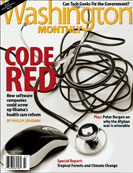 In the article, Phillip Longman describes a few horrifying experiences hospitals have had trying to “go digital” using proprietary software. Here’s a particularly scary quote:
According to a study conducted by [the Children’s Hospital of Pittsburgh] and published in the journal Pediatrics, mortality rates for one vulnerable patient population—those brought by emergency transport from other facilities—more than doubled, from 2.8 percent before the installation to almost 6.6 percent afterward.
In the context of Dark Matter Matters, this story is interesting because it shows how an open source, community-driven effort led by the Veterans Health Administration has been able to not only innovate faster than its proprietary competitors, but also more deeply involve the end customers– the doctors, nurses, and other folks who actually use the software– in development of tools that work in real world situations.
New socialism? Naw, it’s the new individualism.
My friend Jeff Mackanic pointed me to this article from last month’s Wired Magazine where Kevin Kelly makes the assertion that there is a “new socialism” emerging in the form of large-scale collaboration projects online. He discusses contributions to Wikipedia, Flickr, even Red Hat’s own Fedora as examples of village-sized or greater online collective work.
In the context of my recent post regarding what Ayn Rand would think of open source, I think Kevin makes a leap where I might not follow him.The clue is right in the article:
…the leaders of the new socialism are extremely pragmatic. A survey of 2,784 open source developers explored their motivations. The most common was “to learn and develop new skills.” That’s practical. One academic put it this way (paraphrasing): The major reason for working on free stuff is to improve my own damn software. Basically, overt politics is not practical enough.
Where Kevin Kelly reaches the conclusion that contributors working together to “improve [their] own damn software” is a new form of socialism in action, I might take the view instead that this is a new form of individualism.
A form of individualism where people are free to pursue their own self interests, yet do so in such a way that they are still in harmony with those around them. The goal of open source developers is individual pursuit, as the paragraph above from the article makes clear… yet a byproduct of these individual pursuits is a collective good: better software, a better enyclopedia, etc.
If it was socialism, the collective good would be the end goal of everyone. But ultimately, the open source model is based on the individual working for the good of himself in harmony with others, not on being a mindless cog in a much bigger wheel.
But I’m no philosophy expert, what do you think?
What would Ayn Rand think of open source? You can vote!
At the beach over the weekend, I read Anthem by Ayn Rand. Now before you write me off as the kind of guy that would go around telling people he reads Ayn Rand for fun, let me just say in my defense that this is really the first full Ayn Rand book I have read.  And it is only 105 pages long. Having read this, I’d totally read the CliffsNotes for The Fountainhead or Atlas Shrugged (which is like 1200 pages long).
Rand originally titled Anthem as “Ego” and you can definitely tell why. It is about a futuristic world where people are kinda back in the dark ages technologically-speaking, and live in a collective where people have numbers rather than names, are assigned jobs for life, and have forgotten the word “I” (yes, totally annoying… in the first ten chapters, the main character uses the royal “we” to refer to himself).
It seems like Ayn Rand has been back in the news lately, and I’ve seen her name bandied about in political arguments quite a bit, especially regarding healthcare reform. So it made me think, if Ayn Rand’s core philosophy was about maintaining the supremacy of the individual, what she calls “rational self-interest,” and she rejected the idea that the collective good should be put before the good of the individual, what would she think about the open source movement?
After all, I used to remember seeing stories with proprietary companies referring to open source as socialism all the time, although it doesn’t seem to happen as much these days. More and more of the biggest companies are embracing open source software and the concept of open source is more mainstream than ever.
So surely Ayn Rand would hate open source, right? Not so fast. Here are two good reasons why Ayn Rand might totally dig open source:
Summer reading list for Dark Matter Matters
Ah, vacation… the time when the work shuts down for a few days and the Dark Matter Matters blog comes out of hibernation… 3 posts in 3 days!

A few months ago I wrote a post where I highlighted the top ten books behind Dark Matter Matters. In that post I promised to create a list of the books that didn’t make the top 10 cut, but are still pretty awesome.
So here, to celebrate the long holiday weekend, are some more books that have inspired Dark Matter Matters.
Books about how large-scale collaboration is pretty much the deal:
Wikinomics by Don Tapscott and Anthony Williams
The Wisdom of Crowds by James Surowiecki
The Starfish and the Spider by Ori Braffman and Rod Beckstrom
In the open source world, there’s a legendary quote attributed to Linus Torvalds (yes, he is the guy that Linux is named after) “Given enough eyeballs, all bugs are shallow.” The first two of these books are the extended dance remix of this quote. Each has a unique take, but both show how mass collaboration is changing everything about our society and the way we solve problems. The Starfish and the Spider is a interesting look at leaderless organizations and is a nice book for anyone trying to understand how the open source movement (and other leaderless organizations) work, and why open source is so hard to compete against. It is also a nice complement to the Mintzberg article I wrote about in my previous post.
Rebuilding companies as communities

The brilliant Henry Mintzberg. I've got to meet this guy some day.
Holy smokes, Henry Mintzberg is at it again! The guy who predicted the economic collapse in 2006 (why is he not more famous, I don’t get it?) has an article in the July/August issue of the Harvard Business Review suggesting that the cultural framework of the corporation is completely broken.
And, according to Mintzberg, the way to fix it is not by thinking like a corporation, but instead by thinking like a community. From the article:
Beneath the current economic crisis lies another crisis of far greater proportions: the depreciation in companies of community– people’s sense of belonging to and caring for something larger than themselves. Decades of short-term management, in the United States especially, have inflated the importance of CEOs and reduced others in the corporation to fungible commodities…
And it’s is a two way street… When a corporation treats its employees like simple assets to be hired and fired as the share price rises or falls, the employees treat the corporation like… a corporation.
The end result? Disengaged employees who don’t care about the business, and the business (and the shareholders) suffer for it. So for heaven’s sake, Henry, tell us how to fix it!
Red Hat brand/culture link featured on brandchannel.com
There’s a nice article out today on brandchannel.com called Build Your Brand from the Inside Out, interviewing me and Ashley Stockwell from Virgin Media on the role of employees in building a brand. Even Dark Matter Matters gets a plug. Thanks Morgan!
Folks, we have transparency and it’s at data.gov
There was a short article in the New York Times the other day about a quietly launched new government website called data.gov. The purpose of the site is to collect the amazing wealth of information created in the agencies of the US government in one place and make it freely accessible to anyone.
 We open source-minded folks think that is just swell. In fact, this subject has been of interest to me for a long time. When I was right out of college and working for the literary agent Rafe Sagalyn, we actually wrote two books intended to help people find the great information the government was putting together for us, but not doing a good job actually getting to us.
The first was a book called Uncle Sam’s Guide to the Great Outdoors, which told you how and where to write or call the government to get information sent to you before you planned a trip into the American wilderness: national parks, forest, wildlife preserves, and whatnot.
It was all great until this dumb Internet thing came along and made it easy for people to access this sort of information online. Now that book is a relic of a bygone era of phone calls and manila envelopes.
But actual government datasets… that’s a much more complicated issue. Until now, it’s been very hard to get broad, searchable access to these datasets without advanced knowledge or tools. And they’ve certainly never been in one place and one standard format before. Data.gov is just a start, but I love the philosophy of the site so much I’m including it here:
The top 10 books behind Dark Matter Matters
Books are important to me. Growing up, almost every free wall in my parents’ house was lined with bookshelves, some of them stacked two deep. I spent most of my pre- Red Hat career in book publishing, first working during college at The University of North Carolina Press. After college, I went to work for a literary agent named Rafe Sagalyn in Washington DC. Working for Rafe was a great experience because he built his reputation on big think/idea books and business books.
His first big book was the huge bestseller Megatrends by John Naisbitt back in the early 80s. When I was there, I personally got to work with, among others, Bill Strauss and Neil Howe on their great books about generational patterns in society (check out The Fourth Turning… very prophetic these days) and Don Peppers, author of some books back in the 90s like The 1:1 Future about relationship marketing that were the grandparents of today’s books on social media marketing.
I also got to play agent and author myself too. As an agent, I represented some of Tom Bodett’s work (yes, he is the Motel 6 guy, but was also a commentator on NPR) and sold a wonderful novel called The Frequency of Souls to FSG. As author, I helped Rafe write two “cutting edge” books about getting free and open access to government information (they have not aged well, I’m afraid).
Fast forwarding to today, Rafe actually was the agent for two recent big think books that I love, Authenticity and A Whole New Mind, so he is still making things happen.
After I left book publishing, reading became fun again. I read novels and travel literature for a while, nothing that made me think too much. But when I got to Red Hat, I relapsed and started reading the big think books like the ones I used to work on with Rafe. I thought it might be worth taking a few minutes to try to remember the books that have been the biggest influences on my thinking, and get them all down in one place, so here goes:
Top 10 Dark Matter Matters books
Without these ten books, Dark Matter might not even matter to me.
Hey, I Wrote a Book!

Available now in print and electronic versions.
 Dark Matter Matters