Dark Matter Matters
innovation
Howard Schultz of Starbucks: The role of culture in a crisis
This week I was lucky enough to attend the Ernst & Young Strategic Growth Forum in Palm Desert, CA. As you may recall, last year Red Hat Chairman Matthew Szulik was the national Ernst & Young Entrepreneur of the Year, and later this week, he’ll hand over his title to the next entrepreneur in waiting. One of the most exciting things about the Strategic Growth Forum is that it brings together some of the smartest entrepreneurial minds in the world in one place, and this morning, I had an opportunity to hear from one of the best.

Howard Schultz: Chairmain, CEO, and President of Starbucks
Howard Schultz, Chairman, President, and CEO of Starbucks, who won an Entrepreneur of the Year award in 1993, spoke about his experience leading Starbucks through the economic crisis. As Starbucks began going through hard times, Schultz, who had given up the CEO role in 2001 (while remaining Chariman), decided it was time to take back the CEO responsibilities himself in early 2008.
Why? He was worried that the distinct culture, mission, and values that had brought the company great success were eroding.
According to Schultz, he came back into an operational role because he felt that the way out of crisis was not a simple change in business strategy, but instead– in his words– “love and nurturing.” His key to turning things around was revitalizing the investment in his people, recommitting to the core purpose of the organization and providing employees with hope and inspiration.
He says the transformation of Starbucks since this revitalization has been key to a tremendous amount of new innovation happening inside the company. People have even commented to him that it reminds them of what the early days at Starbucks must have been like.
Schultz took 10,000 of his best people and brought them together in New Orleans in late 2008 for a leadership conference where they spent 50,000 volunteer hours helping communities re-build after Hurricane Katrina. Below is a documentary that was filmed about this event.
Love, hate, and memo-list
Top management experts are now acknowledging the importance of creating forums and contexts inside corporations that allow peer review, transparency, and powerful natural hierarchies to flourish. Here’s one great post by Gary Hamel from earlier this year that Iain Gray pointed out today. We’ve had an open forum exactly like this at Red Hat for a very long time. We call it memo-list.

The Greek agora at Tyre. It used to be a popular gathering place back in the day.
When any new employee comes into Red Hat, memo-list is one of the first great shocks to the system. Memo-list itself is not some technological marvel of a collaboration tool– it is just a simple, old skool mailing list where any Red Hat employee can post an email message that goes out to virtually every employee in the company. That’s 3000+ folks.
Memo-list has been a hot issue inside the walls of Red Hat since before I joined ten years ago. Folks tend to either love it or hate it.
Some people are shocked by the fact that any employee can publicly challenge a post by an executive or even the CEO in an email to memo-list (and they do). Some people are annoyed by the discussions that appear over and over, year after year. Some people view it as idle chitchat and a waste of time.
But some people view it as the backbone of the Red Hat culture. A place where the power of meritocracy is nurtured. Where the employees force transparency, openness, and accountability. Where peer review makes for better ideas (after all, given enough eyes, all bugs are shallow).
I love memo-list, warts and all (I think Gary Hamel would like it too). In my view, it is the single most important thing that differentiates the Red Hat culture from most other corporate cultures.
John Seely Brown’s secret formula for an innovation culture
I spent today at the Coach K Leadership Conference at Duke University (Red Hat CEO Jim Whitehurst will be speaking there tomorrow morning). One of today’s highlights was a panel called “Leading the Creative Enterprise” featuring John Seely Brown (the former director of the famous innovation hub at Xerox PARC).
I always love it when really smart people boil down the world into a simple 2×2 matrix, and during his comments, JSB put a chart up on the screen that looked something like this:
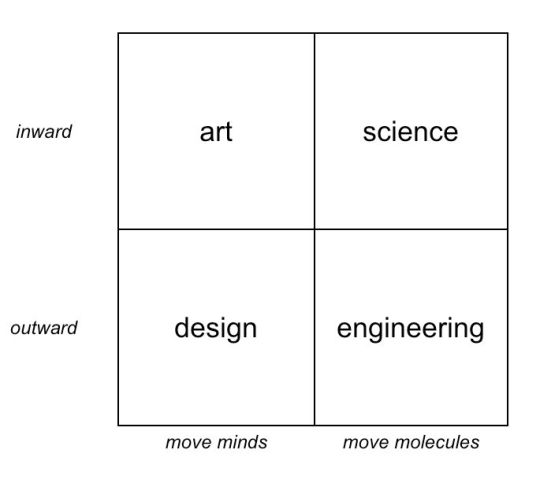 To create a culture that will be successful at innovating, JSB says you must have four types of people: artists, scientists, designers, and engineers working together; each group must be represented.
Two of the groups (the artists and the scientists) get their energy from the way they internally process their own ideas, while the other two groups (designers and engineers) get their energy by thinking about how those ideas are brought to the outside world.
Looking at the matrix the other way, artists and designers share a common cause of trying to move people’s minds while scientists and engineers are firmly grounded in the world of actually making stuff work beyond the idea itself.
I’ve certainly seen these roles all represented in projects at Red Hat that have resulted in great innovations (the group that worked on the Red Hat values years ago comes to mind). And I’ve also been a part of projects that failed because at least one perspective was missing.
What do you think? Does this matrix work for you?
Tom Sawyer Part 2: where can your company pitch in?
A few weeks ago I wrote a post called Tom Sawyer, whitewashing fences, and building communities online, where I outlined one of the biggest mistakes I see companies make when figuring out their community strategy– they expect a mythical “community” will paint their fence for them. But not everyone is Tom Sawyer.
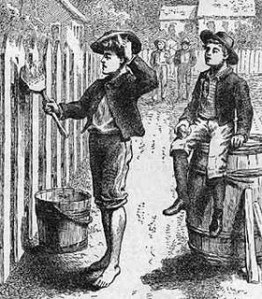 If your community strategy starts with the question, “how can I make the community work for me?” you may still find success if there are a bunch of people out there willing to paint your fence for free, but you definitely are not taking advantage of all of the benefits you can get from participating in communities.
One of the most often used examples of customer/community-driven innovation (perhaps because it is simple to understand) is the My Starbucks Idea site. This is a place where customers can tell Starbucks what they want, people vote on each others’ ideas, and Starbucks takes the best ideas and uses them to make their products, services, and experience better.
A recent example of a service that was launched through the site is a mini Starbucks drink card that can fit on your key chain. Sweet. It looks like they’ve had at least 5-10 innovations like this that have come from customer ideas, maybe more. And Starbucks is not alone– many companies have built similar sites, as has The White House. You’ve seen them.
But this approach is still simple Tom Sawyer-style community-building. People just helping Starbucks paint their fence for free. So why is it working for Starbucks? Because there are people out there willing to spend their time and energy helping Starbucks make their products, services, and experience better. Not every brand can command this sort of attention and loyalty. Most can’t, in fact.
My view? I do think these sort of public idea generation efforts are smart 21st century thinking when they work. But why stop there?
I get excited when I see big companies focused not only on what they take from the table, but what they bring to the table. I love to see companies that aren’t afraid to be humble members of communities, rather than building the community around themselves.
Gary Hamel: Open Source is one of the greatest management innovations of the 21st century
My colleague John Adams, reporting from the World Business Forum in New York, wrote on Twitter yesterday that during his speech, management guru Gary Hamel called open source one of the greatest management innovations of the 21st century (coverage of Gary’s speech here and here).

Management guru Gary Hamel
I love it. Gary Hamel is a hero of mine, and many consider him one of the greatest business minds on the planet. I’ve written about him, well, too much (start here, here, and here), and I follow him via his website, his non-profit called MLab, and his Wall Street Journal blog.
I knew Gary was familiar with open source after reading his book The Future of Management (one of the top ten books behind Dark Matter Matters). He spends five pages (205-210 in the hardcover) discussing open source and at one point says the following:
The success of the open source software movement is the single most dramatic example of how an opt-in engagement model can mobilize human effort on a grand scale… It’s little wonder that the success of open source has left a lot of senior executives slack-jawed. After all, it’s tough for managers to understand a production process that doesn’t rely on managers.
Here’s his analysis of why the model works so well:
Rebuilding companies as communities

The brilliant Henry Mintzberg. I've got to meet this guy some day.
Holy smokes, Henry Mintzberg is at it again! The guy who predicted the economic collapse in 2006 (why is he not more famous, I don’t get it?) has an article in the July/August issue of the Harvard Business Review suggesting that the cultural framework of the corporation is completely broken.
And, according to Mintzberg, the way to fix it is not by thinking like a corporation, but instead by thinking like a community. From the article:
Beneath the current economic crisis lies another crisis of far greater proportions: the depreciation in companies of community– people’s sense of belonging to and caring for something larger than themselves. Decades of short-term management, in the United States especially, have inflated the importance of CEOs and reduced others in the corporation to fungible commodities…
And it’s is a two way street… When a corporation treats its employees like simple assets to be hired and fired as the share price rises or falls, the employees treat the corporation like… a corporation.
The end result? Disengaged employees who don’t care about the business, and the business (and the shareholders) suffer for it. So for heaven’s sake, Henry, tell us how to fix it!
The role of film at Red Hat
Yesterday, Red Hat launched a new series of short films called Red Hat Stories. These films are a key element in our effort to document “the Red Hat way” of doing things. We’ve started with sixteen films covering everything from an overview of what makes Red Hat useful, to our technology leadership, even a set about our perspective on how to liberate innovation. The piece below is a short, sweet distillation of the Red Hat way, and it speaks for itself.
I use the word “film” rather than video on purpose because it better captures the spirit of what we are trying to do with digital media at Red Hat. Films are what you make when you are captuing stories. Videos are what you make when you are selling your stuff. So we aspire to film, certainly with our most strategic work, but sometimes settle for video when the project demands it.
Red Hat’s first attempt at using film as a medium for storytelling was Truth Happens, which we created almost seven years ago. I’ve told that story in an earlier blog post. Since Truth Happens, we’ve expanded our efforts to use film, video, and other digital media tools in many ways.
Folks, we have transparency and it’s at data.gov
There was a short article in the New York Times the other day about a quietly launched new government website called data.gov. The purpose of the site is to collect the amazing wealth of information created in the agencies of the US government in one place and make it freely accessible to anyone.
 We open source-minded folks think that is just swell. In fact, this subject has been of interest to me for a long time. When I was right out of college and working for the literary agent Rafe Sagalyn, we actually wrote two books intended to help people find the great information the government was putting together for us, but not doing a good job actually getting to us.
The first was a book called Uncle Sam’s Guide to the Great Outdoors, which told you how and where to write or call the government to get information sent to you before you planned a trip into the American wilderness: national parks, forest, wildlife preserves, and whatnot.
It was all great until this dumb Internet thing came along and made it easy for people to access this sort of information online. Now that book is a relic of a bygone era of phone calls and manila envelopes.
But actual government datasets… that’s a much more complicated issue. Until now, it’s been very hard to get broad, searchable access to these datasets without advanced knowledge or tools. And they’ve certainly never been in one place and one standard format before. Data.gov is just a start, but I love the philosophy of the site so much I’m including it here:
The top 10 books behind Dark Matter Matters
Books are important to me. Growing up, almost every free wall in my parents’ house was lined with bookshelves, some of them stacked two deep. I spent most of my pre- Red Hat career in book publishing, first working during college at The University of North Carolina Press. After college, I went to work for a literary agent named Rafe Sagalyn in Washington DC. Working for Rafe was a great experience because he built his reputation on big think/idea books and business books.
His first big book was the huge bestseller Megatrends by John Naisbitt back in the early 80s. When I was there, I personally got to work with, among others, Bill Strauss and Neil Howe on their great books about generational patterns in society (check out The Fourth Turning… very prophetic these days) and Don Peppers, author of some books back in the 90s like The 1:1 Future about relationship marketing that were the grandparents of today’s books on social media marketing.
I also got to play agent and author myself too. As an agent, I represented some of Tom Bodett’s work (yes, he is the Motel 6 guy, but was also a commentator on NPR) and sold a wonderful novel called The Frequency of Souls to FSG. As author, I helped Rafe write two “cutting edge” books about getting free and open access to government information (they have not aged well, I’m afraid).
Fast forwarding to today, Rafe actually was the agent for two recent big think books that I love, Authenticity and A Whole New Mind, so he is still making things happen.
After I left book publishing, reading became fun again. I read novels and travel literature for a while, nothing that made me think too much. But when I got to Red Hat, I relapsed and started reading the big think books like the ones I used to work on with Rafe. I thought it might be worth taking a few minutes to try to remember the books that have been the biggest influences on my thinking, and get them all down in one place, so here goes:
Top 10 Dark Matter Matters books
Without these ten books, Dark Matter might not even matter to me.
Customer-driven innovation in the White House?
This week, the White House is holding a two day experiment at www.whitehouse.gov where Americans can ask Barack Obama any question they have regarding the economy. People can enter their own questions or vote on the questions of others. Later this week, Obama will address many of the most popular questions in a national town hall meeting.

In the video on the site, Barack Obama says:
One of my goals as president is opening up the White House to the American people so that folks can understand what we’re up to and have a chance to participate themselves.
In the open source world, we often talk about the idea of user or customer-driven innovation. We make the process of creating open source software transparent and collaborative. Customers can easily contribute their ideas, and we both share in the value that is created– we make better software faster, our customers get better, more relevant software faster. Everybody wins.
How cool is it to see the same principle applied to government? By opening the feedback loop to us regular Americans– the “customers” of our government– might we be able to create a better government faster? Could the old open source adage, “Given enough eyes, all bugs are shallow” apply to governing the American people as well?
As of when I wrote this post, about 40,000 people had voted 1.5 million times times on over 40,000 questions. The site is open through Thursday morning at 9.30 AM, so go ask your questions and vote!
One note… the people from the “Legalize it!” lobby and the “show us your birth certificate” lobby both found this site before you… But don’t worry, in the meritocracy of whitehouse.gov, the best ideas seem to still be winning:)
Hey, I Wrote a Book!

Available now in print and electronic versions.
 Dark Matter Matters