Dark Matter Matters
community
Folks, we have transparency and it’s at data.gov
There was a short article in the New York Times the other day about a quietly launched new government website called data.gov. The purpose of the site is to collect the amazing wealth of information created in the agencies of the US government in one place and make it freely accessible to anyone.
 We open source-minded folks think that is just swell. In fact, this subject has been of interest to me for a long time. When I was right out of college and working for the literary agent Rafe Sagalyn, we actually wrote two books intended to help people find the great information the government was putting together for us, but not doing a good job actually getting to us.
The first was a book called Uncle Sam’s Guide to the Great Outdoors, which told you how and where to write or call the government to get information sent to you before you planned a trip into the American wilderness: national parks, forest, wildlife preserves, and whatnot.
It was all great until this dumb Internet thing came along and made it easy for people to access this sort of information online. Now that book is a relic of a bygone era of phone calls and manila envelopes.
But actual government datasets… that’s a much more complicated issue. Until now, it’s been very hard to get broad, searchable access to these datasets without advanced knowledge or tools. And they’ve certainly never been in one place and one standard format before. Data.gov is just a start, but I love the philosophy of the site so much I’m including it here:
The top 10 books behind Dark Matter Matters
Books are important to me. Growing up, almost every free wall in my parents’ house was lined with bookshelves, some of them stacked two deep. I spent most of my pre- Red Hat career in book publishing, first working during college at The University of North Carolina Press. After college, I went to work for a literary agent named Rafe Sagalyn in Washington DC. Working for Rafe was a great experience because he built his reputation on big think/idea books and business books.
His first big book was the huge bestseller Megatrends by John Naisbitt back in the early 80s. When I was there, I personally got to work with, among others, Bill Strauss and Neil Howe on their great books about generational patterns in society (check out The Fourth Turning… very prophetic these days) and Don Peppers, author of some books back in the 90s like The 1:1 Future about relationship marketing that were the grandparents of today’s books on social media marketing.
I also got to play agent and author myself too. As an agent, I represented some of Tom Bodett’s work (yes, he is the Motel 6 guy, but was also a commentator on NPR) and sold a wonderful novel called The Frequency of Souls to FSG. As author, I helped Rafe write two “cutting edge” books about getting free and open access to government information (they have not aged well, I’m afraid).
Fast forwarding to today, Rafe actually was the agent for two recent big think books that I love, Authenticity and A Whole New Mind, so he is still making things happen.
After I left book publishing, reading became fun again. I read novels and travel literature for a while, nothing that made me think too much. But when I got to Red Hat, I relapsed and started reading the big think books like the ones I used to work on with Rafe. I thought it might be worth taking a few minutes to try to remember the books that have been the biggest influences on my thinking, and get them all down in one place, so here goes:
Top 10 Dark Matter Matters books
Without these ten books, Dark Matter might not even matter to me.
Customer-driven innovation in the White House?
This week, the White House is holding a two day experiment at www.whitehouse.gov where Americans can ask Barack Obama any question they have regarding the economy. People can enter their own questions or vote on the questions of others. Later this week, Obama will address many of the most popular questions in a national town hall meeting.

In the video on the site, Barack Obama says:
One of my goals as president is opening up the White House to the American people so that folks can understand what we’re up to and have a chance to participate themselves.
In the open source world, we often talk about the idea of user or customer-driven innovation. We make the process of creating open source software transparent and collaborative. Customers can easily contribute their ideas, and we both share in the value that is created– we make better software faster, our customers get better, more relevant software faster. Everybody wins.
How cool is it to see the same principle applied to government? By opening the feedback loop to us regular Americans– the “customers” of our government– might we be able to create a better government faster? Could the old open source adage, “Given enough eyes, all bugs are shallow” apply to governing the American people as well?
As of when I wrote this post, about 40,000 people had voted 1.5 million times times on over 40,000 questions. The site is open through Thursday morning at 9.30 AM, so go ask your questions and vote!
One note… the people from the “Legalize it!” lobby and the “show us your birth certificate” lobby both found this site before you… But don’t worry, in the meritocracy of whitehouse.gov, the best ideas seem to still be winning:)
Conversational Capital: I’m totally not wearing any pants
On a recommendation from Michael Tiemann, I got the book Conversational Capital: How to Create Stuff People Love to Talk About by the folks at Sid Lee, who have done work for brands like Cirque du Soleil, Adidas, and Red Bull.
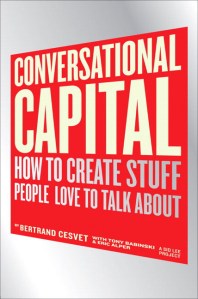 Michael had sent a note at Red Hat a few months back where he said this book helped him understand the “x-factors” that had allowed Red Hat to create a strong brand position at such a small, young company. Thought I should check it out.
In case you were wondering, that headline above is an example of Relevant Sensory Oddity, one of the topics they cover in the book. I thought I’d try it and see if it works:) I actually am wearing pants. Today.
The main thesis of Conversational Capital is that there is a more powerful way to get consumers engaged with your brand by “making your story part of their story,” creating stories or experiences that are meaningful to them. The authors turn their noses up at “buzz marketing,” equating it to style over substance, with no depth or continuity, all sizzle and no steak.
Fedora, Red Hat, and open brands
A Twitter friend asked me the other day if I had been doing any more thinking about open brands. Turns out I have. Two weeks ago, she and I had a conversation where we discussed how Red Hat had opened up the Fedora brand and the positives (tons!) and negatives (some) of doing so.
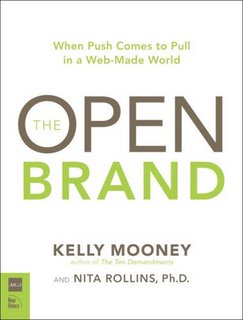 This week, on an plane ride up to Boston, I read the book The Open Brand by Kelly Mooney, which another friend had handed to me a while back.
The book is a eulogy for brands that are not willing to open themselves up, and an instruction manual for those that are considering becoming more open.
It was particularly interesting to read as a Red Hat guy, because the book is based on the idea that today’s single most powerful technology is “a mashup of the World Wide Web and the open source movement.”
The book opens with the question… “are you dangerously CLOSED?”
Whew… passed that one. But the book did make me think some about where the Red Hat brands fall on the spectrum of closed to open.
David Burney in BusinessWeek, Obama the first design thinking president?
David Burney’s blog post about Obama being the first “design thinking” president just got picked up by Bruce Nussbaum of BusinessWeek. Nussbaum is another one of those guys who gets it– he’s been writing about design thinking and innovation in business for quite some time.
Read the full text of Nussbaum’s article, entitled President Obama Goes Optimistic: Obama Is The Design President.
David Burney’s New Kind of gig
My good friend, former boss, and Swingin’ Johnsons bandmate, David Burney, has revealed his new venture, a company called New Kind. He’s partnering with Matt Munoz, an extremely talented designer who created the original Fedora logo (an interesting open, collaborative process to be discussed in another blog) among other things.
Both David and Matt come from graphic design backgrounds, but their firm intends to explore the role of design in business from a “new kind” of perspective. According to their website:
New Kind helps organizations solve complex problems and build competitive brands. We do so by combining the problem-solving principles of design thinking with the collaborative power of open source. We help our clients create authentic customer communities, build and nurture innovative cultures and tell meaningful, memorable stories through the most relevant media choices.
David is actively blogging on some interesting stuff, including Barack Obama and MBAs, Gary Hamel, and orange juice. Do it. Click on the orange juice link. You know you want to.
Fedora fails… and that’s a good thing!
Great post by Red Hat’s Karsten Wade on the role of failure in Fedora (and in life). One of the key tenets of both the open source and design thinking movements is the  idea of “failing fast.” To innovate, we need to overcome the fear of failure, and learn how, as Karsten notes, failure is a sign that we have pushed things to their limits. Because that’s where you have to be if you want to innovate:)
One of the gurus of the failing fast mentality is David Kelley of IDEO— the guy who started the Stanford “d-school” and a leader of the design thinking movement. Here’s a Fast Company article from a couple of years ago where he talks some more about how to suceed by failing fast.
Matt Asay on the Red Hat Mission
Matt Asay just posted about Red Hat’s new mission, which he discovered on a visit to our Westford office in one of our “bathroom briefings” (important aside: we post some internal company news right front and center in the bathroom… if you want people to read something, post it in the bathroom– not everyone reads mailing lists, but everyone pees! Remember, internal communications is a strategic role at Red Hat!).
It’s not a secret, so I don’t mind that he saw the mission or posted about it. In fact, we are pretty happy with the transparent process we employed to get it done. Those of you who have read some previous posts know how strongly I feel about having the entire company aligned on mission and vision and values– the core stuff.
People who get it #2: Marty Neumeier
I ordered 3 copies of Marty Neumeier’s new book, The Designful Company, yesterday for the team. Will let you know what I think once I’ve had a chance to read it. His two previous books, The Brand Gap and Zag, both had a profound influence on the Red Hat  overall brand strategy. I especially love The Brand Gap, which David Burney first introduced to me in 2005.
I’ve probably bought 20-30 copies of The Brand Gap over the last few years, try to keep a few at my desk to hand out to any potential brand converts I meet (why do I never get the copies back?). What’s beautiful about this book is the design and content are one–the message of the book is communicated by its design and its content together. And it is short– any busy executive can read it on a plane up to NYC.
In addition to helping us articulate the overall organizational design of the Brand Communications + Design group within Red Hat, this book has given us many other good ideas to chew on over the years. Probably the most famous quote from the book is:
A brand is not what YOU say it is, it’s what THEY say it is.
which many other people have glommed onto over the last couple of years (including me).
Even if you don’t have time to check out Marty’s books, go check out his great (and beautiful) presentation that explains many of the key concepts of his thinking here.
Hey, I Wrote a Book!

Available now in print and electronic versions.
 Dark Matter Matters