Dark Matter Matters
community
Is your brand out of control?
I’m lucky enough to have the opportunity to spend much of my time these days doing something I love—helping clients position and manage their brands. My experience helping build the Red Hat brand over ten years had a profound impact on the approach I take to brand positioning.
 In the past year, as I’ve applied open source principles I learned at Red Hat to brand positioning projects in many different types of organizations, I’ve started thinking a mashup of classic brand positioning concepts and tenets of the open source way might help provide some clues for how brands might be better managed in the future.
I’ve put my time where my mouth is, and am currently in the process of writing a book entitled The Ad-free Brand: Secrets to Successful Brand Positioning in a Digital World, which will be published this fall.
Rather than writing the book behind closed doors and only revealing the finished product, I thought I’d share some of my ideas with you along the way, taking a cue from the open source way and releasing early and often.
Today, I’d like to explore the traditional role of brand positioning, and share some ideas for how I believe it might change to remain relevant in a digital world.
Audience or Community?
Typical marketing experts would define positioning as the art of creating meaning for a brand that occupies a distinct, valued place in the minds of members of a target audience.
But is the idea of an audience for brand messages outdated? Certainly in the heyday of traditional advertising, brands had an audience. The brands spoke, consumers listened… or didn’t.
Are you an expert in building communities? Prove it.
Over the past few months, I’ve started moonlighting as a contributor on the Management Innovation Exchange (MIX), which we’ve featured regularly on opensource.com. My posts on the MIX focus on how to enable communities of passion in and around organizations.
 A few months ago, the MIX announced a new contest, the Human Capital M-Prize, which is looking for the best ideas on how to unleash passion in our organizations.
Since this particular challenge is right in my stomping ground on the MIX, and because many people who regularly read and contribute to opensource.com probably know better how to enable communities of passion than almost anyone else in the world, I thought I should highlight the contest in the hopes that some of you might enter.
Details? From the MIX website:
The MIX and HCI are looking for the boldest thinking, most powerfully-developed vision, and the most cleverly-designed experiments for unleashing passion in our organizations. What is your bold new idea or radical solution to the lack of engagement and passion in our workforce? What game-changing story or hack can transform employees everywhere into more engaged, motivated and productive contributors?
If you have a story or hack you think might fit, go here to learn more or enter the contest.
The deadline for entries is January 20th—only about two weeks away.
The grand prize winner will get a chance to present their story or hack to a global audience at the HCI Human Capital Summit in Atlanta in March, and there are other interesting prizes as well. So if this sounds compelling to you, get on over to the MIX and submit your entry.
Make our community of passion at opensource.com proud and let’s show these future-of-management-types that we open source folks know a thing or two about building community.
Avoid the tool trap when building communities
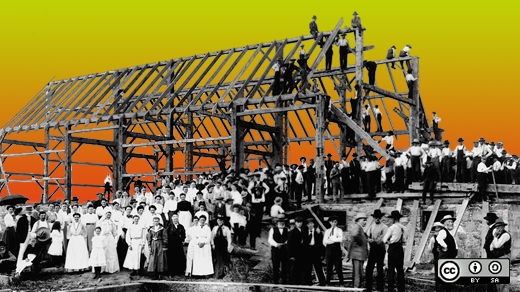 Over the last few years, I’ve had the opportunity to work with many different organizations attempting to build successful communities inside and outside the open source world.
Many of them quickly fall into something I call the tool trap.
Meaning, they immediately jump into a conversation about what tool or technology they will use to support the community:
“Where are we going to put the wiki?”
“Should we build the website using Drupal?”
“What should we call the mailing list?”
“We should starting playing around with [new technology X].”
This is no huge surprise. Great community-building tools are now available to us that never existed before and it is very hard to resist the urge to start nerding out on new technology.
And tools are important. But tools alone do not create community.
People create community.
[Read the rest of this post on opensource.com]
Open innovation and open source innovation: what do they share and where do they differ?
Recently, Stefan Lindegaard, open innovation expert and author of the new book The Open Innovation Revolution, joined opensource.com for a webcast about open innovation.
 Based on the positive feedback from this webcast, we decided to host a conversation between Stefan and regular opensource.com contributor Chris Grams regarding the ways open source and open innovation are different and the things they share.
To learn more about open innovation, visit Stefan’s 15inno blog.
Collaboration & Sharing
CHRIS: In the open source world, we always come back to collaboration and sharing as key principles. These days, many organizations would say they have collaborative cultures (or aspire to, at least), but where the open source way really shines is in its ability to inspire people to collaborate beyond the boundaries of their own organization.
It strikes me that the open innovation world also encourages people to reach beyond the walls of their organization as well, but if I were to point out one key difference, it would be that in the open innovation world, collaboration is clearly transactional or even contractual. You give on the promise of receiving in return.
STEFAN: You are right about this. Big companies engage with open innovation because the combination of their internal resources and the external resources provides more innovation opportunities that they can feed their corporate engines with. They want to increase revenues and profits, and they definitely put this focus first rather than “just” trying to do good things.
[Read the rest of this post on opensource.com]
My newest hobby: hacking management
My first blog post went up today on the Management Innovation Exchange (MIX).
 The MIX is the brainchild of Gary Hamel, author of one of my favorite management books of the last 10 years, The Future of Management, and the guy who the Wall Street Journal ranked as the most influential business thinker in the world.
The thesis of the MIX is that management itself has been a fantastic innovation— the “technology of human accomplishment” to use Hamel’s words. Yet for all management has done to improve the world we live in, it is technology invented over 100 years ago, and old skool management practices are becoming increasingly outdated in the modern world (Gary Hamel explains this all better than I do, watch his short introduction to the MIX below).
The MIX is an open, collaborative effort to reinvent management built around 25 management “moonshots” (see the full list here). In addition to Hamel, there are some amazing folks contributing to the site, including famous visionaries like Terri Kelly of W.L. Gore & Associates and John Mackey of Whole Foods.
But perhaps the most exciting part of the site for me has been to see that it is built as a meritocracy of ideas, where anyone can add a story, a hack, or a barrier. And many do. I’ve seen some amazing ideas as I’ve begun to participate in the MIX over the last few months and can’t wait to point some of them out in my role as a Moonshot Guide.
In particular, I’ll be tackling the moonshot “Enable communities of passion” building on my experiences at Red Hat and here at New Kind as we continue to build a company around the concept of being community catalysts.
So if you have ideas for things you think I should cover, drop me a line, I’d love to hear them.
A community-building perspective on the Gap logo controversy
Over the last week, a handful of folks have reached out and asked me what I think about the events surrounding the launch, then crowdsourcing, then full repeal of the new Gap logo (if you haven’t already heard the story, catch up here).
 Honestly, I’d been hesitant to comment at length, partially because so many articles were hitting the best angles already (take your pick of this one, this one, this one, this one, or this one for starters), and partly because somewhere inside I secretly wondered whether the geniuses behind the Gap brand are simply playing us as pawns in a New Coke-esque scheme of diabolical marketing genius (on that point, I still don’t think I know the answer).
While most articles have focused on the aesthetics of the logo itself or on issues surrounding crowdsourcing a logo effort (note to self: must… avoid… commenting… on… crowdsourcing… so… tempting), I’ve been wondering more about the strong reaction of the Gap community.
Specifically, why did the community of customers surrounding the Gap brand have such a visceral negative reaction to the logo change? Is it really that bad? The firm in charge of the redesign has a great reputation and deep understanding of the Gap brand. How did a project run by experienced brand professionals working with one of the largest consumer brands in the world go so wrong so quickly?
For me, the answer can be found in a quote I really love from outgoing Mozilla CEO John Lilly:
“Surprise is the opposite of engagement.”
[Read the rest of this post on opensource.com]
Are you building a community or a club?
I’ve never been much for clubs. When I was young, I made a lousy cub scout. I wasn’t a real “joiner” in high school or college either (just enough to get by) and I still don’t get actively involved in many professional associations today.
 But I’m a sucker for a noble mission. I find myself getting drawn into all sorts of things these days. Good causes, interesting projects, even big ideas like the reinvention of management all share my extra attention, brainpower, and resources.
I love to contribute to things I believe in.
So why don’t I care much for clubs or associations? They are typically groups of people who have come together to support a common purpose. Right?
I believe many of these groups have fallen into the trap of losing touch with the core purpose that brought the initial group of people together in the first place.
They have lost their raison d’etre.
In the beginning, most clubs start off as communities. In fact, the definition of a club is “an association of two or more people united by a common interest or goal.” Which is pretty similar to this definition of a community: a “self-organized network of people with common agenda, cause, or interest, who collaborate by sharing ideas, information, and other resources.”
So what goes wrong? How and why do clubs and associations lose their sense of purpose?
First, let’s take a quick look at how a community might grow in an ideal setting. Watch the short animation below before you read on:
[Read the rest of this post on opensource.com]
Five questions about open innovation with Stefan Lindegaard
On Wednesday, September 1, opensource.com will be hosting a webcast with Stefan Lindegaard, one of the world’s leading experts on open innovation.
 Stefan is author of the recently published book The Open Innovation Revolution, and blogs regularly on 15inno.com and stefanlindegaard.com.
We see a lot of commonalities between the open source way and the key concepts of open innovation, and thought inviting Stefan to come share his knowledge about open innovation with the opensource.com audience might be a good way to spur dialog between people in open source and open innovation communities.
In preparation for the webcast, we’ve asked Stefan five questions about subjects he may cover in more detail on September 1.
CHRIS: Early in your book, The Open Innovation Revolution, you share an idea that came out of one of your discussions with innovation leaders: “Embracing the outside requires that you know the inside.” Why do you think companies struggle so much to understand their own internal innovation model? How does this hinder their ability to pursue open innovation strategies?
STEFAN: Companies have chronic issues making innovation happen internally. This has many reasons. Executives might not fully understand innovation, the organization is not trained for innovation or there is just not enough focus on how to make innovation happen. On the latter, I can add that only very few companies actually have an innovation strategy that is aligned with the overall corporate strategy.
If you want to bring in external partners to your innovation process, these partners expect that you have order in your own house. If you fail to work efficiently with these partners nothing happens in terms of outcome. Even worse, the word spreads that you are not a good innovation partner and thus you will have a harder time attracting future partners.
Some companies believe that if they just embrace open innovation, then all their internal innovation issues will be solved. This will not happen. Open innovation is not a holy grail.
[Read the rest of this post on opensource.com]
Do you aspire to build a brand community or a community brand?
In my day job at New Kind, I spend quite a bit of my time working on brand-related assignments, particularly for organizations interested in community-based approaches to building their brands.
 When marrying the art of community building to the art of brand building, it’s hard not to talk about building “brand communities.” It’s a convenient term, and brand experts love to trot out examples like Harley Davidson and Apple as examples of thriving communities built around brands.
The term “brand community” even has its own Wikipedia page (definition: “a community formed on the basis of attachment to a product or marque”). Harvard Business Review writes about brand communities. Guy Kawasaki writes about brand communities.
Yet almost every article I’ve read about building “brand communities” shares a common trait:
They are all written by brand people for brand people.
The result? Articles focusing on what’s in it for the brands (and the companies behind them), not what’s in it for the communities. Learn how to build a brand community so your company will succeed, not so a community will succeed.
Typical corporate thinking.
What if we turned things on their heads for a second and changed the words around? What if, instead of “brand community,” the phrase du jour was “community brand?”
[Read the rest of this post on opensource.com]
Facebook breaks the brand permission rules
Back in February, I wrote a post about how Google stepped beyond its brand permission limits with the launch of the Buzz platform, a classic brand mistake (read more about brand permission here or here). Over the last few months, Facebook has also moved into a dangerous brand space, and may be doing permanent damage to its brand in the process.
 You’ve probably seen people (or participated in) spewing venom at Facebook about its privacy practices, so I certainly won’t rehash that stuff here. If this is news to you, and you want to see what people are saying and how Facebook is responding, this interview in The New York Times with Facebook’s VP for Public Policy from earlier this week is a good starting point.
So, beyond the (really good) privacy reasons, why is it so bad that Facebook is making more of your information public by default? What’s the brand mistake? Let’s again look to the brand tags site for some clues. According to the site, the top terms associated with Facebook are:
addictive
annoying
boring
college
community
friends
fun
kids
lame
myspace
networking
people
social networking
stupid
waste of time
young
I’ve put in bold a few terms I think are especially important. If I was to put them in a sentence, it’d read something like “Facebook is a social networking site where people have fun or waste time with their community of friends.”
For most people, this sentence describes the service they signed up for. And hundreds of millions of people must value the Facebook brand for this purpose, because Facebook has been one of the fastest growing platforms the world has ever seen.
Hey, I Wrote a Book!

Available now in print and electronic versions.
 Dark Matter Matters