Dark Matter Matters
collaboration
What if politicians innovated the open source way?
In the discussions around some of my previous articles, I’ve noticed a trend: we seem to be focusing on cultural changes that need to be made for the open source way to be effective in contexts beyond technology. One cultural context I think could really use some help is politics.
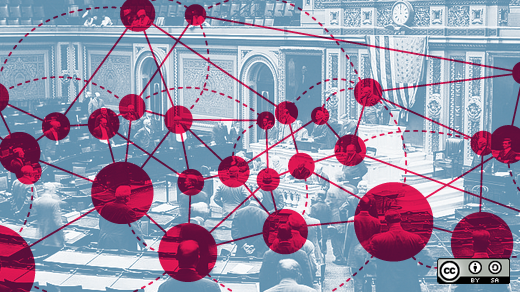 I read an interesting post last week by Morton Hansen (author of Collaboration: How Leaders Avoid the Traps, Create Unity, and Reap Big Results) entitled Obama’s Five Collaboration Mistakes. In the comments below the post, some folks interpreted his words as an attack on the Obama administration. Me? I’d probably interpret Hansen’s words more broadly. Perhaps something like:
Politicians are pretty darned bad at collaborating a lot of the time.
I think many folks would agree with this statement no matter where they sit politically. No matter where they live around the world.
In fact, the word “political” has become almost synonymous with anti-collaborative behavior in many contexts. Certainly in the business world.
But there is a lot a stake here. The economic downturn has hurt our businesses badly. And this has affected many of us in even more personal ways. Jobs. Homes. Security.
We need innovation in the political world to help solve the problems of the business world. Which means we are going to need better collaboration across political boundaries, both inside and between our countries.
Could we open source folks help?
[Read the rest of this article on opensource.com]
Three signs your corporate culture isn’t ready for the open source way
It’s a good bet that the next generation of defining companies will have corporate cultures built the open source way– around openness and collaboration, while fostering community and culture that extend outside the company walls.
 In fact many of the defining companies of the first decade of this century show these characteristics (with one very notable exception we discussed earlier).
It kind of makes you want to rush in and see if you can change your old style corporate culture and get in on the action. But try to change too fast and your efforts may backfire.
So here are three signs that your corporate culture may not quite be ready for the open source way– and some tips to help you move closer.
[Read the rest of this post over at opensource.com]
Introducing opensource.com
One of the things I’m most excited about as I start my new job at New Kind is that I have the opportunity to continue to do work with Red Hat. Today, in the spirit of release early, release often, Red Hat opened the doors to a new website, opensource.com. In addition to my work here at Dark Matter Matters, I’ll also be writing for the Business channel of opensource.com.
 So what is opensource.com?
It is the beginning of a conversation about how the world can apply the lessons of the open source way broadly– in business, in government, in education, in the law, and generally in our lives. Unlike most other open source sites, it is not just about software. From the site:
The term open source began as a way to describe software source code and the collaborative model for how it’s developed. Red Hat used this model for developing technology and built a business model around open source and its principles: Openness. Transparency. Collaboration. Diversity. Rapid prototyping… The open source way is more than a development model; it defines the characteristics of a culture.
Although this site was started by Red Hat, it is not intended to be a Red Hat site, but rather a site where the open source conversation is extended to all companies and organizations, even beyond the technology industry. Red Hat CEO Jim Whitehurst states it really well in his introductory post:
2 reasons why the term “crowdsourcing” bugs me
Interesting article in Forbes the other day about the way Threadless, the awesome t-shirt company, thinks about community-building. For those of you who aren’t familiar with Threadless, they do about $30 million in revenues with a unique cultural/business model that merges a community of t-shirt creators and consumers into one happy family (you can read more about them in the Forbes article).

We are a crowd. We are ready to "source" something.
This quote from Cam Balzer, the Threadless VP of Marketing, in particular, caught my eye:
“Crowdsourcing is antithetical to what we’re doing. That’s because crowdsourcing involves random sets of people who suddenly have a say in how the business works, but that’s not how Threadless operates. We’ve got a close-knit group of loyal customers and have worked hard to build that. The people who submit ideas to us, vote and buy our products aren’t random people, and they aren’t producing random work. We work closely with our consumers and give them a place on our site, the Threadless forum, where they can exchange ideas with one another–ideas that go beyond designing T-shirts. We have consumers who have voted on 150,000 designs, which means they’ve spent hours interacting on our site. People who do that aren’t jumping into a random crowd. They’re part of the community we’ve cultivated.”
This really hit the nail on the head for me. I often see the word crowdsourcing being used in the same sentence with open source or community building. But the word crowdsourcing doesn’t describe the type of community I like to be involved in. Here’s why:
Can mass collaboration save our beloved Pabst Blue Ribbon?
At the beginning of November, news sources reported that Pabst (maker of Pabst Blue Ribbon, the official beer of our little honky-tonk band) was up for sale. Apparently, Pabst is owned by a non-profit foundation and the IRS has been trying to get the foundation to sell it for years.
 Problem is, last time Pabst was on the market in 2005 there were no buyers, and the IRS gave them a reprieve until 2010 before they had to try again.
The selling price? $300 million. Which doesn’t sound too bad until you hear that Pabst doesn’t even have any breweries– the last one closed in 2001. They are now essentially a marketing vehicle for a bunch of beer brands, including PBR, but also Old Milwaukee, Schlitz, Stroh’s and about 25-30 others (check out the full list here).
Well now two enterprising advertising agencies have banded together to see if they can create a mass collaboration movement to buy Pabst. They’ve created a website called Buy A Beer Company where you can actually pitch in to purchase a piece of Pabst for yourself. Once they get to $300 million in crowd-sourced funds, they make a formal offer to buy the company.
Sound like a marketing stunt? It is… but it has only been going on for two weeks, and they have already raised almost $10 million!
That’s pretty impressive for a stunt.
Who knows were this will lead? Perhaps a rival crowd-sourced movement will appear and make an aggressive counter-offer? Or maybe some rich investor will swoop in and buy Pabst, the two ad agencies, and their list of donors all at one time. One way or another, it’ll be interesting to watch what happens next. If you want to stay tuned in, you can follow the Buy a Beer Company Twitter feed here.
The Adaptable Company: Gary Hamel’s new book that isn’t
Over the past few weeks, Gary Hamel has written two posts on his Wall Street Journal blog about his next book (the posts are here and here). The catch? He’s decided that he isn’t going to write another book. So instead, he published the CliffsNotes version of what he’d write if he was going to write a book, and started what he refers to as an “open source project” about the ideas, inviting people to add their thoughts and comments.

Management guru Gary Hamel
I thought I’d share some of my favorite bits that fit in really well with a Dark Matter Matters world view.
On what it means to be an adaptable company:
An adaptable company is one that captures more than its fair share of new opportunities… An enterprise that is constantly exploring new horizons is likely to have a competitive advantage in attracting and retaining talent. When a once successful company runs aground and starts to list, its most talented employees usually don’t stick around to bail water, they jump ship. A dynamic company will have employees who are more engaged, more excited to show up to work every day, and thus more productive… Adaptability didn’t rate very highly as a design criteria when those early pioneers set out to invent Management 1.0 a hundred years ago. But it’s essential now…
On the problems with big organizations:
Big things aren’t nimble. That’s why there aren’t any 200-pound gymnasts or jumbo-sized fighter jets… In a company comprised of a few, large organizational units, there tends to be a lack of intellectual diversity—since people within the same unit tend to think alike. Within any single organizational unit, a dominant set of business assumptions is likely to emerge over time. One way of counteracting the homogenizing effects of this groupthink is to break big units into little ones. Big units also tend to have more management layers—which makes it more difficult to get new ideas through the approval gauntlet. In addition, elephantine organizations tend to erode personal accountability.
What can community leaders learn from dancing Sasquatch guy?
Earlier this summer at the Sasquatch Music Festival, someone captured the three minute video I’ve pasted below. One guy dancing to M.I.A. (we love her!) starts what becomes a massive dance mob by the end of the song. The video became an YouTube sensation, with over 2,000,000 views.
Many folks have written interesting posts analyzing the event (here are a few of my favorites) and at some point you’ve gotta stop analyzing and realize this man just needed to DANCE and maybe the rest of us do too. But before we do that, a couple of observations from the place where open source community-building intersects with Sasquatch guy dance mob-building.
Love, hate, and memo-list
Top management experts are now acknowledging the importance of creating forums and contexts inside corporations that allow peer review, transparency, and powerful natural hierarchies to flourish. Here’s one great post by Gary Hamel from earlier this year that Iain Gray pointed out today. We’ve had an open forum exactly like this at Red Hat for a very long time. We call it memo-list.

The Greek agora at Tyre. It used to be a popular gathering place back in the day.
When any new employee comes into Red Hat, memo-list is one of the first great shocks to the system. Memo-list itself is not some technological marvel of a collaboration tool– it is just a simple, old skool mailing list where any Red Hat employee can post an email message that goes out to virtually every employee in the company. That’s 3000+ folks.
Memo-list has been a hot issue inside the walls of Red Hat since before I joined ten years ago. Folks tend to either love it or hate it.
Some people are shocked by the fact that any employee can publicly challenge a post by an executive or even the CEO in an email to memo-list (and they do). Some people are annoyed by the discussions that appear over and over, year after year. Some people view it as idle chitchat and a waste of time.
But some people view it as the backbone of the Red Hat culture. A place where the power of meritocracy is nurtured. Where the employees force transparency, openness, and accountability. Where peer review makes for better ideas (after all, given enough eyes, all bugs are shallow).
I love memo-list, warts and all (I think Gary Hamel would like it too). In my view, it is the single most important thing that differentiates the Red Hat culture from most other corporate cultures.
Jim Whitehurst: 20th century companies already hiring 21st century employees
Last night, Red Hat President and CEO Jim Whitehurst gave a talk to a group made up of mostly students and faculty at the NC State School of Engineering. Nice writeup of it in the student newspaper here. His ideas were very timely for me; just the other day, I wrote a post with some tips for companies with 20th century cultures trying to make the move into the 21st century.

Your future employee sez: I'm going to need a bit more collaboration and meritocracy up in here! (photo by D Sharon Pruitt)
Jim Whitehurst is in a rather unique position because he has managed both an icon of the 20th century corporation (Delta Airlines) and what we’d like to think is a good example of the 21st century corporation here at Red Hat.
Because of his experiences, Jim is able to clearly see and articulate the differences between the old model of corporate culture, based on classic Sloan-esque management principles, and the emerging model, based in many ways on the power of participation broadly (and in our case, the open source way specifically).
One very simple point Jim made that really struck me: Companies with 20th century business models need to realize that they are already hiring 21st century employees.
People coming out of school today have grown up in an age where the ability to participate and share broadly is all they’ve known. These folks have grown up with email accounts, the Internet, Facebook, and all of the other trappings of a connected world.
So when they graduate from school and take jobs working in old-style corporate cultures, where progressive principles like transparency, collaboration, and meritocracy lose out to the old world of control, power, and hierarchy, what happens?
The difference between collaboration and clobberation

Seal colony sez: you can't force true collaboration, yo!
Picture this: You are sitting in a meeting, and someone from another department is beating you up because you won’t go along their vision. They’ve never asked your for your opinion, they didn’t involve you in their process, and now you are sitting there getting railed because you are not sure what they are pushing is the right thing to do.
And then it comes. You get accused of not being collaborative.
You were just a victim of clobberation.
Clobberation [klob-uh-reh-shun] (n)
The art of beating someone into submission under the guise of collaboration.
I first heard this term from my friend Todd Barr a few years ago, and it’s stuck with me ever since.
Especially for us open source folks, who think of true collaboration as something almost holy, getting clobberated is really, really painful. And the hard part? It is sometimes difficult to articulate how someone clobberated you, but you almost always know it when you feel it. You feel anxious, cheated, even guilty.
So what’s an honest collaborator to do?
Hey, I Wrote a Book!

Available now in print and electronic versions.
 Dark Matter Matters