Dark Matter Matters
brand
The role of film at Red Hat
Yesterday, Red Hat launched a new series of short films called Red Hat Stories. These films are a key element in our effort to document “the Red Hat way” of doing things. We’ve started with sixteen films covering everything from an overview of what makes Red Hat useful, to our technology leadership, even a set about our perspective on how to liberate innovation. The piece below is a short, sweet distillation of the Red Hat way, and it speaks for itself.
I use the word “film” rather than video on purpose because it better captures the spirit of what we are trying to do with digital media at Red Hat. Films are what you make when you are captuing stories. Videos are what you make when you are selling your stuff. So we aspire to film, certainly with our most strategic work, but sometimes settle for video when the project demands it.
Red Hat’s first attempt at using film as a medium for storytelling was Truth Happens, which we created almost seven years ago. I’ve told that story in an earlier blog post. Since Truth Happens, we’ve expanded our efforts to use film, video, and other digital media tools in many ways.
Brand positioning tip #1: points of parity and points of difference
In my recent post on the books behind Dark Matter Matters, I mentioned Dr. Kevin Keller from Dartmouth. Kevin is the  author of Strategic Brand Management, which placed #3 on my list. But in addition to being an author and professor, Kevin is also a long time friend of Red Hat. He has helped us work through some of the most challenging corporate branding and positioning decisions we’ve faced over the past six or seven years.
I thought it might be nice to pass along some favorite lessons that I learned from Kevin over the years, many of which we have put into practice at Red Hat. In this post, we’ll cover 2 of the key elements behind good brand positioning: Points of Parity and Points of Difference.
If you need the primer on what positioning is all about, read my previous post here or go buy a copy of Jack Trout’s book Positioning: The Battle for Your Mind.
There’s a working definition of points of parity and points of difference in Wikipedia here, but I hope the explanation below will appeal more to average folk who aren’t as into the marketing-speak.
Intel’s new campaign… about their culture!
Yesterday Red Hat’s brand manager, John Adams, showed me a New York Times article about Intel’s new brand campaign that they call “The Sponsors of Tomorrow” that launches on Monday.
From the Times article:
[The campaign] focuses on the amusingly weird, technology-focused culture of Intel and celebrates the company’s role in the future, rather than the present… the ads highlight achievements of Intel engineers in a humorous way.
The campaign is Intel’s first ever that focuses on the brand rather than products… and that’s where its power comes from.
…ad executives began spending time at Intel, and noticed its appealing culture. “We started thinking about Intel, like, ‘OK, what’s it like in the cafeteria when they’re in there eating lunch together?’ There’s got to be a whole hierarchy of people in there who they admire,” Mr. Bell said.
There first few bits are pretty funny and showcase the weird rock star computer nerd culture that exists in every tech company I’ve ever seen. It will be very interesting to see where Intel takes this… and how the public reacts. I’m kind of digging it myself!
The top 10 books behind Dark Matter Matters
Books are important to me. Growing up, almost every free wall in my parents’ house was lined with bookshelves, some of them stacked two deep. I spent most of my pre- Red Hat career in book publishing, first working during college at The University of North Carolina Press. After college, I went to work for a literary agent named Rafe Sagalyn in Washington DC. Working for Rafe was a great experience because he built his reputation on big think/idea books and business books.
His first big book was the huge bestseller Megatrends by John Naisbitt back in the early 80s. When I was there, I personally got to work with, among others, Bill Strauss and Neil Howe on their great books about generational patterns in society (check out The Fourth Turning… very prophetic these days) and Don Peppers, author of some books back in the 90s like The 1:1 Future about relationship marketing that were the grandparents of today’s books on social media marketing.
I also got to play agent and author myself too. As an agent, I represented some of Tom Bodett’s work (yes, he is the Motel 6 guy, but was also a commentator on NPR) and sold a wonderful novel called The Frequency of Souls to FSG. As author, I helped Rafe write two “cutting edge” books about getting free and open access to government information (they have not aged well, I’m afraid).
Fast forwarding to today, Rafe actually was the agent for two recent big think books that I love, Authenticity and A Whole New Mind, so he is still making things happen.
After I left book publishing, reading became fun again. I read novels and travel literature for a while, nothing that made me think too much. But when I got to Red Hat, I relapsed and started reading the big think books like the ones I used to work on with Rafe. I thought it might be worth taking a few minutes to try to remember the books that have been the biggest influences on my thinking, and get them all down in one place, so here goes:
Top 10 Dark Matter Matters books
Without these ten books, Dark Matter might not even matter to me.
The Swingin’ Johnsons: Poor branding? Probably.
A good friend told me a few weeks ago that I should write more about music here, since music is such an important part of my life. So I thought I’d give it a go.
I play bass in a band called The Swingin’ Johnsons. Yes, that’s right.
Occasionally, we call ourselves a Lyndon Johnson tribute band, when we need to water down the story, and most of our show posters have pictures of Lyndon Johnson on them. I don’t know exactly how we are paying “tribute” to Lyndon Johnson by what we do, but there it is.
Why did I just write a post about Viking Longships?
 A great brand can seem from the outside to be an awesome speedboat, like the kind they rode around on Miami Vice… Just grab the wheel, hit the throttle, and send it screaming through the water to wherever you want to go. He who controls the brand has all of the power to steer and go wherever he wants… right?
I’ve always envied those brand managers (kind of…) who have a marketing budget of millions and can go out and “buy” an image for their brand using advertising. They are driving the speedboats. If they want, they can associate their brand with skydivers and bungee jumping (Do the Dew, man!) or whatever they choose.
But the reality is that a brand like Red Hat is more like a Viking longship. Here’s what Wikipedia says about how longships moved:
Brand and human resources in one department? Are you nuts?
A few months back, Red Hat rearranged a few organizational boxes, as companies tend to do from time to time. One result of this was the creation of a new department called People & Brand, a combination of the existing Red Hat Human Capital team and our Brand Communications + Design team.
When some folks hear that, their faces crinkle all up in confusion and they say something akin to “That doesn’t make any sense… brand is a marketing function, not an HR function!”
It’s true that brand is traditionally thought of as a tool of marketing, but in the 21st century company, we are going to have to rethink some things. One thing the 21st century company is going to have to do is resist the urge to put things into silos so quickly. One former boss of mine who loved to do this called it “bucketizing”– a beautiful markepoetry term.
Look at the statement above again: “Brand is a marketing function, not an HR function.”
I disagree.
Brand is an HR function. And a marketing function. And a sales function. And a service and support function. And a finance function. Brand should be deeply embedded in everything a company does.
The organizational structures of the 20th century “bucketize” by default. One box at the top. A bunch of boxes connected to that one. And each of those boxes has a bunch of boxes connected to it. We tend to spend most of our time worrying about which box is connected above us rather than which boxes might be connected beside us.
Conversational Capital: I’m totally not wearing any pants
On a recommendation from Michael Tiemann, I got the book Conversational Capital: How to Create Stuff People Love to Talk About by the folks at Sid Lee, who have done work for brands like Cirque du Soleil, Adidas, and Red Bull.
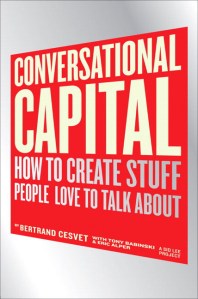 Michael had sent a note at Red Hat a few months back where he said this book helped him understand the “x-factors” that had allowed Red Hat to create a strong brand position at such a small, young company. Thought I should check it out.
In case you were wondering, that headline above is an example of Relevant Sensory Oddity, one of the topics they cover in the book. I thought I’d try it and see if it works:) I actually am wearing pants. Today.
The main thesis of Conversational Capital is that there is a more powerful way to get consumers engaged with your brand by “making your story part of their story,” creating stories or experiences that are meaningful to them. The authors turn their noses up at “buzz marketing,” equating it to style over substance, with no depth or continuity, all sizzle and no steak.
Fedora, Red Hat, and open brands
A Twitter friend asked me the other day if I had been doing any more thinking about open brands. Turns out I have. Two weeks ago, she and I had a conversation where we discussed how Red Hat had opened up the Fedora brand and the positives (tons!) and negatives (some) of doing so.
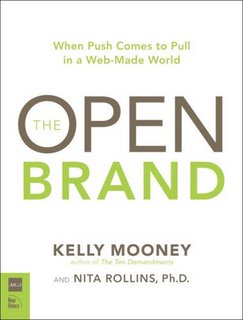 This week, on an plane ride up to Boston, I read the book The Open Brand by Kelly Mooney, which another friend had handed to me a while back.
The book is a eulogy for brands that are not willing to open themselves up, and an instruction manual for those that are considering becoming more open.
It was particularly interesting to read as a Red Hat guy, because the book is based on the idea that today’s single most powerful technology is “a mashup of the World Wide Web and the open source movement.”
The book opens with the question… “are you dangerously CLOSED?”
Whew… passed that one. But the book did make me think some about where the Red Hat brands fall on the spectrum of closed to open.
David Burney’s New Kind of gig
My good friend, former boss, and Swingin’ Johnsons bandmate, David Burney, has revealed his new venture, a company called New Kind. He’s partnering with Matt Munoz, an extremely talented designer who created the original Fedora logo (an interesting open, collaborative process to be discussed in another blog) among other things.
Both David and Matt come from graphic design backgrounds, but their firm intends to explore the role of design in business from a “new kind” of perspective. According to their website:
New Kind helps organizations solve complex problems and build competitive brands. We do so by combining the problem-solving principles of design thinking with the collaborative power of open source. We help our clients create authentic customer communities, build and nurture innovative cultures and tell meaningful, memorable stories through the most relevant media choices.
David is actively blogging on some interesting stuff, including Barack Obama and MBAs, Gary Hamel, and orange juice. Do it. Click on the orange juice link. You know you want to.
Hey, I Wrote a Book!

Available now in print and electronic versions.
 Dark Matter Matters