Dark Matter Matters
brand
Google Buzz didn’t get permission, but it also didn’t get brand permission
You’ve probably seen at least one of the 9 zillion articles written over the last week about Google Buzz. The feedback from the public has been, well… kinda ugly. There are plenty of articles and blogs analyzing problems with the Buzz launch around user privacy, opt in vs. opt out, and that kind of thing, so I won’t rehash those arguments.

Bumblebee sez: yo Google, you really should have asked first!
In this post, we’ll look at the brand mistake Google made in how they launched Buzz.
This article from the San Francisco Chronicle website about a class action lawsuit filed against Google caught my eye because of the following paragraph:
Google turned Gmail “into a social networking service and that’s not what they signed up for, Google imposed that on them without getting their consent,” said Kimberly Nguyen, consumer privacy counsel with EPIC of Washington, D.C.
That sentence is a great articulation of why Buzz is a classic case of not securing brand permission, a subject I have covered here and here.
To be of any value, a brand must create meaning in people’s minds. People associate certain terms or ideas with that brand. If you want to see a awesome experiment in brand meaning, check out the Brand Tags site.
Brand positioning tip #8: five great books you should check out
For today’s tip, I thought I’d compile a list of my five favorite brand positioning books in one place. I’ve tried to put them in some semblance of an order, with the must-reads at the top.
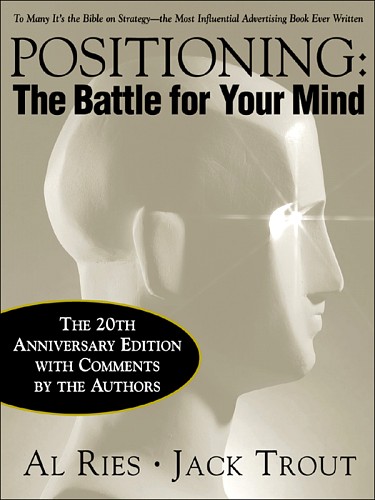 1. Positioning: The Battle for Your Mind by Jack Trout and Al Ries: The original book about positioning from the folks who coined the term. I’ve linked here to the 20th anniversary edition, which has some more modern examples than the original. Jack Trout and Al Ries have gone on to milk the positioning meme with about a zillion other books. I’ll link to some more of the best of these below.
2. Strategic Brand Management by Kevin Keller: Not only a great book on positioning, but on every other aspect of brand management as well. I use Kevin Keller’s model every time I run a positioning exercise. If you have already mastered the intellectual side of the positioning concept, consider this book the how-to manual. Expensive– it is a business school textbook– but worth way more than five lesser branding books.
3. Zag by Marty Neumeier: He calls it “radical differentiation,” but this is at heart a book about brand positioning from the guy that wrote The Brand Gap, one of my favorite branding books. It’s short, well-designed, inexpensive, and easy to understand. What more could you want?
4. The 22 Immutable Laws of Marketing by Al Ries and Jack Trout: I have a soft spot for this book because it introduced me to the concept of positioning– I actually didn’t read the original Trout and Ries Positioning book until later. This is billed as a more general marketing book, but is still a positioning classic from the guys who invented the term.
5. Differentiate or Die by Jack Trout: Another classic from the usual suspect. Sure, by the time you read this, you’ll probably start feeling like you’ve heard it all before. After all, positioning is a fairly simple concept– just hard to execute well.
These books should set you on your way to a clear understanding of brand positioning. One last link: Jack Trout has a new book on positioning that just came out last fall called Repositioning: Marketing in an Era of Competition, Change and Crisis, and it is being billed as the 30th anniversary update of the original positioning concept. I haven’t read it yet, but have it on my Kindle ready to go and will write a post about it when I am finished.
Happy reading!

Brand positioning tip #6: build peninsulas, not islands
In previous posts about brand positioning, we’ve talked about points of parity & points of difference, the competitive frame of reference, brand mantras, and the concept of “brand permission” as tools you can use when developing your brand positioning. Today I want to cover one of the biggest positioning mistakes that I see companies make.

Island hopping is for the South Pacific, not for brands.
I call it island hopping. Let me explain with an example.
Say your company makes dish detergent. You’ve been making dish detergent for 50 years. All you know how to make is dish detergent. Your kids grew up as the famous heirs to a dish detergent fortune. When you show up at parties, people go “hey, look, it’s that dish detergent dude/dudette!” (When your kids show up at parties, people start whispering about videos they saw on the internet, but that’s another story).
Now you hire a new CEO. He has a Harvard MBA. He shows you lots of PowerPoint slides that explain how crappy the market for dish detergent is going to get over the next 50 years. He says you need to diversify into another business, and he suggests the boutique hand soap business is starting to really heat up (after all, who doesn’t want to smell like juniper peppermint citrus after they wash their hands?).
And he’s right. Your kids are spending all your money, and the dish detergent business is going pretty sour.
Top 10 Dark Matter Matters posts of 2009

Benjamin sez you all deserve some props!
Ah, late December. The time when bloggers get lazy and start reposting their old crap rather than writing new material. We here at Dark Matter Matters are no exception. For the Dark Matter Matters top 10 posts of 2009, I’ve split the list into two categories. First we have 5 posts that were popular with readers, followed by 5 posts that were popular with, well, me.
Five posts popular with readers:
- Brand positioning tip #1: points of parity and points of difference: Perhaps it’s the combination of analyzing Mexican food and brand positioning, but this post, the first in a series of tips that I wrote starting in June, is the most read post I’ve done yet on the blog.
- Tom Sawyer, whitewashing fences, and building communities online: Written in September, this post was the first in a series about community-building where I talk about the difference between creating communities to do your work for you and being a humble member of a community larger than just you.
- Brand positioning tip #3: the brand mantra: A short post explaining Scott Bedbury’s concept of a brand mantra.
- Maslow’s hierarchy of (community) needs: Comparing a company’s community motivations to Maslow’s hierarchy of needs, introduces the Iain Gray hierarchy of community needs.
- The top 10 books behind Dark Matter Matters: Exactly what it says it is. Books that inspire me.
Five posts that hardly anyone read. Give them a chance, people:
- Tom Sawyer Part 2: where can your company pitch in?: As usual, the sequel isn’t as good as the original, but I still like this post, which has really helped me focus some of my ideas on corporate humility.
- How to conduct a symphony of communications: Compares the role of a 21st century communications professional to a conductor in a symphony.
- Sharing your brand story (and here’s ours): Introduced the Red Hat Story book (including a downloadable copy).
- Why did I just write a post about Viking longships: Compares the job of brand manager to the guy at the front of a Viking longship. Yeah, I wouldn’t read it from that bobo article title either, but this is the kind of post that makes me happy.
- Markepoetry Part 2: It turns out I have needs: Talking about making (only) myself happy, no list of the Dark Matter Matters posts that no one reads would be complete without including one of my pieces of markepoetry– the language of marketing, made beautiful. Basically, I take real statements that I find in marketing copy and transform them from ugly marketing-ese into poetry. I thought this one was nice.
So as we close out 2009, I just want to say thanks for everything.
I’m approaching one one year of writing this blog, and it sure has been a lot of fun. I still can’t believe I’ve written over 100 posts. What has made it the most fun for me is getting to meet lots of new people, while also becoming closer to people I already know.
I’m looking forward to 2010. I’m sure we’ll have lots to talk about.
Catalyst or controller of the brand message? Here’s some new data.
A key theme we’ve returned to over and over in this blog is the idea that the corporate model for communications is rapidly changing from one where communications leaders keep tight control of the message their company is putting out to a model where these same folks are instead the catalyst for the ensuring the brand message is delivered well– whether by them, by other employees, or by brand evangelists.

This communicator has the right idea. Conduct a symphony of communications rather than trying to play every instrument yourself.
Control to catalyst.
It’s happening whether we like it or not. So it is a good time to heed my friend Tom Rabon‘s advice: “the train can’t run you over if you’re on it.”
How do you get on board? I keep coming back to the fabulous report by the Arthur W. Page Society, The Authentic Enterprise, which lays out this change in great detail. If you are in the communications field and haven’t read it, please do. It’ll help.
As formal communications channels like advertising and press releases become less relevant and things like social media and reputational capital become more relevant, marketing folks are simply going to have to make changes to where they put their money and effort if they want to continue to be successful.
A new study out today from The CMO Club and Hill & Knowlton (and reported on CMO.com) suggests Chief Marketing Officers are still running behind in moving their marketing dollars from the old model to the new one. According to the study, 84% of these folks spend less than 10% of their budgets on social media and non-traditional communications channels, and over 1/2 of them spend 5% or less.
That means they are still spending a lot of money on the old tools of the trade.
A quote from the CMO.com story:
Help! Who the heck are you? (a poll)
When I first started this blog, my hope was to create a home for an open source perspective on brand, culture, and community issues in communications and business.
I figured there might be some people out there in business-land who don’t really understand all this open source stuff too well, and would like to hear more about how the open source way might apply to the issues they face in their work. After all, lots of folks are writing about open source in the macro business context (Chris Anderson, Malcolm Gladwell, Gary Hamel, Tom Peters among many others), but not too many of them work inside an open source business.
I have a sense from the comments I get that there are quite a few readers who have already drank the open source kool-aid too (thank you, friends!). I may not always have as much to offer you, but I love getting your comments and ideas because they make me work harder, give me new ideas, and they often force me to challenge my thinking about open source.
I definitely want to understand who is coming here a bit better. So today, a simple question– who are you?
Thanks for responding, hopefully it’ll help me make this a more interesting place!
Maslow’s hierarchy of (community) needs
Over the past month or so, I’ve been having a conversation with Iain Gray, Red Hat Vice President of Customer Engagement, about the ways companies engage with communities. I’ve also written a lot lately about common mistakes folks make in developing corporate community strategies (see my two posts about Tom Sawyer community-building here and here and Chris Brogan’s writeup here).
One idea we bounced around for a while was a mashup of community thinking and Maslow’s hierarchy of needs. For those of you who slept in with a bad hangover the day you were supposed to learn about Maslow in your intro psych class (damn you, Jagermeister!), here is the Wikipedia summary:
“[Maslow’s hierarchy of needs] is often depicted as a pyramid consisting of five levels: the lowest level is associated with physiological needs, while the uppermost level is associated with self-actualization needs, particularly those related to identity and purpose. The higher needs in this hierarchy only come into focus when the lower needs in the pyramid are met. Once an individual has moved upwards to the next level, needs in the lower level will no longer be prioritized. If a lower set of needs is no longer being met, the individual will temporarily re-prioritize those needs by focusing attention on the unfulfilled needs, but will not permanently regress to the lower level.”

Maslow's hierarchy of needs
Now granted, the needs of a company are very different than the needs of a human being. At its very basic level, a company has a “physiological” need to make money. If that need is not being met, little else will matter. But in an ironic twist, this basic need to make money can actually hinder the company’s ability to make money if it is not wrapped in a more self-actualized strategy.
To explain what I mean, think about the last annoying salesperson who called or emailed you. Why were you annoyed? Probably because it was very clear to you that the salesperson was badly hiding his basic motivation to make money. He wasn’t talking to you because he valued you– he was talking to your wallet.
Now think about the best recent sales experience you’ve had. Mostly likely, this salesperson was being motivated by a higher purpose, perhaps something as simple as a desire to make you happy. Sometimes the most effective salespeople aren’t even in sales at all– like a friend who tells you about a new album you should buy, for example. Or sites like Trip Advisor, where you can learn about where to go on vacation from other folks like you.
When it comes to community strategy, most companies have trouble finding motivation beyond the simple need to make money– and the communities they interact with can tell.
Yet if you look at the greatest companies out there, you’ll find that they usually have a strong sense of identity and purpose– just like Maslow’s self-actualized people. Read anything by Jim Collins and you’ll see what I mean.
For a recent presentation, Iain developed a chart that looks a lot like the one below. And to embarrass Iain, let’s call it the Gray hierarchy of community needs.
The latest in the search for dark matter
As people who’ve been reading this blog for a while know, it’s called Dark Matter Matters because I see some similarities between the struggle that physicists and astrophysicists are going through attempting to find and measure dark matter and dark energy in the universe and the struggle among marketing and communications professionals trying to quantify and measure the value of their investments in brand, culture, and community. Read more in my intro article here.

A picture from the Hubble Space Telescope. The fuzzy stuff might be evidence of dark matter.
From time to time I like to keep all the marketing folks up to date on how their colleagues in physics are doing on the whole dark matter thing, and there’s been some interesting news over the past week.
First, there was an article in the New York Times on Saturday saying that scientists have discovered a mysterious haze of high-energy particles at the center of the Milky Way. Some think these particles may be the decayed remains of dark matter. From the article:
At issue is the origin of a haze of gamma rays surrounding the center of our galaxy, which does not appear connected to any normal astrophysical cause but matches up with a puzzling cloud of radio waves, a “microwave haze,” discovered previously by NASA’s WMAP satellite around the center. Both the gamma rays and the microwaves, Dr. Dobler and his colleagues argue, could be caused by the same thing: a cloud of energetic electrons.
The electrons could, in turn, be the result of decaying dark matter, but that, they said, is an argument they will make in a future paper.
Clearly the authors of the research are still hedging their bets, and other scientists apparently believe the findings are inconclusive. There will need to be still more research before anything gets proven for sure.

The Large Hadron Collider: ready for action!
Meanwhile, our good friends in charge of the Large Hadron Collider, which has been out of commission for the last year, are about ready to roll again after the massive failure last September that caused catastrophic damage. The Large Hadron Collider is an enormous, multi-billion dollar supercollider built underground beneath France and Switzerland by physicists trying to prove, among other things, the existence of dark matter (funny side note, read this article about how the collider might be being sabotaged from The Future). Good article in The Guardian yesterday here on the current status. From the article:
Cern scientists have begun firing protons round one small section of the collider as they prepare for its re-opening. Over the next few weeks, more and more bunches of protons will be put into the machine until, by Christmas, beams will be in full flight and can be collided.
The LHC will then start producing results – 13 years after work on its construction began.
So stay tuned. The physicists are getting closer– if only we marketing folks were doing as well!
Brand tip: Call a duck a duck
Imagine this: You walk into a pet store, looking for a canary, because, i don’t know, maybe your coal mine is having dirty air issues or something. The salesman, eager to please, walks you over to a cage with a duck sitting in it.

I may be yellow, but I ain't no canary, yo.
He says, “Do I have just the thing for you, check out this canary. He is a new, better breed of canary. He has webbed feet, can swim, quacks rather than sings, he’s bigger. We call this the web-footed hydro ultracanary. You’ll love him.”
So you buy the “canary” and take him into your coal mine, where he quacks incessantly. In fact, he is still waddling around quacking about ten minutes after you and all of the other miners are lying dead from breathing poisonous air.
In this case, the brand promise (a canary) and the brand experience (a duck with strong lungs) did not match. If you had been looking for a duck, this little guy would have probably been perfect. But as a canary… not so much.
One of my favorite brand rules is to call your ducks ducks. What do I mean? Make things simple for your customers. Don’t make them learn your language or analyze your intent in order to understand your message. Be straight with them.
Brands are like sponges, people
On Twitter yesterday, my friend Chris Blizzard mentioned to someone that I often say “brands are like sponges.” When I saw this, I realized that a) I haven’t said this in a while and b) I should say it more often because it is a freakin’ awesome way to think about brands. So I’m saying it again right now. Right here.

A brand is like a sponge. Except it is probably dirtier than this one.
It’s actually not my line. I got it from the Scott Bedbury book A New Brand World (one of the top ten books behind Dark Matter Matters). Near the beginning of the book, Scott, who is one of the masterminds behind the good ol’ days of the Nike brand in the 80s and the Starbucks brand in the 90s, provides one of my favorite definitions of what a brand is:
A brand is the sum of the good, the bad, the ugly, and the off strategy. It is defined by your best product as well as your worst product. It is defined by award-winning advertising as well as by the god-awful ads that somehow slipped through the cracks, got approved, and, not surprisingly, sank into oblivion. It is defined by the accomplishments of your best employee– the shining star in the company who can do no wrong– as well as by the mishaps of the worst hire that you ever made. It is also defined by your receptionist and the music your customers are subjected to when they are placed on hold. For every grand and finely worded public statement by the CEO, the brand is also defined by derisory consumer comments overheard in the hallway or in a chat room on the Internet. Brands are sponges for content, for images, for fleeting feelings. They become psychological concepts held in the minds of the public, where they may stay forever. As such, you can’t entirely control a brand. At best you can only guide and influence it.
Those last two lines have stuck in my mind since I first read them. First, the idea that a brand is a sponge, soaking up everything, both good and bad. And second, that you cannot control a brand, you can only guide and influence it.
Hey, I Wrote a Book!

Available now in print and electronic versions.
 Dark Matter Matters