Dark Matter Matters
culture
10 more people from Red Hat you should follow
A few weeks ago, I posted a list of ten people from Red Hat you should be following, and promised there were more people to come. For today’s list, the rule is that they must be on Twitter, and I’ve split them into two groups: The first group is all Red Hat executives and the second group is what I’m going to call Red Hat catalysts– people inside of Red Hat who make things happen because of their ideas and passion.
First, here are five Red Hat executives on Twitter:
1. Jim Whitehurst, CEO
Yes, Jim Whitehurst is on Twitter and has been for almost a year. Sure he’s not saying much yet, but he has a pretty impressive list of followers (almost 400 at last count). Perhaps if a bunch of you go follow him right now, he’ll feel the need to start tweeting more often. Make sure to send him a message saying Chris Grams told you to say he’s not posting enough.
2. Iain Gray, Vice President of Customer Engagement
Iain Gray, who I just wrote about earlier this week here, is starting to become a regular Twitterer, which is a good thing for Red Hat, because he has some of the best ideas in the company. The only bummer about following Iain on Twitter is you lose the killer Scottish accent. Find him here.
3. DeLisa Alexander, Senior Vice President of People & Brand
DeLisa Alexander is the executive who spearheaded the combination of HR and brand communications into one group at Red Hat, a subject I wrote about here. She is just getting started on Twitter, but that doesn’t mean you should go easy on her. Ask her some tough questions, like “how much transparency is too much?” or “do job titles matter?”. Oh yeah, she is also a great boss. I’m such a suck up.
4. Rachel Cassidy, Vice President of Global Professional Services
Rachel Cassidy is one of those smart executives who perfectly balances professional experience, diplomatic savvy, and fun. She also manages some of the smartest and best Red Hat employees, the ones that spend their days in the customers’ worlds making them happy. I’d love to see her sharing more of her ideas and experiences on Twitter. Please tell her I said so.
5. Marco Bill-Peter, Vice President of Global Support
You know, I think I have only met Marco Bill-Peter once or twice in person (he works out of our Westford, MA office), but I still feel like I know him well. He’s just one of those people. Workwise, he’s a Red Hat superstar who is in charge of Red Hat support globally. Which doesn’t mean he will fix your server issue via Twitter, so don’t go there. But you can find his tweets here.
Ok, now on to the Red Hat catalysts:
Love, hate, and memo-list
Top management experts are now acknowledging the importance of creating forums and contexts inside corporations that allow peer review, transparency, and powerful natural hierarchies to flourish. Here’s one great post by Gary Hamel from earlier this year that Iain Gray pointed out today. We’ve had an open forum exactly like this at Red Hat for a very long time. We call it memo-list.

The Greek agora at Tyre. It used to be a popular gathering place back in the day.
When any new employee comes into Red Hat, memo-list is one of the first great shocks to the system. Memo-list itself is not some technological marvel of a collaboration tool– it is just a simple, old skool mailing list where any Red Hat employee can post an email message that goes out to virtually every employee in the company. That’s 3000+ folks.
Memo-list has been a hot issue inside the walls of Red Hat since before I joined ten years ago. Folks tend to either love it or hate it.
Some people are shocked by the fact that any employee can publicly challenge a post by an executive or even the CEO in an email to memo-list (and they do). Some people are annoyed by the discussions that appear over and over, year after year. Some people view it as idle chitchat and a waste of time.
But some people view it as the backbone of the Red Hat culture. A place where the power of meritocracy is nurtured. Where the employees force transparency, openness, and accountability. Where peer review makes for better ideas (after all, given enough eyes, all bugs are shallow).
I love memo-list, warts and all (I think Gary Hamel would like it too). In my view, it is the single most important thing that differentiates the Red Hat culture from most other corporate cultures.
Ten people from Red Hat you should follow
Most Twitter users have probably heard of the Twitter tradition of Follow Friday, where you take time on Fridays to introduce your friends to some folks they should be following. Well, I’m lucky to be working alongside some awesome people here at Red Hat, and I thought today I’d introduce you Dark Matter Matters readers to ten Red Hatters who say some pretty smart things online.
 First, meet three members of the Red Hat Community Architecture team. If you are interested in the Red Hat approach to community-building, check out these three rock stars. When it comes to understanding how to build an effective architecture of participation, very few people have more experience or good ideas than Greg, Max, and Karsten.
1) Greg DeKoenigsberg: Blog | Fedora page | Twitter feed
2) Max Spevack: Blog | Fedora page
3) Karsten Wade: Blog | Fedora page | Twitter feed
As a special bonus, I’m going to introduce you to the newest member of the Community Architecture team, Mel Chua. From what I can tell, Mel may be teaching those three old guys a thing or two about how the next generation will be building community.

Jan Wildeboer sporting his brand new Red Hat tattoo (10-23-09)
Red Hat has a quite a few folks with a deep passion for open source, but when Michael Tiemann, Jan Wildeboer, Venky Hariharan, and Gunnar Hellekson enter the room, their passion takes your breath away (example: I think Jan got a Red Hat tattoo last night– that is passion, man). These guys are great ambassadors for Red Hat, but also for the entire open source movement. Don’t expect any of these four to just toe the corporate line, though– each of them has interests and ideas that extend well beyond the corporate walls.
5) Michael Tiemann: Blog | Web page | Wikipedia entry
6) Jan Wildeboer: Blog | Identi.ca | Twitter
7) Venkatesh Hariharan: Blog
8) Gunnar Hellekson: Blog | Twitter
And finally, closer to home, I want to point you to a couple of folks in the Brand Communications + Design team that I think are doing some really great stuff online. First, my friend and 10-year Red Hat colleague Jonathan Opp, who has begun actively posting on his blog about brand, voice, design, and culture. You will not meet a more talented writer.
9) Jonathan Opp: Blog | Twitter
The last person I want to point out today is BC+D designer Adrienne Yancey. But it’s not her Red Hat work I want to point you to– instead, it’s a really cool blog she writes about food in her spare time. Her photography is beautiful, and it is worth visiting just to drool over the pictures of edamame salad and okra.
10) Adrienne Yancey: Blog
OK, that’s it for today. I’ll try to highlight some other Red Hat folks doing cool stuff online in a later post. After all there are over 3000 of us now working in about 30 countries around the world– there are plenty of great people and ideas to show you.
Two videos about the culture of technology disruption
Yesterday at the Coach K Leadership Conference, James McCaffrey of Turner Broadcasting gave a talk about leadership in a technology disrupted organization. He talked a lot about the evolution of the Turner brands, including CNN, Turner Classic Movies, TNT and the rest, in the face of massive change in the media industry. Sometimes we forget just how fundamentally the way people consume news, information, and entertainment has been revolutionized over the last few years, and this talk really got me thinking.
James showed a couple of videos I thought were freakin’ awesome. The first is called Did You Know, and it does an fabulous job of conveying the scale of change. I’d seen the original, but had never seen this version:
And the second video is laugh out loud funny. A quick look at how the media would have covered the moon landing if it happened today.
John Seely Brown’s secret formula for an innovation culture
I spent today at the Coach K Leadership Conference at Duke University (Red Hat CEO Jim Whitehurst will be speaking there tomorrow morning). One of today’s highlights was a panel called “Leading the Creative Enterprise” featuring John Seely Brown (the former director of the famous innovation hub at Xerox PARC).
I always love it when really smart people boil down the world into a simple 2×2 matrix, and during his comments, JSB put a chart up on the screen that looked something like this:
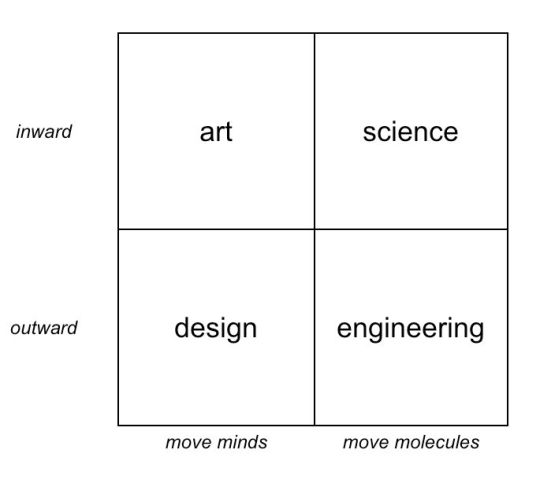 To create a culture that will be successful at innovating, JSB says you must have four types of people: artists, scientists, designers, and engineers working together; each group must be represented.
Two of the groups (the artists and the scientists) get their energy from the way they internally process their own ideas, while the other two groups (designers and engineers) get their energy by thinking about how those ideas are brought to the outside world.
Looking at the matrix the other way, artists and designers share a common cause of trying to move people’s minds while scientists and engineers are firmly grounded in the world of actually making stuff work beyond the idea itself.
I’ve certainly seen these roles all represented in projects at Red Hat that have resulted in great innovations (the group that worked on the Red Hat values years ago comes to mind). And I’ve also been a part of projects that failed because at least one perspective was missing.
What do you think? Does this matrix work for you?
Gary Hamel: Open Source is one of the greatest management innovations of the 21st century
My colleague John Adams, reporting from the World Business Forum in New York, wrote on Twitter yesterday that during his speech, management guru Gary Hamel called open source one of the greatest management innovations of the 21st century (coverage of Gary’s speech here and here).

Management guru Gary Hamel
I love it. Gary Hamel is a hero of mine, and many consider him one of the greatest business minds on the planet. I’ve written about him, well, too much (start here, here, and here), and I follow him via his website, his non-profit called MLab, and his Wall Street Journal blog.
I knew Gary was familiar with open source after reading his book The Future of Management (one of the top ten books behind Dark Matter Matters). He spends five pages (205-210 in the hardcover) discussing open source and at one point says the following:
The success of the open source software movement is the single most dramatic example of how an opt-in engagement model can mobilize human effort on a grand scale… It’s little wonder that the success of open source has left a lot of senior executives slack-jawed. After all, it’s tough for managers to understand a production process that doesn’t rely on managers.
Here’s his analysis of why the model works so well:
Brands are like sponges, people
On Twitter yesterday, my friend Chris Blizzard mentioned to someone that I often say “brands are like sponges.” When I saw this, I realized that a) I haven’t said this in a while and b) I should say it more often because it is a freakin’ awesome way to think about brands. So I’m saying it again right now. Right here.

A brand is like a sponge. Except it is probably dirtier than this one.
It’s actually not my line. I got it from the Scott Bedbury book A New Brand World (one of the top ten books behind Dark Matter Matters). Near the beginning of the book, Scott, who is one of the masterminds behind the good ol’ days of the Nike brand in the 80s and the Starbucks brand in the 90s, provides one of my favorite definitions of what a brand is:
A brand is the sum of the good, the bad, the ugly, and the off strategy. It is defined by your best product as well as your worst product. It is defined by award-winning advertising as well as by the god-awful ads that somehow slipped through the cracks, got approved, and, not surprisingly, sank into oblivion. It is defined by the accomplishments of your best employee– the shining star in the company who can do no wrong– as well as by the mishaps of the worst hire that you ever made. It is also defined by your receptionist and the music your customers are subjected to when they are placed on hold. For every grand and finely worded public statement by the CEO, the brand is also defined by derisory consumer comments overheard in the hallway or in a chat room on the Internet. Brands are sponges for content, for images, for fleeting feelings. They become psychological concepts held in the minds of the public, where they may stay forever. As such, you can’t entirely control a brand. At best you can only guide and influence it.
Those last two lines have stuck in my mind since I first read them. First, the idea that a brand is a sponge, soaking up everything, both good and bad. And second, that you cannot control a brand, you can only guide and influence it.
Jim Whitehurst: 20th century companies already hiring 21st century employees
Last night, Red Hat President and CEO Jim Whitehurst gave a talk to a group made up of mostly students and faculty at the NC State School of Engineering. Nice writeup of it in the student newspaper here. His ideas were very timely for me; just the other day, I wrote a post with some tips for companies with 20th century cultures trying to make the move into the 21st century.

Your future employee sez: I'm going to need a bit more collaboration and meritocracy up in here! (photo by D Sharon Pruitt)
Jim Whitehurst is in a rather unique position because he has managed both an icon of the 20th century corporation (Delta Airlines) and what we’d like to think is a good example of the 21st century corporation here at Red Hat.
Because of his experiences, Jim is able to clearly see and articulate the differences between the old model of corporate culture, based on classic Sloan-esque management principles, and the emerging model, based in many ways on the power of participation broadly (and in our case, the open source way specifically).
One very simple point Jim made that really struck me: Companies with 20th century business models need to realize that they are already hiring 21st century employees.
People coming out of school today have grown up in an age where the ability to participate and share broadly is all they’ve known. These folks have grown up with email accounts, the Internet, Facebook, and all of the other trappings of a connected world.
So when they graduate from school and take jobs working in old-style corporate cultures, where progressive principles like transparency, collaboration, and meritocracy lose out to the old world of control, power, and hierarchy, what happens?
Trying to change a 20th century corporate culture? Where should you start?
 When I talk about the culture that we’ve built at Red Hat over the years around the principles of the open source way, one of the most popular questions I get is something along these lines.
That’s great and all, Chris. But Red Hat built its culture from scratch. My company culture has been the same for over 50 years. Can you change a deeply entrenched 20th century culture?
It’s a great question. Clearly there is a big advantage to being able to organically build a corporate culture from scratch. But, with support from the top levels of management, it is not impossible to change an entrenched culture, too.
Where do you start? Here are three tips:
The difference between collaboration and clobberation

Seal colony sez: you can't force true collaboration, yo!
Picture this: You are sitting in a meeting, and someone from another department is beating you up because you won’t go along their vision. They’ve never asked your for your opinion, they didn’t involve you in their process, and now you are sitting there getting railed because you are not sure what they are pushing is the right thing to do.
And then it comes. You get accused of not being collaborative.
You were just a victim of clobberation.
Clobberation [klob-uh-reh-shun] (n)
The art of beating someone into submission under the guise of collaboration.
I first heard this term from my friend Todd Barr a few years ago, and it’s stuck with me ever since.
Especially for us open source folks, who think of true collaboration as something almost holy, getting clobberated is really, really painful. And the hard part? It is sometimes difficult to articulate how someone clobberated you, but you almost always know it when you feel it. You feel anxious, cheated, even guilty.
So what’s an honest collaborator to do?
Hey, I Wrote a Book!

Available now in print and electronic versions.
 Dark Matter Matters