Dark Matter Matters
community
Jim Whitehurst: 5 tips for competing in the 21st century
I spent two days this week at the Coach K Leadership Conference at Duke. It’s always good to get above the trees for a few days, and this experience was exactly that kind of opportunity. Jonathan Opp did a nice summary post on the conference here and you can see the live Twitter stream here.

Jim Whitehurst on stage at the Coach K leadership conference (photo by Jonathan Opp)
On Wednesday, Red Hat CEO Jim Whitehurst gave a keynote entitled “Competing as a 21st Century Enterprise Among 20th Century Giants.” Jim comes at this subject from a pretty unique vantage point: he is probably one of the few people in the world who has run both a 20th century company (Delta Airlines, as COO) and a 21st century company (that would be us, Red Hat).
In his presentation, Jim covered some of the things he has learned in moving from the command and control, military-inspired corporate environment of Delta (which is pretty similar to the structure of many of the other great 20th century companies) to the open source-inspired corporate structure here at Red Hat (if you want to learn more about Red Hat and the open source way, here and here and here and here are some posts that will help). In particular, Jim gave five tips that will help your company compete better in the 21st century world– I’ve summarized them below:
Banking your community karma for a rainy day

Ms. Piggy Bank sez: community karma no longer requires a deposit slip.
At lunch today, I sat in on a presentation by Red Hat community architect Karsten Wade about open source community-building best practices. Karsten referenced a concept he attributed to Greg DeKoenigsberg, who I believe may be the most talented community architect on the planet. The idea was crazy simple, and it was the first time I’d heard it:
Think of good community work as money you’d put in a bank.
Do really helpful things in the communities you participate in, things that make those communities more successful. If you continue to make these positive karma deposits for a long period of time, the balance in your community karma account will go up. Why do you want a lot of good karma in your account?
For a rainy day, of course!
Every company has times when, for one reason or another, they can’t (or don’t) put their best foot forward. Even the best community citizens (and Red Hat is one of the best, according to Matt Asay “Red Hat is considered the paragon of open-source virtue.”) have bad days.
That is precisely when you make a withdrawal from your community karma account.
If your balance is high, you are more likely to get the benefit of the doubt when trouble arises. If your balance is low or you have a negative balance, well, not so much. If you start making too many withdrawals (i.e. doing a lot of dumb stuff) and don’t make enough deposits, you will start having problems effectively engaging in that community.
I don’t know how that could be any simpler. Or more true. Nice one, Greg.
Tom Sawyer Part 2: where can your company pitch in?
A few weeks ago I wrote a post called Tom Sawyer, whitewashing fences, and building communities online, where I outlined one of the biggest mistakes I see companies make when figuring out their community strategy– they expect a mythical “community” will paint their fence for them. But not everyone is Tom Sawyer.
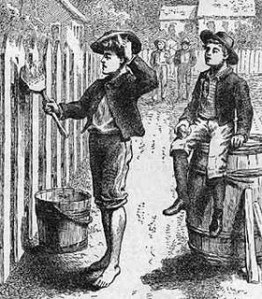 If your community strategy starts with the question, “how can I make the community work for me?” you may still find success if there are a bunch of people out there willing to paint your fence for free, but you definitely are not taking advantage of all of the benefits you can get from participating in communities.
One of the most often used examples of customer/community-driven innovation (perhaps because it is simple to understand) is the My Starbucks Idea site. This is a place where customers can tell Starbucks what they want, people vote on each others’ ideas, and Starbucks takes the best ideas and uses them to make their products, services, and experience better.
A recent example of a service that was launched through the site is a mini Starbucks drink card that can fit on your key chain. Sweet. It looks like they’ve had at least 5-10 innovations like this that have come from customer ideas, maybe more. And Starbucks is not alone– many companies have built similar sites, as has The White House. You’ve seen them.
But this approach is still simple Tom Sawyer-style community-building. People just helping Starbucks paint their fence for free. So why is it working for Starbucks? Because there are people out there willing to spend their time and energy helping Starbucks make their products, services, and experience better. Not every brand can command this sort of attention and loyalty. Most can’t, in fact.
My view? I do think these sort of public idea generation efforts are smart 21st century thinking when they work. But why stop there?
I get excited when I see big companies focused not only on what they take from the table, but what they bring to the table. I love to see companies that aren’t afraid to be humble members of communities, rather than building the community around themselves.
Former Red Hat intern is gonna rent out the world
From the we’ll-all-be-working-for-him-someday files:
 Former Red Hat intern and project manager Tim Hyer has been working on a new startup company named Rentcycle. Last night, Techcrunch picked up their story here. Tim worked for us here in the Brand Communications + Design group at Red Hat from 2005 to 2007 and then moved out to the west coast. He is the person most responsible for the hard work of making David Burney‘s design thinking vision come true at Red Hat.
Rentcycle a pretty neat idea– sign up rental businesses around the country, and then let people rent stuff from one website. See what is in stock at many stores at once, without having to run around a dusty warehouse looking in rusty bins full of candelabras and fine silverware.
Some other folks have tried similar things, but many have tried the Craigslist style approach of one consumer renting to another. Tim’s approach is more B2C (in non-marketing-speak, that means he wants to partner with businesses selling to regular folks), which should make it easier for him to achieve scale without as much pain. My view? Someone’s going to do this right, and knowing Tim, it’s a pretty good bet it will be him.
Follow them on Twitter here or watch their video pitch of the concept (nice stick figure, Tim):
Gary Hamel: Open Source is one of the greatest management innovations of the 21st century
My colleague John Adams, reporting from the World Business Forum in New York, wrote on Twitter yesterday that during his speech, management guru Gary Hamel called open source one of the greatest management innovations of the 21st century (coverage of Gary’s speech here and here).

Management guru Gary Hamel
I love it. Gary Hamel is a hero of mine, and many consider him one of the greatest business minds on the planet. I’ve written about him, well, too much (start here, here, and here), and I follow him via his website, his non-profit called MLab, and his Wall Street Journal blog.
I knew Gary was familiar with open source after reading his book The Future of Management (one of the top ten books behind Dark Matter Matters). He spends five pages (205-210 in the hardcover) discussing open source and at one point says the following:
The success of the open source software movement is the single most dramatic example of how an opt-in engagement model can mobilize human effort on a grand scale… It’s little wonder that the success of open source has left a lot of senior executives slack-jawed. After all, it’s tough for managers to understand a production process that doesn’t rely on managers.
Here’s his analysis of why the model works so well:
Does transparency really have to start on day 1?
Open source folks often talk about transparency as a key part of the open source way. And if you ask most good open source folks when a project should start being open, they’ll say it should be open from the very beginning.
 But what does that really mean?
Let’s look at the example of one of the most famous and successful open source projects (and one that is close to my heart), Linux.
Back in January, I wrote a post that broke down the first message Linus Torvalds ever sent out to the world about Linux into some of the key concepts that would become central to the open source way. Linus created a blueprint for the open source culture in the tone of his first email, long before the term “open source” was even coined.
Here again are the first few lines of his initial Linux post from August 25, 1991:
Test my theory… when it comes to community, are the words “monetize” and “kill” interchangeable?
I was reading an article online the other day discussing how to “monetize” community. For those of you who don’t speak marketing, monetize means “to convert into money.”

Hey babe! Wanna monetize this community with me?
Am I the only one who gets a creepy feeling when I see the words monetize and community used closely together?
Bringing up the idea of monetizing stuff at the beginning of a conversation about community is akin to a guy going up to a girl he’s never met and asking her to sleep with him straight out.
Nothing kills community mojo like bad intentions. And when you lead with bad intentions in a community setting, best case people will turn their backs on you, worst case they’ll pour a drink on your head or get their boyfriend to beat you up. Metaphorically speaking.
Look, people, I’m not saying it is wrong to make a living off of good community work. Just like it’s not wrong to date in the hope of finding someone to love you forever. There are just some ways of going about it that are gonna work better than others. And if your own happiness/success is your only goal, you will fail. To be successful in creating community you must take pleasure in sharing something.
So here’s my theory. Next time you hear someone in a meeting use the words “monetize” and “community” closely together (or see someone doing it online), think of me. Try substituting the word “kill” for monetize, and see if it fits. Feel free to post your examples here, send them to me via Twitter, whatever.
Here are a couple of examples I found online to get you started:
Tom Sawyer, whitewashing fences, and building communities online
I spoke on a panel at GE today with Chris Brogan, author of the book Trust Agents (almost finished with it, more comments in a later post…).

Tom Sawyer sez everyone's fence gets whitewashed today, people!
After hearing Chris talk about building trust in online communities, it hit me that one of the biggest mistakes I’ve seen people make when trying to build communities online, even in the open source world, is that they think like Tom Sawyer.
Here’s how Wikipedia retells the story of Tom Sawyer and the fence:
After playing hooky from school on Friday and dirtying his clothes in a fight, Tom is made to whitewash the fence as punishment on Saturday. At first, Tom is disappointed by having to forfeit his day off. However, he soon cleverly persuades his friends to trade him small treasures for the privilege of doing his work.
When thinking about building communities online, are you thinking like Tom Sawyer? Why are you building a community in the first place? When it comes right down to it, do you really just want people to whitewash your fence for you and give you small treasures in return for the privilege?
If you are looking to ideas like open source or social media as simple means to get what you want for your company, it’s time to rethink your community strategy.
Do you have 10,000 hours in yet? The 21st century is waiting…

Baby Mozart sez I got my 10,000 hours of practice in before I was five years old, suckers!
Finally got around to reading Malcolm Gladwell’s new book Outliers. I’m late to the game on this one, so I’ll skip the full review and instead point to some good summaries about the book here, here, and here. I have other fun stuff I want to cover today.
For me, this book was his best yet. Gladwell’s gift is he is an amazing storyteller, and in this book he once again takes semi-boring academic research and makes it deeply relevant and interesting by crafting a beautiful story around it.
Here’s a short synopsis of Outliers. I decided to write it in the form of a limerick. I have no idea why.
Some folks become world-class Outliers,
Achieving success we can’t help but admire,
But smarts and ambition,
Aren’t the only pre-conditions,
Great timing and practice are required.
Basically, Gladwell is saying you can be the smartest guy on Earth and achieve nothing worth mentioning. But incredible, world-class success (think Bill Gates, Mozart, the Beatles) is a mashup of being born at the right time in the right place to the right people with the right genetic makeup while having the right things occur to you at exactly the right times in your life.
Oh, and you need to get in 10,000 hours of practice to become an expert at your craft.
This last concept really got to me. The idea that in order to become an expert in your field, you need to put in 10,000 hours of practice has been covered extensively. In fact there are two other books out describing the research behind this assertion, The Talent Code by Daniel Coyle and Talent is Overrated by Geoff Colvin.
Hearing the Bill Gates and Steve Jobs stories of perfect timing and early practice in Gladwell’s book started me thinking about a few things.
Save us, General Zinni! Teach us corporate folks some 21st century leadership skills
I happened to catch General Tony Zinni on The Daily Show a few weeks ago. This was the first time I’d seen him talk, and I found him to be an incredibly creative, thoughtful man. So this weekend, I sat down and read his recently published leadership book Leading the Charge: Leadership Lessons from the Battlefield to the Boardroom. If you want to learn more about General Zinni’s long list of accomplishments, both inside and outside the military, there is a really good Wikipedia profile of him here.
 In this book, General Zinni describes an introspective, creative, and rapidly changing American military mindset. After reading, I’m convinced the subtitle should have been something like “Lessons from the New Military for a Corporate America Totally Blowing It.”
This book provides a crisp analysis of the failures of the 20th century leadership model still prevalent in most businesses today. It is an indictment of the post-economic-meltdown-state of American business, which he believes was caused in large part by a systemic failure of this traditional leadership model.
Like a true man of action, General Zinni brings his own ideas and experience of leadership methods that work in the high-pressure, high-risk world of the military to the table. He provides a vision for how we can fix what is broken, and shows what the leadership model for the 21st century organization could be.
Hey, I Wrote a Book!

Available now in print and electronic versions.
 Dark Matter Matters