Dark Matter Matters
brand
Catalyst or controller of the brand message? Here’s some new data.
A key theme we’ve returned to over and over in this blog is the idea that the corporate model for communications is rapidly changing from one where communications leaders keep tight control of the message their company is putting out to a model where these same folks are instead the catalyst for the ensuring the brand message is delivered well– whether by them, by other employees, or by brand evangelists.

This communicator has the right idea. Conduct a symphony of communications rather than trying to play every instrument yourself.
Control to catalyst.
It’s happening whether we like it or not. So it is a good time to heed my friend Tom Rabon‘s advice: “the train can’t run you over if you’re on it.”
How do you get on board? I keep coming back to the fabulous report by the Arthur W. Page Society, The Authentic Enterprise, which lays out this change in great detail. If you are in the communications field and haven’t read it, please do. It’ll help.
As formal communications channels like advertising and press releases become less relevant and things like social media and reputational capital become more relevant, marketing folks are simply going to have to make changes to where they put their money and effort if they want to continue to be successful.
A new study out today from The CMO Club and Hill & Knowlton (and reported on CMO.com) suggests Chief Marketing Officers are still running behind in moving their marketing dollars from the old model to the new one. According to the study, 84% of these folks spend less than 10% of their budgets on social media and non-traditional communications channels, and over 1/2 of them spend 5% or less.
That means they are still spending a lot of money on the old tools of the trade.
A quote from the CMO.com story:
How to conduct a symphony of communications
The communications profession is in the midst of a revolutionary change (you might have noticed). In my mind, it boils down to a simple concept:
Old model = company has one voice
New model = company has many voices

Mr Conductor sez: we can make beautiful music together!
Ah, the good old days. It used to be easy to go to the “official company spokesperson” to get the scoop on what “the company” was thinking. Now, with the advent of Facebook, Twitter, blogs, and a bunch of other stuff that probably hasn’t even been invented yet, and the blurring lines between people’s personal and work lives (damn you, Google!), it’s a lot harder for us communications folks to stay in control of how the corporate message comes out.
If you are the head of communications for your company, what should you do? Lock all the doors, scare the employees into online silence, and continue the status quo? This is what some companies are doing. There are very real concerns with how and when employees use social media tools in a work setting.
But ultimately, the shift toward a company of many voices rather than one voice is going to happen whether you like it or not. As Bob Dylan said, “You don’t need a weather man to know which way the wind blows.”
So rather than forcing yourself into a sucker’s choice of “Should I communicate my corporate story well or allow my employees to be using social media at work?” perhaps there is a better question:
Brand tip: Call a duck a duck
Imagine this: You walk into a pet store, looking for a canary, because, i don’t know, maybe your coal mine is having dirty air issues or something. The salesman, eager to please, walks you over to a cage with a duck sitting in it.

I may be yellow, but I ain't no canary, yo.
He says, “Do I have just the thing for you, check out this canary. He is a new, better breed of canary. He has webbed feet, can swim, quacks rather than sings, he’s bigger. We call this the web-footed hydro ultracanary. You’ll love him.”
So you buy the “canary” and take him into your coal mine, where he quacks incessantly. In fact, he is still waddling around quacking about ten minutes after you and all of the other miners are lying dead from breathing poisonous air.
In this case, the brand promise (a canary) and the brand experience (a duck with strong lungs) did not match. If you had been looking for a duck, this little guy would have probably been perfect. But as a canary… not so much.
One of my favorite brand rules is to call your ducks ducks. What do I mean? Make things simple for your customers. Don’t make them learn your language or analyze your intent in order to understand your message. Be straight with them.
Brands are like sponges, people
On Twitter yesterday, my friend Chris Blizzard mentioned to someone that I often say “brands are like sponges.” When I saw this, I realized that a) I haven’t said this in a while and b) I should say it more often because it is a freakin’ awesome way to think about brands. So I’m saying it again right now. Right here.

A brand is like a sponge. Except it is probably dirtier than this one.
It’s actually not my line. I got it from the Scott Bedbury book A New Brand World (one of the top ten books behind Dark Matter Matters). Near the beginning of the book, Scott, who is one of the masterminds behind the good ol’ days of the Nike brand in the 80s and the Starbucks brand in the 90s, provides one of my favorite definitions of what a brand is:
A brand is the sum of the good, the bad, the ugly, and the off strategy. It is defined by your best product as well as your worst product. It is defined by award-winning advertising as well as by the god-awful ads that somehow slipped through the cracks, got approved, and, not surprisingly, sank into oblivion. It is defined by the accomplishments of your best employee– the shining star in the company who can do no wrong– as well as by the mishaps of the worst hire that you ever made. It is also defined by your receptionist and the music your customers are subjected to when they are placed on hold. For every grand and finely worded public statement by the CEO, the brand is also defined by derisory consumer comments overheard in the hallway or in a chat room on the Internet. Brands are sponges for content, for images, for fleeting feelings. They become psychological concepts held in the minds of the public, where they may stay forever. As such, you can’t entirely control a brand. At best you can only guide and influence it.
Those last two lines have stuck in my mind since I first read them. First, the idea that a brand is a sponge, soaking up everything, both good and bad. And second, that you cannot control a brand, you can only guide and influence it.
Brand naming strategy: branded house or house of brands?
At Red Hat, I often get questions about how we name stuff. It is usually not just idle curiosity, mind you, in most cases someone has a new program or product and would like to call it something like Supersexyshinyfoo. Our team has to play the bad guy role and explain that we don’t usually create new brands like that at Red Hat.

Cow sez: Dude. Do I really need another brand?
The response is typically something like “Let me get this straight… You guys think long, boring names like Red Hat Enterprise Linux, Red Hat Enterprise Virtualization, and JBoss Enterprise Application Platform are better than Supersexyshinyfoo?”
My answer? We already have a Supersexyshiny… it’s the Red Hat brand.
We’ve spent years building the Red Hat brand into something that people associate with (according to our surveys) value, trust, openness, choice, collaboration, and a bunch of other neat things. Studies have shown that Red Hat brand karma is pretty positive. And the logo looks great on a t-shirt. Our brand is one of our most valuable assets.
This is why most Red Hat products have very descriptive (some would say boring…) names. The equation probably looks something like this:
(Supersexyshiny + Foo) = (Red Hat + descriptive name)
This brand strategy is often referred to as a “branded house” strategy. Take one strong brand, plow all of your brand meaning into it, while differentiating each product with descriptors instead of brand names.
These days, many automobile manufacturers do things this way. Remember when Acura used to have the Acura Integra and the Acura Legend? Honda simplified the branding strategy by moving to RL, TL, TSX, etc. as descriptors for their cars, pointing all of the brand energy back at the Acura brand. Many other auto manufacturers follow similar principles.
In the whirlwind of Chris Brogan, author of Trust Agents
Last week I was on a panel with Chris Brogan, author of (with Julien Smith) the NY Times bestselling book Trust Agents. Also on the panel were Robert Cook (founder of Freebase and Metaweb), Gary Slack (Chairman of Slack Barshinger and head of the Business Marketing Association), and June Arunga (partner at Black Star Lines and one of Fast Company’s 100 Most Creative People in Business). The panel was moderated by Sree Sreenivasan (Dean of Student Affairs at Columbia Journalism School and regular TV commentator).
 After looking up the kickin’ credentials of each of these folks, I figured I’d better get my act together and do some research so I wouldn’t immediately out myself as the weak bulb. As part of my homework, I picked up a copy of Trust Agents to read on the plane.
Now I must admit, I’m not a big fan of most books about social media stuff. I think I may be allergic to what I call social media meta-marketing: people using social media to show others how much they know about social media. If all the people using social media to talk about social media just shut up for a minute, we’d probably save Twitter some serious bandwidth expense. But I digress…
So I buy this book, sign up for Chris’s Twitter feed, all the normal stuff. It turns out Chris has almost 100,000 followers on Twitter, and almost every post on his blog gets like 50 or 100 comments (and most of them seem really nice and friendly, us open source folks aren’t used to that).
His Twitter feed almost looks like a breathing rhythm, with tweets coming in and out every few seconds. You could probably even calculate how much sleep he gets by putting the times of his first and last tweets of the day for a month in a spreadsheet and averaging out the results. If I hadn’t seen him sneaking some tweeting in under the panel table via his phone, I’d guess TweetDeck was directly wired into his brain.
OK, cut to it. The book is great. I really dug it. It turns out it isn’t so much about social media as it is about building relationships, building trust, being helpful, being useful, being nice, and a bunch of other stuff your mom told you to do when you were younger. After reading the book and spending an afternoon with Chris, it’s pretty obvious how he’s been so successful. He’s just really, really freaking nice.
From the book, here is his strategy:
Brand positioning tip #5: the brand audit
Oh no! An audit? That can’t be good, right?
Actually, if you are a brand manager, a brand audit is an incredibly useful tool (I’m sure the IRS feels the same way about their audits).
What is a brand audit?
There are plenty of people out there who’d be happy to tell you about brand audits (here are a few interesting links). But as you found out in previous brand positioning tips, I’ve learned a lot about brand positioning from Dr. Kevin Keller, author of Strategic Brand Management and professor at Dartmouth (plug: buy the book, great section on brand audits). When we did our most recent brand audit at Red Hat, we used Dr. Keller’s approach.
A brand audit is a deep introspective look at your brand from inside and out. Done the Kevin Keller way, the audit is made up of two pieces: 1) the brand inventory and 2) the brand exploratory.
I think of them this way:
Free and the economics of Woodstock
1) In case you’ve been under a rock for the past week, this weekend marks the 40th anniversary of the original Woodstock Festival. 2) I recently finished reading Chris Anderson’s new book Free (which I covered in a post here). Listening to the Woodstock album again (on LP, I’m totally old skool) and thinking about Woodstock in the context of Free made me remember the announcement that changed the concert completely:
It’s a free concert from now on. That doesn’t mean that anything goes, what that means is we’re going to put the music up here for free. What it means is that the people who’re put — backing this thing, who put up the money for it, are going to take a bit of a bath. A big bath. That’s no hype, that’s true, they’re going to get hurt.
According to the New York Post, the initial budget for the festival was $500,000. The promoters’ goal was to host a three-day concert for about 100,000 people paying 5 bucks each. Although they met the goal of selling 100,000 tickets, the promoters never finished the ticket booths or fences (due to a late change in venue), and the crowd quickly became overwhelming. To avoid making a dangerous situation worse, they made the decision to turn Woodstock into a free concert.
Although great for the spirit of Woodstock, this was a devastating financial decision for the festival organizers. The Telegraph did an interesting interview with the Woodstock promoters where they explained the financial mess this way:
Whole Foods and the brand promise
Whole Foods is a clear example of a mission-driven company. Over the years, they’ve taken strong activist stances on a number of topics related to healthy living. In fact, they are one of the few big corporations that I’ve seen actually link to their values as a main navigation element on their homepage. You’ve probably also seen these same values posted in your local store. I think this is awesome.
 And personally, I love Whole Foods. My guess is, based on their corporate values, that their core customer leans to the left politically.
This week, in the Wall Street Journal, John Mackey, CEO of Whole Foods, wrote an editorial entitled The Whole Foods alternative to Obamacare.
I see the strategy… a few weeks ago, Whole Foods launched a campaign to help empower Americans to lead healthier lives. At the campaign launch, Mackey even said Whole Foods is going to reverse the 14 year trend toward having more pre-processed food in their stores. I’m sure this editorial was one piece of a larger campaign strategy. And certainly most people would agree that Americans could use a healthier diet.
In moving from talking about healthier food into talking about healthcare, Whole Foods has hit on a massively politicized issue. When your core customers lean to the left, and as a corporate leader you take a position to the right, you take a risk that people might start to question whether they really affiliate themselves with your brand promise.
Red Hat brand tip: esse quam videri
A long time ago, a smart North Carolina native mentioned to me that the official NC state motto was the Latin phrase “esse quam videri,” which translates as “to be rather than to seem to be.” Yeah, I didn’t know states had mottoes either. Turns out a lot of them do.
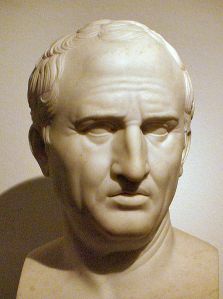
Cicero sez take my advice and be rather than seem. It's Latin, which makes it right, people.
I was struck by this phrase. As Red Hat has grown from North Carolina roots into an international company with offices around the world, we’ve adopted this one little piece of North Carolina-ness as an unofficial litmus test for the Red Hat brand voice as well.
Esse quam videri first appeared in the Cicero essay On Friendship, but a similar concept can actually be traced back to the Greek playwright Aeschylus. His line, which later appeared in Plato’s The Republic, was “His resolve is not to seem the best but in fact to be the best.” You can find more on the history of the phrase here.
Esse quam videri inspires authenticity. When Red Hat is communicating at our best, we use esse quam videri as the muse of simple, honest talk; conversation that doesn’t hide behind the foreign languages of marketing, law, or business.
Sometimes it inspires us to not communicate at all, to simply do instead. When we are not communicating well, we are not listening to our muse.
Hey, I Wrote a Book!

Available now in print and electronic versions.
 Dark Matter Matters