Dark Matter Matters
brand
The Ad-Free Brand tip #1: to get the brand out, get the community in
My publisher recently filmed a series of short video interviews where I discuss my new book The Ad-Free Brand. This is the first in a series of tips from the book, entitled “To get the brand out, get the community in.”
A short video intro to The Ad-Free Brand
My publisher recently created a series of short video segments where I discuss The Ad-Free Brand. They were filmed in our New Kind office with a laptop internal video camera and Skype connection, so keep your expectations low (and certainly don’t confuse these videos with the kind of expensive advertising I rail against in the book:)
Today, I’ll share a five-minute overview of the book itself, and next week I’ll feature three separate Ad-Free Brand tips.
Three approaches to designing brand positioning for ad-free brands
In my last few posts (here and here), I shared some tips for collecting and synthesizing the brand research you will use to design positioning for your brand. In this post, I’ll share three approaches to designing brand positioning I believe will work for the majority of brands:
• The lone designer approach
• The internal community approach
• The open community approach
Each of these approaches has strengths and weaknesses, and they can also be mashed up into a hybrid that better suits the culture of your organization.
The Lone Designer Approach
Are you a small organization or an organization of one? Perhaps you are attempting to position a website or simply get a small company off the ground on a foundation of solid positioning. If you found during the research phase that you were doing most of the work yourself and don’t want or can’t afford to bring others into the positioning process, you may be a good candidate for the lone designer approach.
The lone designer approach is exactly what it sounds like: a positioning process run by one person alone or by a very small group. The advantage of this approach is that you have complete control over the process. You won’t have to spend much time arguing with others over the exact words in your brand mantra; you won’t need to conduct time-consuming collaboration sessions; and you will only go down rat holes of your own choosing. The lone designer approach can be very efficient and is the least resource-intensive of the three approaches.
The downside of the lone designer approach is that it gives you no head start on rolling out your positioning to your brand community. By making your positioning process a black box and revealing only the finished product, you are taking some risks. First, the positioning you design might not resonate or, worse, might be ignored because you didn’t include input from others beyond the initial research. Second, you may have trouble getting others to help you roll it out or take ownership over its success because they had no role in creating it.
Usually I recommend the lone designer approach only to small or new organizations with no access to a preexisting community of employee or community contributors who care about the brand. If you already have a community of supporters around your brand—even if it is small—strongly consider one of the other two approaches (internal community or open community).
The Internal Community Approach
You understand the powerful impact that engaging members of your brand community in the positioning process might have on your brand. You believe your organization is progressive enough to allow employees to help with the brand positioning process. But you just don’t think your organization is ready to open up the brand positioning process to the outside world. If this sounds like your situation, the internal community approach might be the best option for your brand.
The internal community approach opens up the positioning process to some level of participation from people inside the organization. It may broadly solicit contributions from every employee, or it can simply open up the process to a hand-selected group of people representing the employee base.
The internal community approach to brand positioning is a smart, safe approach for many organizations. It makes brand positioning a cultural activity within the organization, allowing you to collect a broad range of interesting ideas and begin to sow the seeds for future participation in the brand rollout down the road. In addition, it can become a compelling leadership opportunity, helping develop future leaders of your brand as well.
While this internal approach is still community-based, it is usually perceived as less risky than an approach involving external contributors. You might find it easier to sell the internal approach to executives who fear opening up the organization to the outside world or think doing so will give the external community the perception the organization is confused or doesn’t know what it is doing because it is asking for help.
The Open Community Approach
Even though I’ll be the first to admit that it is not right for every brand, the open community approach is by far my favorite approach (as you can probably tell by now) and is a very effective one for ad-free brands. The open community approach opens the positioning process to contributions from members of both the internal and external brand communities. Running an open community brand positioning project is similar to running an internal community one. Both approaches have the advantage of bringing in a variety of viewpoints.
Both can create valuable brand advocates who will be helpful down the road. The open community approach just takes things as step further and allows people outside the organization to contribute as well. The benefit of this approach is that it can usually form the beginning of a constructive dialogue with all the people who care about your brand—not just those who work for your organization. It can help you build relationships based on trust, sharing, and respect with people in the outside world. And it can save you money and time by revealing flaws in your positioning much earlier in the process.
The downsides of an open approach? If the project is poorly organized or badly communicated, it really will realize the fears of some executives and show the outside world you don’t know what you’re doing. An open positioning approach requires a deft, highly skilled, effective communicator and facilitator. It requires coordination between different parts of the organization that are in touch with the outside world to ensure communication is clear and consistent.
But although the risks of opening up your positioning process to the outside world are higher, the rewards can be much bigger as well. By transparently opening a relationship between your brand and the outside world, you are embracing the future of brand management, accepting the role of your brand community in the definition of your brand, and proactively getting your community involved in a positive way.
You are beginning a conversation.
—
This is the sixth in a series of posts drawn from The Ad-Free Brand, which is available now.

Some words of thanks from a new author
The first copies of The Ad-Free Brand showed up at the house on Friday afternoon. So I guess that means, after nine months of work, it is finally out. Awesome.
 This book is the work of many people. It is filled with the helpful edits and brilliant suggestions of Jonathan Opp, Rebecca Fernandez, and Rick Kughen, plus the insightful contributions of Kevin Keller, Greg DeKoenigsberg, Paul Frields, and many others. It is a product of the patience and support of my wonderful girlfriend Maggie and my New Kind friends David Burney, Matt Muñoz, Tom Rabon, and Elizabeth Hipps.
There are so many people who’ve helped me out over the past year, and I owe all of them a debt of gratitude.
I thought I’d share the acknowledgments from the back of the book here in the hopes of introducing you to the work of a few of the people who helped me make this book a reality. Please take a few minutes to click through the links and get to know some of these great folks and the very cool projects they are working on. I can only hope you learn as much from them as I have.
Acknowledgments
One day last September, I received an interesting email out of the blue from someone named Lisa who had stumbled across a blog post of mine. She asked me whether I had ever lived in Indiana as a child. I was born in West Lafayette, Indiana.
As it turns out, Lisa was my neighbor and childhood best friend. I moved to Kansas City, Missouri at age 5 and had lost touch with her until I received this email, almost 35 years later.
As Lisa and I caught up, we learned we each had book publishing in the blood. Lisa is a Senior Publicist at Pearson in Indianapolis. I spent the first five years of my career as a literary agent and editor. In one email to her, I mentioned that I had been thinking of going back to my publishing roots and actually writing a book of my own. Lisa introduced me to Rick Kuhgen, an Executive Editor at Pearson. One thing led to another, and before I knew it, I was writing.
So I’d like to thank my childhood friend and current publicist, Lisa Jacobsen-Brown, without whom this book would probably still be something I was thinking about doing… eventually. I’d also to thank Rick Kuhgen, a true writer’s editor—responsive, thoughtful, and with a hint of poetry to his own words.
I’ve benefitted from the wisdom and friendship of many wonderful people along the journey.
Thanks first to Maggie, my source of energy. This book would have never been possible without you.
Thanks to my mother and father, who I hope see parts of themselves in me and in this book.
Thanks to my sister, Erika, who has been a great friend and confidant ever since she quit telling on me.
To Matthew Szulik, my mentor and friend, for letting the best ideas win. To Jonathan Opp for helping me find a voice. To David Burney, for opening my eyes and making me a designer. To Matt Muñoz, for always bringing optimism and passion.
To Jeff Mackanic, for your friendship and for quietly, consistently making everything happen. To Rebecca Fernandez, for bringing value before words. To DeLisa Alexander, for your faith and friendship.
To Tom Rabon and Elizabeth Hipps, for making each day at New Kind better than the last.
To all of my friends from the Red Hat nation, past and present, around the world. Special thanks to the Red Hat Brand Communications + Design team, a group of the most talented folks I’ve had the opportunity to work alongside.
To Kevin Keller, for your wise advice, guidance, and contributions.
To Michele Zanini, Polly LaBarre, Gary Hamel, and the team at the Management Innovation Exchange for introducing me to a new set of friends.
To Bob Young, Lisa Sullivan, Michael Tiemann, and Donnie Barnes, who were open when open wasn’t cool.
To Greg DeKoenigsberg, Jeremy Hogan, Chris Blizzard, Paul Frields, and Max Spevack, who know more about inspiring communities than I ever will.
To Kevin Trapani and Dan Moore, for inspiring us to consider a better way.
To Alina Wheeler and Jelly Helm, for perspective, at the right time.
To the rest of the Pearson team, especially Seth Kerney, Megan Wade, and Bill Camarda, for all of your hard work bringing this book to life.
And finally, thanks to my other friends who don’t give a crap about brands, ad-free or not. You know who you are, and I appreciate everything you do.
Synthesizing your positioning research
In my last post, I shared some of the sources of data that you can use to inform your brand positioning. But once you’ve collected all of the information you can get your hands on, what do you do with it? In this post, I’ll share some tips for how to synthesize your brand positioning research so you can begin to draw some meaningful conclusions from it.
My advice? Get a room. No really, try to find a dedicated space inside your office where you can begin to hang materials on the wall, sort them into piles, and write up your ideas. The physical act of organizing materials often helps you draw connections between them.
You might want to create a wall like the one we created for the Red Hat brand inventory. Here’s a picture of it:

Consider hanging things by where they were created, or how old they are, or whatever other variables are important to you. You might want to reorganize them multiple times in different configurations to see if that gives you new ideas.
If you can’t afford the space or don’t want to create a big messy room, you can create the equivalent on your computer. Organize your research into folders, one folder for each of the four key questions. Make duplicate copies of or shortcuts to research that informs the answer to more than one question, and put one in each folder that applies.
Once you have all the research that informs the answer to each question in one place, it’s time to start doing some analysis. If you are like me, you aren’t starting from scratch, but have been beginning to analyze the data and information as you’ve collected it. But looking at all of the data at once will help you see it differently, making new connections and revealing things you might not have noticed before.
At this point, your goal is to synthesize all your sources of information into the clearest, simplest possible answers to the four key questions. Are the data points revealing common themes, ideas, or opportunities?
Where can you find the data that will inform your brand positioning?
In a recent post, I highlighted the four key questions that your brand positioning research must answer. And I promised a followup post showing you some of the places you could find data to help inform your brand positioning. Here it is!
To review, great positioning is found at the intersection of the answers to the following four questions:
1. What does the brand community currently believe about or value in the brand?
2. What might the brand community believe or value about the brand in the future?
3. What does the organization currently claim about the brand?
4. What would the organization like the brand to become down the road?

So to make things as simple as possible, I’ve made a chart below that will show you many of the places I look first for data to inform brand positioning. At the top of the chart you’ll find many things you probably already have access to and just need to analyze through a brand positioning lens (like marketing materials or website copy), while at the bottom of the chart you’ll find some more complicated research sources that will take a bit more work (like surveys or interviews you’d need to conduct, for example).
The low-cost, high-value approach to brand positioning research
In my last positioning post, I discussed the four key questions you must answer if you want your positioning research to lead you to effective brand positioning. So how exactly do you discover the answers to the four key questions? Do you need to hire an expensive market research firm and spend hundreds of thousands of dollars on surveys and focus groups?
Here is how I think ad-free brands should answer the question “how much should I spend on research?”
I always answer that question with an astoundingly simple approach that became the backbone of our entire brand strategy during my time at Red Hat. I call it the low-cost, high-value approach, and if you were to illustrate it, it’d look something like this.
 The low-cost, high-value approach means that you always analyze potential strategies in terms of their cost and value. You then default to choosing strategies first that are inexpensive in terms of time and money yet bring you a lot of potential value, before selecting strategies that cost more, even if they bring you great value.
Pretty simple, huh?
For example, hiring a research company to set up a brand tracking study with 10,000 potential customers for your brand might provide you with a lot of useful information (high value). But the study can also cost you a lot of money and take up a lot of your team’s valuable time (high cost).
If you have the time and money, you might still decide to field the high-value brand tracking study, but only after you have exhausted all of the low-cost, high-value strategies that might help answer those questions more inexpensively.
So, the essence of the low-cost, high-value approach is to default to spending as little time and money as you can and consider high-cost strategies only when there are no other options that will get you the information you need.
You’d be surprised how many organizations are essentially blind to an entire category of low-cost, high-value research options because they prefer to stick to practices they used in the years before better options became available.
The reality is that the last 10 years have given us a variety of low-cost, high-value digital media tools and resources that are perfect for doing brand positioning research and for rolling out positioning effectively. We now have low-cost, high-value alternatives that can provide data that helps us effectively position brands, many of which were not available before the Internet.
Doing research for positioning a brand is less expensive than it has ever been in history. Some people just haven’t received the memo.
So how much should you spend on research?
When you keep the low-cost, high-value approach in mind, the answer to this question should be clear: balance the amount of time and money you put into the research with the value of the brand you are positioning.
If you are trying to position a small web-based business just getting off the ground, you might attempt to answer the four questions with data you already have at your disposal. Perhaps you’ve already done some customer surveys; you’ve just completed a formal business plan; or you and your team even have strong, well-informed ideas about the direction you want to take the brand. You can use all of this preexisting information to answer the four critical questions I listed in the previous post.
But if you are attempting to position or reposition a brand where the stakes are high, especially if the brand is already generating significant amounts of revenue, the information you have at your disposal might not be enough.
If the stakes are high, but your time or money is short, don’t despair. The ad-free brand positioning approach really shines in low-budget situations because you can always take advantage of the “release early, release often” principle that this open, transparent positioning process embraces.
Don’t have any money to invest in research? You can still create a starting brand position by answering the four questions with the best information you have at your disposal. Then immediately start testing the positioning with others in the organization and potentially even in communities outside the organization. Incorporate the feedback, revise the positioning, and try again.
So if you are positioning a small brand, please don’t feel like you need to break the bank doing research. If you consider the low-cost, high value approach while always keeping the investment you are making in line with the value of the brand you are trying to position, you’ll be nicely set up for long-term positioning success.
—
—
This is the fourth in a series of posts drawn from The Ad-Free Brand, which is available now.
Three tired marketing words you should stop using
 Over the years, I’ve had many people label me as a marketing guy just because I help build brands. I don’t like being labelled, but I particularly don’t like that marketing label. Why?
In my view, traditional marketing sets up an adversarial relationship, a battle of wills pitting seller vs. buyer.
The seller begins the relationship with a goal to convince the buyer to buy something. The buyer begins the relationship wary of believing what the seller is saying (often with good reason). It is an unhealthy connection that is doomed to fail most of the time.
What’s the alternative? I believe companies should stop trying to build relationships with those interested in their brands using a marketing-based approach and instead move to a community-based approach where the culmination of the relationship is not always a transaction, but instead a meaningful partnership or friendship that may create multiple valuable outcomes for both sides.
How do you do this? Consider beginning by eradicating three of the most common words in the marketing vocabulary: audience, message, and market.
So you better understand what I mean, let me attempt to use all three of these words in a typical sentence you might hear coming out of a marketer’s mouth:
We need to develop some key messages we can use to market to our target audience.
Yikes. So much not to like in there. Let me break this one down.
Audience
You hear companies talk about their “target audiences” all the time. So what’s wrong with that?
The word audience implies that the company is talking and the people on the other end are listening. This sort of binary, transactional description of the relationship seems so dated to me.
Certainly in the glory days of advertising where companies had the podium of TV, magazine, and newspaper ads, the word audience was more appropriate. After all, no one ever got far talking back to the TV set.
But in the age of Twitter and Facebook, companies must respect that everyone has the podium. Everyone is talking, everyone is listening.
Where most marketing folks would use the word audience, I often substitute the word community. By thinking of those who surround your brand as members of communities rather than simply as ears listening to you, you’ll already be on your way to a healthier, deeper relationship with the people who engage with your company.
Message
The word message bothers me for the same reason. It is such an antiquated, transactional term. When a company talks about “creating messaging” or “delivering targeted messages” I start thinking we should call the Pony Express.
I believe the move to a community-based approach begins when you quit worrying about “delivering messages” and begin thinking about sharing stories, joining conversations, or sparking dialogue.
These are much better ways to communicate authentically in a collaborative world.
Market
Perhaps the word that bugs me most is market (used as a noun or a verb) and its related friend consumer. Companies that think of people interested in them as consumers or markets take what could become a multi-dimensional relationship and whittle it down to one dimension: a transaction.
If you think of someone as part of your “target market” or a “consumer” you are making your interest in them abundantly clear. You want them to consume something. You want their money.
But what if there were more that people who are interested in your brand could share besides just their money? Perhaps they have valuable ideas that might make your company better? Perhaps they’d be willing to volunteer to help you achieve your mission in other ways?
When you stop thinking of the people that care about your company as consumers or a market, you can begin to see opportunities that you would have been blind to before.
Want an example? Look anywhere in the open source world. Sure there are buyers and sellers, but there are also lots of people bringing value in other ways. Developing code. Hosting projects. Writing documentation. The list goes on.
So let me be the first to admit these three words are the tip of the iceberg. Moving a company from a marketing-based to a community-based approach to building relationships will take more than changing a few words. It will require you to embrace new media, new skill sets, and a totally new way of thinking.
But you have to start somewhere.
Do you see other things that may need to change as we move from a marketing-based to community-based approach to building brands and companies?
I’d love to hear your ideas.
[This post originally appeared on opensource.com]
The four questions your brand positioning research must answer
To create great brand positioning, you must do your homework. In a brand positioning project, this homework mostly consists of doing some research about the brand ahead of time. But how do you organize your research?
In this post, I’ll teach you a simple tip I learned from Dr. Kevin Keller that will help you frame your positioning research in a way that will ensure you find the answers you need.
When doing research to inform a brand positioning project, I am not satisfied until I can answer the following four questions:
1. What does the brand community currently believe about or value in the brand?
2. What might the brand community believe or value about the brand in the future?
3. What does the organization currently claim about the brand?
4. What would the organization like the brand to become down the road?
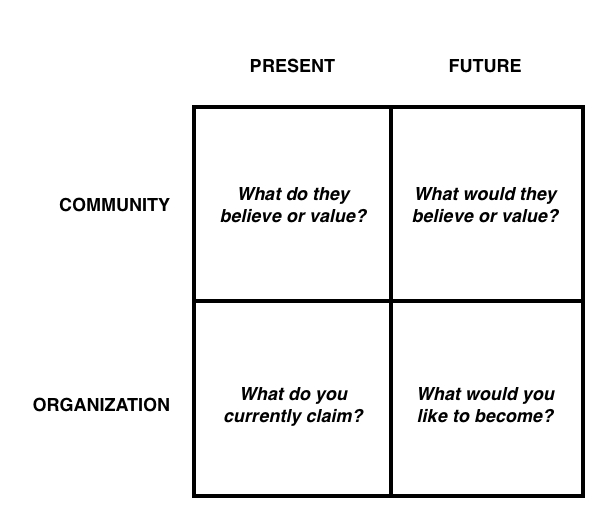 Why are the answers to these four questions so important?
Great brand positioning has one foot in the present and one foot in the future. The research we’re doing to answer these questions helps us understand exactly where each foot should be planted.
The Foot in the Present
By studying what your brand community members currently believe the brand stands for and what they value about it today, you’ll begin to understand their current experience of the brand. Yet your community’s experience of the brand can be very different than how you see or talk about the brand inside the organization. So the brand research should study the brand from both an internal and external perspective.
Often organizations will notice gaps or inconsistencies between the brand they claim to be and the brand their community sees or experiences—the brand promise-brand experience gap.
Once you deeply understand what your community currently believes or values about the brand and compare this to what you currently claim about the brand, you’ll have a complete picture of where your “foot in the present” is planted. You’ll see clearly how big the gap is between your brand promise and brand experience. Only then can you begin the work of building brand positioning that closely aligns the brand promise claimed with the brand experience delivered.
The Foot in the Future
But a brand that is only concerned with the present state of affairs is a brand in stagnation. You’ll want your brand to grow, prosper, and remain relevant down the road. So you should also try to understand what the brand community might believe or value about the brand in the future.
What directions might people give you permission to take the brand? Where do they not want you to take it? What would they value in the brand that you don’t provide today? What does the organization do today that people would rather not see you continue to do down the road?
Equally important is that you strongly consider where you want to take the brand. Remember the apocryphal Henry Ford quote, “If I had asked people what they wanted, they would have said faster horses.”
Sure, to remain relevant you should deeply understand what the community members want the brand to become, but do not become a slave to their vision. You might have entirely different and amazing places you’d like to take the brand that your customers or other community members can’t yet see.
So, in order to understand where your foot in the future is planted, you should seek to understand both what your community would believe or value in the brand and what you want the brand to become down the road.
Where Great Positioning Lives
Great positioning lives where all four answers intersect. It is a bridge between your current brand experience and the brand you’d like to become in the future. It deeply reflects the brand you currently see while lighting the path to what it could become.
Great positioning lives in all four of these quadrants at once. It can be like the North Star, guiding the organization toward the future, while paying homage to the past and making clear connections between things that resonate about the brand with both your organization and your brand community.
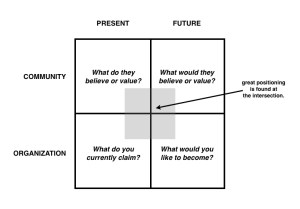
So where should you look for data that will help you answer these four questions and start on the road to great brand positioning?
I’ll share some of the mostly likely sources of data in a followup post.
—
This is the third in a series of posts drawn from The Ad-Free Brand, which is available now.
Why does brand positioning matter and what must change?
I believe almost all great brands are built on a foundation of great positioning.
I feel so strongly about positioning that one of the core elements of this blog is a series of brand positioning tips I learned over the years as an eager student of classic brand positioning.
Sometimes great positioning is led by a branding genius such as Scott Bedbury (who helped grow the Nike and Starbucks brands); sometimes a great leader and communicator with a very clear vision (like Steve Jobs at Apple) drives it into the organization; sometimes people stumble on great positioning by pure luck; and more and more often, organizations are developing positioning by collaborating with the communities of people in and around the organization who care most passionately about the brand.
This last way is the ad-free brand way of developing brand positioning.
 Why does great positioning matter? In my view, there are four key reasons brands should care about positioning.
1. Great positioning helps people understand the brand
The best brand positioning is always simple and clear. The greatest product or organization in the world won’t be successful if people can’t or don’t bother to comprehend why they should care about it. Your story must be able to break through the clutter.
2. Great positioning helps people value the brand
Getting people to understand the brand is the first step, but no less important is ensuring they value the brand. The best brands stand for things people care about or desire.
3. Great positioning helps people identify with the brand
Once people understand and value the brand, they must also understand how they fit in and how they can engage with the brand. They need to see some of themselves in it.
4. Great brand positioning helps people take ownership over the brand
It may sound like a brand’s worst nightmare to lose control and have the brand community take over. But the most self-actualized brands of the twenty-first century allow the communities of people surrounding them to take some ownership of and responsibility for the brand. Essentially, the brand owners become in command and out of control of the brand.
In 1981, when Jack Trout and Al Ries wrote Positioning: The Battle for Your Mind (the book that really defined the discipline of brand positioning) traditional advertising was still a dominant force. In fact, as you glance through their book, you’ll notice that most of the examples they use to illustrate positioning concepts are classic advertisements or advertising campaigns like the Avis “We’re #2, so we try harder” or the 7-Up “Uncola” campaign.
In the book, Trout and Ries define positioning as follows:
“…positioning is not what you do to a product. Positioning is what you do to the mind of the prospect. That is, you position the product in the mind of the prospect.”
The Trout and Ries definition is a perfect way to achieve the first three of the four benefits above; it helps people understand, value, and identify with the brand.
Where the Trout and Ries model of positioning is all about what you do to the mind of the prospect, ad-free brands are less interested in creating meaning for a brand in people’s minds and more interested in creating meaning for a brand with the help of people’s minds.
By giving the communities of people who care about a brand some ownership over its future direction, we begin to build relationships based on trust, respect, and a mutual exchange of value.
Where 21st century brands will really shine is by mimicking the open, collaborative, meritocratic model of the open source software movement (and the Internet itself) in their positioning work. In my view, without beginning to engage the communities of people who care about a brand as co-owners, classic brand positioning by itself will continue to be less and less effective as traditional advertising and PR continue to be less and less effective.
The secret? Marrying those classic brand positioning principles to a 21st century way of collaborating with the communities of people who care about a brand. By doing both together, we’ll be able to build stronger, more resilient brands than ever before.
—
This is the second in a series of posts drawn from The Ad-Free Brand, which is available now.
Hey, I Wrote a Book!

Available now in print and electronic versions.
 Dark Matter Matters