Dark Matter Matters
brand
Hey, oil companies. Stop using advertising to tell us you don’t suck.
From a public relations standpoint, oil companies have it tough these days. The price of gas in the United States is hovering between $3.50 – $4.00 a gallon while oil companies continue to report record profits. Environmental troubles also continue, with the most recent example being an oil spill off the coast of Brazil courtesy of Chevron (where profits doubled in the just reported quarter to $7.83 billion).
It was against this backdrop that I saw the following Chevron advertisement appear on my television set last week:
This is one incredibly tone-deaf advertisement. It actually made me angry.
Articulate, neatly-coiffed, and impeccably-dressed Chevron spokesperson “talks to us straight” as she addresses the concerns of a blue collar everyman. And by the end of 30 seconds, she’s convinced us that, hey, wow, we really are saying the same thing, aren’t we?
No.
After seeing the ad, I went and did a bit of research into the campaign. Surely I wasn’t the only person who found this to be patronizing and inauthentic…
As it turns out, the initial ads first appeared about this time last year, and before the campaign had even launched it had already been dramatically spoofed. Watch the following video or read this New York Times article if you want to hear the whole story.
In fact, the anti-Chevron campaign that this series of advertisements spawned seems to be more powerful than the original campaign (and probably cost millions of dollars less to execute). For example, check out this website, which features over 200 fake print ads based on the campaign. There were also many spoofs of the ads themselves, like this one:
Which brings me to two questions:
1) Why the heck is Chevron still running this campaign?
2) More generally, why do oil companies like Chevron, BP (which spent $93 million on advertising during the height of the gulf oil spill), and Exxon keep wasting their money on advertising campaigns like this?
Advertising is the wrong medium for big oil. When an industry already viewed as disingenuous uses a medium to communicate a message that is also viewed by most people as disingenuous, what do you get?
A double dose of inauthenticity. And very little impact for the money spent, I would guess. So what advice would I give the oil companies on where they should spend their advertising dollars instead?
I’d let Esse Quam Videri (which means, “To be rather than to seem to be” and is the motto of my home state of North Carolina) be the guide.
Rather than spending money seeming to be better corporate citizens, spend that same exact amount of money actually becoming better citizens. Spend the money preventing oil spills. Or making things right for those you’ve already hurt. Or begin a dialog with citizens to learn their concerns and let them share their ideas.
But don’t advertise.
I’m afraid there are no shortcuts to building a positive brand reputation. You actually have to do positive stuff.
Those who chose to invest in perception rather than reality in an Internet-connected world, where everyone has a voice and everyone can impact a brand’s image, should understand that this:
will never be heard over this:
So oil companies, please. Stop using advertising to try to convince us you are something you aren’t. Instead, use the money to make yourselves better, and, over time, with enough good work and progress, you might end up becoming brands we can trust again.
I hate (most) taglines. There, I said it.
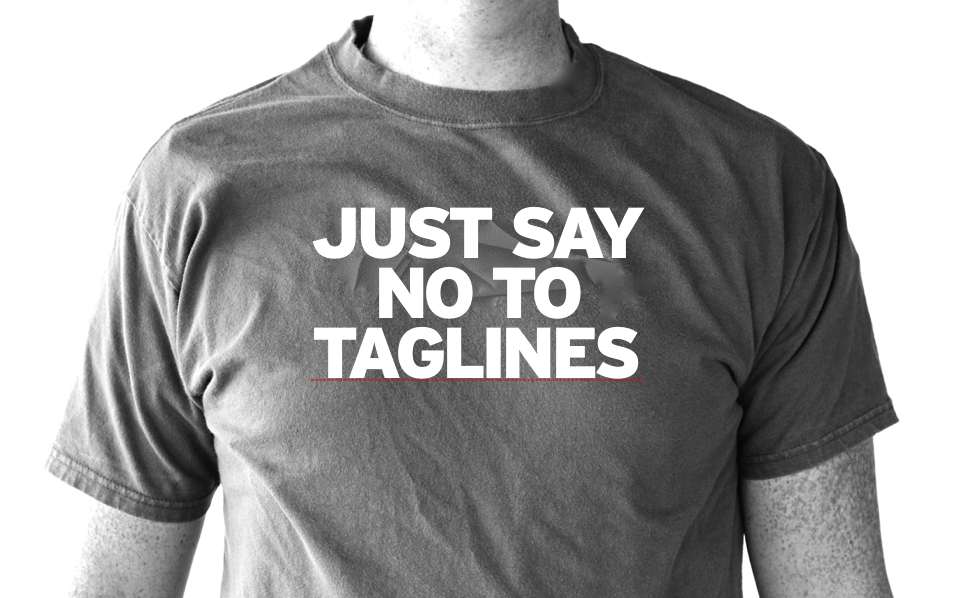 Nothing drives me nuts more than a bad tagline. And by bad tagline, I mean most of them.
Why such a tagline hater? Because to me, most taglines still speak the language of advertising. And, as my business partner David Burney is fond of saying, we no longer trust the language of advertising because our experience tells us it is usually disingenuous.
Is DeBeers right when it says a Diamond is Forever? Could we afford to live in a world where Every Kiss Begins with Kay? Are the champions really still eating Wheaties for breakfast? While these have all been successful taglines over the years that have probably sold a lot of jewelry and cereal, they lack something increasingly important to brands in the 21st century: honesty.
When confronted with a bad tagline, I’m sure you immediately think or say something like “Wow, I wonder how much someone got paid to come up with that?”
Which was exactly my reaction when I was flying on Delta last week and saw a sign with their “Keep Climbing” tagline on it. I couldn’t help but think about the big bucks they probably paid the legendary Wieden+Kennedy advertising agency to develop it. According to Weiden+Kennedy’s case study about the campaign on their website, the tagline “is a declaration of the company’s commitment to making flying better and a celebration of where the brand is and where it is heading.”
So at the same time Delta was telling us how amazing their people were in advertisements like this one:
Delta’s customers were telling us about experiences they were having like this one:
The most successful brands of the 21st century will be the most authentic brands. I’ve talked previously on this blog about my home state of North Carolina’s motto, Esse Quam Videri, which means “To be rather than to seem to be.”
When you watch the two videos above about Delta, do you wonder, as I do, if Delta might have been able to avoid the bad publicity of the soldiers’ story if they had taken the money they spent telling us how great Delta’s people are through advertising and used it instead to empower those employees with training, revised policies, or technology tools that would have actually helped ensure a better experience for customers?
In other words, don’t tell us you are climbing. Climb.
Do I ever like taglines? Absolutely—when they reinforce something I already know and appreciate about a brand. When I see the tagline and immediately recognize what I love about the brand in it, it’s a winner. For example, when Apple started using the tagline Think Different in the late 90s, I believed that the people at Apple actually did think different, and their products helped (and continue to help) me think different as well. The words felt true to the brand I already knew.
But when I see a tagline that is trying to sell me a vision of a brand that I don’t currently see, that is the language of advertising. Telling and selling versus being an authentic representation of the brand.
My own personal experience has been that the best, most authentic taglines are often not developed in marketing departments or by advertising agencies, but instead emerge from the organization’s stories and experiences over time. Sometimes we don’t even see them as taglines until later.
 For example, the only thing even close to a tagline we ever used at Red Hat was “Truth Happens.” But it was not developed as a tagline, it was the title of a short film that we were only going to show once—to introduce a keynote by Red Hat CEO Matthew Szulik (you can read the story of the Truth Happens film and watch it here). In fact, if the marketing guy had his way, it would have been called “Innovation Happens” (yes, the marketing guy was me).
In retrospect, as a film title or as a tagline, “Innovation Happens” sucks.
We made the right choice to go with Truth Happens as the name, which didn’t just tell the story of a company, it told the story of a movement (the open source movement) that many had predicted didn’t have a chance of succeeding. Lots of folks who saw the film at that original keynote asked about it, and, over the next few years, it became a rallying cry inside and outside the company.
It wasn’t until a few years later that we put it on a t-shirt.
So if your first question when building your brand is “What should our tagline be?” maybe consider taking a different approach. Perhaps instead start by attempting to uncover the deepest truths about your brand.
Begin a conversation with your members of your brand community and let them help you. Maybe eventually that conversation will lead you to a great tagline, maybe it won’t.
But you’ll likely discover things much more important and true to your brand than a tagline along the way, and you may find the conversation itself is its own reward.
–
 Was this post helpful?
If so, you can find more tips about how to position your brand effectively in my book, The Ad-Free Brand (not an advertisement, mind you, just a friendly suggestion:).
Only $9.99 for the Kindle, but available in each of these formats:
Book | Kindle | Nook | EPUB/PDF
What is a brand story and why does it matter?
There is no more important tool for rolling out brand positioning than a great brand story. The best brand stories can create gravity around a brand and also help build a strong brand community. They show the concepts behind the brand positioning in action, making it more than words on a page.
Does your organization have legends or stories that have been told and retold over the years? How the brand got its name? How the founders of your organization first met? The original problem they were trying to solve by developing your product? Perhaps your particular worldview or internal values became very clear at one moment in the organization’s history. Most organizations have internal legends, stories, and fables that are already being told. Your existing stories and legends are powerful because they are illustrations of who you are and why you do what you do. Often, these stories serve as building blocks for a larger brand story.
A brand story is an attempt to articulate the brand positioning by answering the deepest truths about the brand, things such as:
– Who are we?
– Why are we here?
– What do we care about?
– What do we do?
– Why does it matter?
In all likelihood, your brand story is already partway being told in the form of these stories and legends that follow the brand around everywhere it goes. Consider collecting as many of these stories as you can as background research and inspiration. An authentic brand story won’t just be made up on the spot. Great brand stories have a lineage and a heritage that are built over time and with the hard work and perseverance of many people.
In attempting to articulate the brand story, your job will be part historian, part archeologist, and part sculptor, taking the existing building blocks that have been provided to you by those who built the brand and merging them with the new brand positioning you’ve developed. You’ll need to mold these two views together into an overarching brand story that is both authentic to the brand’s past and relevant to the brand’s future at the same time.
It is hard work creating a great story that will get passed on from person to person. You’ll need to recruit the best storytellers you can find to the cause, including your organization’s top writers, designers, and poets (or if you work with an outside firm, bring their best folks in, too).
But based on my experience helping develop brand stories for organizations over the past decade, I can tell you that the effort is worth it. A great brand story will not only help you attract new people to your brand community, it will become a powerful guiding force within your organization as well.
If you’d like to learn more about the brand stories we created during my time at Red Hat, take a look at the following posts:
– Sharing your brand story (and here’s ours)
And here is an example of one of the original Red Hat “legends” that we collected during our time building the brand.
–
If you found this post helpful…
Consider taking a look at my new book The Ad-Free Brand (not an advertisement, mind you, just a friendly suggestion:). It has some nice tips for how to build a great brand without the help of… you guessed it… advertising!
Only $9.99 for the Kindle, but available in each of these formats:
Book | Kindle | Nook | EPUB/PDF
We’re awesome! (you suck)
The best 21st century brands won’t be built on advertising alone. Here’s why:
 In a world where everyone has a voice, the biggest brands in the world with the biggest advertising budgets can be quickly repositioned… whether they like it or not.
Ask Delta Airlines.
Or ask BP.
The problem isn’t your marketing. The problem is that, when it comes to your brand, your customers aren’t just listening to you anymore; they are listening to everyone who is talking about your brand.
You know this.
But if so many people are aware that the world has changed, why has the way most organizations allocate their marketing and communications time and money not changed?
My advice? Instead of focusing only on customers and prospects, take a more holistic approach where you engage all of the people who care about your brand: what I refer to as the brand community. (I spend a lot more time sharing ways to do this effectively in The Ad-Free Brand.)
In a world where every person on the planet has the power to change the fate of your brand (whether they spend money with you or not), the brand community has to be seen as more than just customers.
For some more from me on this subject, check this out:
–
If you found this post helpful…
Consider taking a look at my new book The Ad-Free Brand (not an advertisement, mind you, just a friendly suggestion:). It has some nice tips for how to build a great brand without the help of… you guessed it… advertising!
Only $9.99 for the Kindle, but available in each of these formats:
Book | Kindle | Nook | EPUB/PDF
Ad-Free Brand Challenge #1: A picture is worth 1000 words
Over the past few weeks, I’ve had folks share sightings of my book The Ad-Free Brand in Malaysia and Singapore, which was super cool. Since I love to travel and see new places, but can’t do it as much as I like, I thought I’d issue a challenge and see if I could convince anyone to take me up on it.

The Ad-Free Brand, spotted in Kuala Lumpur, Malaysia.
Here’s the challenge: If you have a copy of The Ad-Free Brand in your possession, take a picture of it for me.
In what context? That’s for you to decide. I’d just love to see the book in a setting other than our office here at New Kind.
Do you live in some cool place you think I might have never seen before? Go to a local landmark and take a picture of you or a friend and the book in front of it. Do you run a business? Send me a picture that showcases both the book and your office or building.
Take a picture from your favorite hangout spot. Take the book on vacation with you and send me a picture from there. Take a picture of the book performing a death-defying stunt. Dress it up in drag, I don’t care.
I’d love to see whatever creative idea you have. Bonus points if your picture helps communicate a concept behind the book.
So what’s in it for you? If I receive some cool pictures (and I have no idea if anyone will actually take me up on this), I’ll write a blog post featuring each picture and the person who captured it.
In this post, I’ll share not only the picture, but also some details about you: where you are from, what you are passionate about, why you took the picture, and whatever else you’d like to share. Also, if you have something that you think people who check out my blog might be interested in, perhaps it is your own blog, your business, a charitable cause you are passionate about, or a project you think people might be interested in joining, whatever, I’d love to help point some people to it.
I don’t have any strict policies or rules for this challenge (after all, New Kind has a tightly-enforced No Policy Policy), but I do have some friendly suggestions that you should consider:
– Ensure that anyone featured in the photo is OK with it being shown on this blog.
– Don’t send pictures that may offend my readers (but don’t worry about offending me, that’s fine).
– Don’t hurt or desecrate the book unless it is totally worth it.
– Be sure to include not just the book itself, but some context in the picture so people might be able to guess where you took it (in case it isn’t totally obvious). I may want to do some Where in the World is Carmen Sandiego-type games if the opportunity arises.
– Even if you think you live in a place you think is totally boring, take a picture anyway. Find a spot to take the picture that says something meaningful about your town or that shows off your own personality or tastes.
So that’s pretty much the challenge. If you want to take me up on it, send your picture to me at chris(at)newkind.com along with the following information:
1. Your name, email, and other contact info (Twitter, LinkedIn, etc.)
2. Place where you took the picture
3. Any information about yourself or things you are passionate about that you’d like to share (including your blog, company information, a project, charity, or whatever else you think might be relevant)
There is no deadline for entry. Just send your picture whenever you have it.
Happy photographing!
–
Seven great books for people interested in branding their small businesses
I tend to read a lot of business and marketing books (stop laughing at me) and over the past few years, I’ve noticed one important group that I don’t think is being served well by the existing books out there: small business owners.
Some branding books are too theoretical or philosophical, with little in the way of practical tips or tangible projects. You end up nodding your head a lot, but have no idea what you should actually do when you are finished. Other brand books are too technical or jargon-y and require you to already have an MBA and twenty years of marketing experience to understand them.
Yet branding and positioning are critical tools for anyone with a small business to master. If there are 10 other dry cleaning chains in your town, how do you ensure yours stands out? If you are about to open the fifth Mexican restaurant on the street, what makes you different or better than your competitors?
I believe that the rise of Groupon and other deep-discount social coupon services are a direct result of small businesses grasping at straws because they are struggling in tough times, looking for answers, and don’t understand the basics of branding and positioning that could really help them stand out without destroying their margins.
The Ad-Free Brand was a direct response to this dearth of branding books that spoke to small business owners. My goal was to write a book that provided a clear, simple process that anyone could follow, filled with plenty of tips and the absolute bare minimum of marketing jargon. My hope was that it would be just as understandable and useful to someone with no marketing experience as it is to a brand professional (if you’ve read it, let me know how you thought I did).
Out of all of the branding books out there, I have seven that I recommend regularly to small business owners who are interested in going a little deeper into branding issues. I thought I’d share the list with you here.
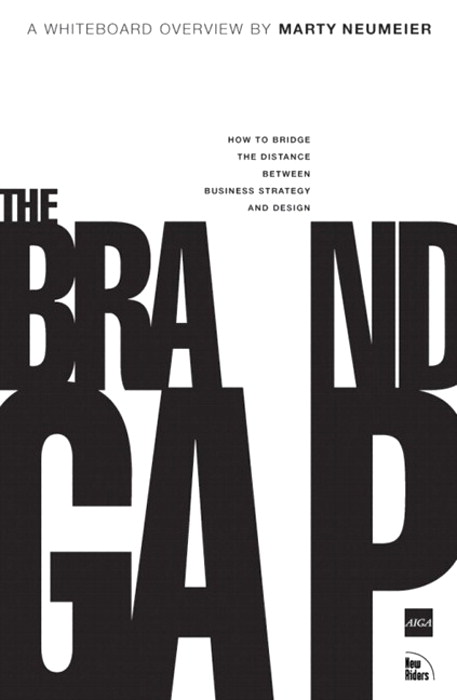 1. The Brand Gap by Marty Neumeier: This is probably my favorite simple branding book of all time. It is very visual, can be read in an hour, and is great for sharing and discussing with colleagues.
—
 2. Zag by Marty Neumeier: Another great book by Marty Neumeier, Zag is also a quick read with plenty of ideas that will help you think about how to differentiate your business from your competitors.
—
 3. Positioning: The Battle for Your Mind by Jack Trout and Al Ries: This is the book that defined the art of brand positioning, still just as relevant as it was when first published 30 years ago. In fact, in The Ad-Free Brand, I drew inspiration from the thinking of Trout and Ries, just updating the way positioning is implemented for a post-advertising era.
—
 4. Differentiate or Die by Jack Trout: Another classic, in my view the best of several other positioning-related books published by Jack Trout over the years. An easy read.
—
 5. Designing Brand Identity by Alina Wheeler: This is the guide to building out the brand identity for your business. It is an elegant and beautiful book, filled with useful case studies—you may be able to find an example in here that you’d like to emulate for your business.
—
 6. Brand Atlas by Alina Wheeler and Joel Katz: Alina Wheeler’s newest book is an overview of many of the most important issues in branding today. Simple descriptions of the key concepts, featuring quotes and insights from leading practitioners, are paired with simple, beautiful diagrams and illustrations by Joel Katz.
—
 7. Strategic Brand Management by Kevin Keller: When you are ready to move beyond the basics and want to attempt a graduate-level curriculum in branding, head directly for this book. It is the textbook used on college campuses around the world for brand management courses, and it is about as comprehensive a guide to brand management as I have ever encountered.
—
I’ve also compiled these books into a guide on Amazon here in case you want to buy the whole library (just for convenience, I don’t get any commission since Amazon doesn’t like North Carolina, my home state).
Happy reading!

How to test your brand positioning: is it desirable, deliverable, and differentiated?
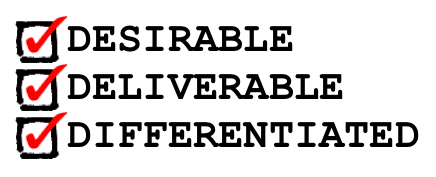 Once you and your positioning team have determined what the positioning for your brand should be and identified the points of difference, points of parity, and maybe even a brand mantra, consider checking your work with the following approach I learned from branding expert Kevin Keller.
Write up your key points of difference and points of parity (and your brand mantra if you have it) where you can see them together, representing the sum of your positioning. When you look at these pieces as a whole, does your chosen positioning pass the following three-question test?
1. Is this positioning desirable to your brand community?
Does the positioning reflect characteristics your brand community would want? It isn’t enough just to be different—the positioning should show that you are different in a way that people would value.
2. Is this positioning deliverable by the brand?
Does your brand experience already deliver on this positioning? If not, and if you’ve identified aspirational points of parity or points of difference, can you make changes to the organizational strategy that will ensure this positioning will reflect the actual brand experience at some point in the near future? If your brand can’t deliver on the positioning, it won’t feel authentic to your brand community and may actually do some damage if people perceive it as false or misleading.
3. Is this positioning differentiated from your competitors?
Does this positioning distinguish your brand from everyone else in the competitive frame of reference? Even if the positioning is desirable and deliverable, if it is indistinguishable from the positioning of your competitors it won’t be effective.
Desirable, deliverable, and differentiated: great positioning will be all three at once.
Sighting: The Ad-Free Brand in Singapore
Thanks to my friend Jesslyn Koh for sharing this picture from the from the Kinokuniya Bookstore in Singapore. If you happen to be in the neighborhood and haven’t yet picked up a copy of the book, looks like they have a few available!

Sighting: The Ad-Free Brand in Malaysia
Thanks to Pip Kasim, an MBA student in Kuala Lumpur, Malaysia, for sharing this picture of her friend Jojo Ds and the book!
Ally Bank shows there’s a right time for even ad-free brands to advertise
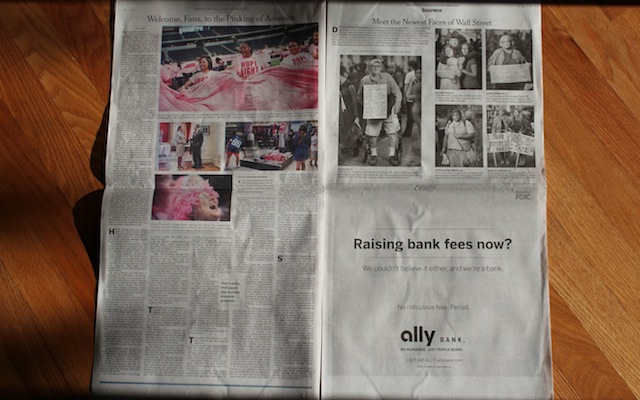 Even though I wrote a book called The Ad-Free Brand, I don’t hate all traditional advertising. In fact, sometimes, I absolutely love it. Today is one of those days.
This morning I opened the New York Times, reading, among other things, stories about the Occupy Wall Street protests. In the business section, on page 7, the top of the page featured a series of images of the protesters, from an 87 year-old man in a walker to a woman carrying a sign that says “Logic of capitalism: you cannot be rich without making others poor.”
Right beneath these photos was a half-page ad from Ally Bank. I’ve been keeping an eye on Ally for the past few years because they seem to be a fantastic example of a Zag approach—a bank that is going one way when every other bank is going the other (in my view, wrong) way. Here is a story that will give you some background on Ally’s approach, but essentially their mission is to re-humanize banking. According to their website, the bank was founded on three simple principles: 1) talk straight 2) do right 3) be obviously better.
That sounds pretty good for a bank.
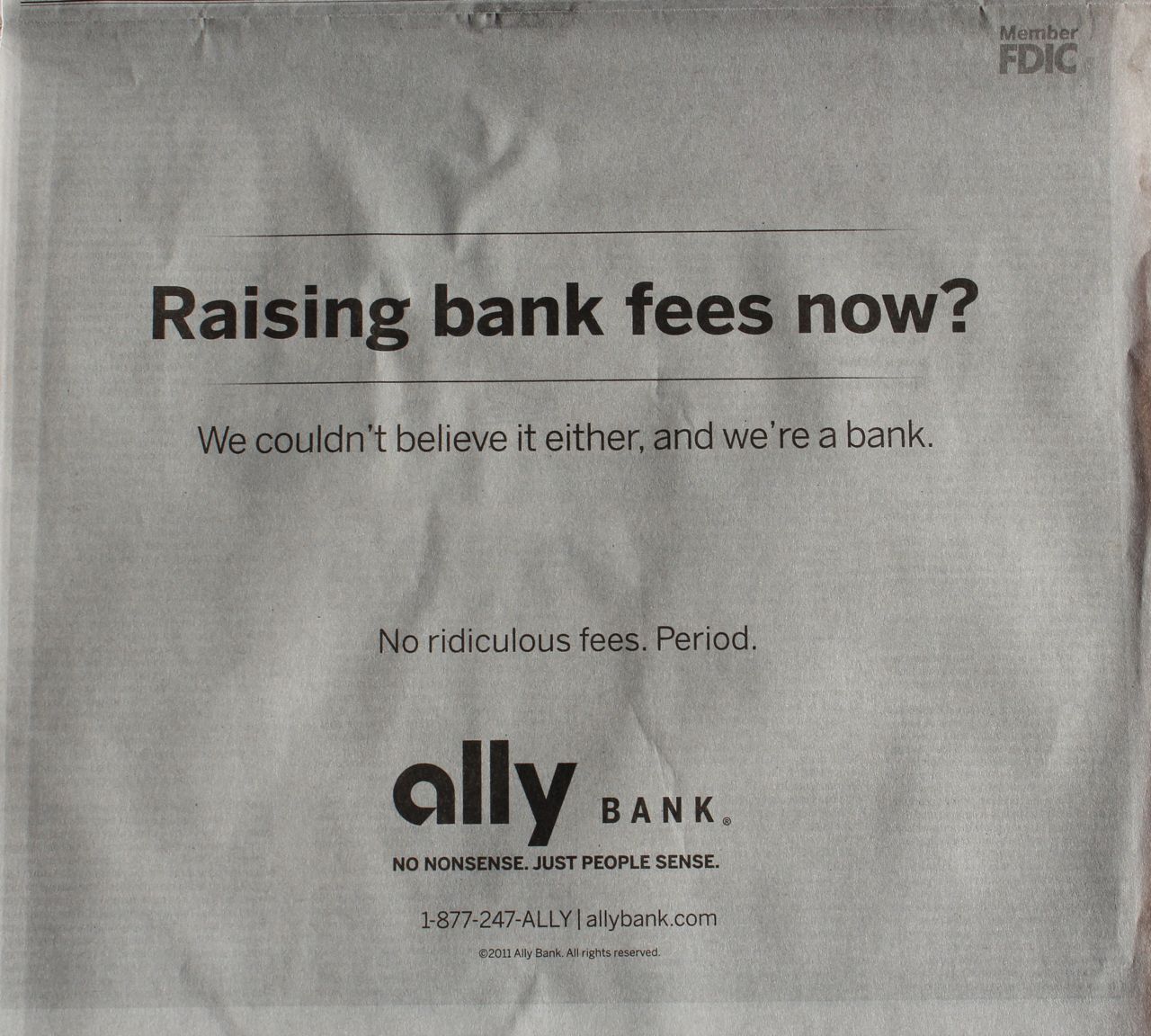
Here is a close up of the ad that appeared beneath the protester photos:
 In The Ad-Free Brand, I answer a question I’m often asked: Can ad-free brands ever advertise?
The answer?
Absolutely.
But rather than building their brands exclusively through traditional advertising, ad-free brands build their brand by following the principle of esse quam videri, “To be rather than to seem to be.”
Rather than talking about what the brand is through the language of advertising, they live the brand and design it into the DNA of the organization so that the brand comes through in every interaction with it.
But sometimes there is a moment in history when a brand story resonates especially well on a broad scale.
For Ally Bank, this is that time.
For the last few years, Ally has been building a brand as a different type of bank from the inside out, by being a more human bank rather than just seeming to be a more human bank. Even though Ally isn’t exactly an ad-free brand (they do regularly spend money on traditional advertising), they are investing much more money and effort getting the brand experience right than they are in spouting endless marketing messages.
Now, with a growing movement increasingly dissatisfied with the financial industry, it is a perfect time for them to dial up the volume with a few well-placed advertisements. And with a pitch-perfect, authentically-articulated message, this particular ad not only differentiates Ally from its banking competition, it serves as an olive branch—one bank willing to break with its brethren and show sympathy to the pain being expressed by a growing movement.
I mean, come on. Are the banks really arrogant enough to believe it is OK for them to screw the very consumers who bailed them out and have seen none of the benefits from that investment trickle back to them? Ally Bank doesn’t think so.
I don’t either.
—
Was this post helpful?
If so, you can find more thoughts about how to build your brand effectively in my book, The Ad-Free Brand (not an advertisement, mind you, just a friendly suggestion:).
Only $9.99 for the Kindle, but available in each of these formats:
Book | Kindle | Nook | EPUB/PDF
Hey, I Wrote a Book!

Available now in print and electronic versions.
 Dark Matter Matters