Dark Matter Matters
the open source way
Five questions about authenticity and the open source way with Jim Gilmore
A few months ago, I had the opportunity to meet Jim Gilmore, co-author (with Joseph Pine) of the book Authenticity: What Consumers Really Want. I first read the book a few years ago, and it really struck a nerve for me—these guys were on to something.
 So I convinced Jim to subject himself to a Five Questions interview about the place where authenticity and the open source way intersect.
CHRIS: After joining the open source world ten years ago, it didn’t take me long to figure out that most open source folks despise marketing as it is traditionally practiced. Is there something inherently inauthentic about the language of marketing? Perhaps open source folks have a low tolerance for inauthenticity?
JIM: I often quote from a letter-to-the-editor that appeared in the Harvard Business Review following the publication of our article, “Welcome to the Experience Economy.” In this letter, Robert Jones of Wolf-Olins shared his definition of a brand as “the promise of an experience.”
Joe Pine and I responded by saying Amen to that, but added that so often the actual experience fails to fulfill against the promise. Indeed, marketing in general, and advertising in particular, has become a giant phoniness-generating machine. And not just the language of marketing, but the very practice of marketing so often serves to erode the perception of authenticity among consumers—by making promises that bear little resemblance to the actual experience encountered.
So much creative talent today is engaged in making promises as marketing instead of being employed to create compelling experiences as actual output. The experience itself should be the marketing.
My friend Robert Stephens, founder of the Geek Squad, is fond of saying, “Advertising is the tax you pay for being unremarkable.” I feel that way about most marketing. I’d like to see creative talent diverted from making messages about goods and services and used instead to help create truly remarkable experiences, ones so compelling that they command a fee as product.
[Read the rest of this post on opensource.com]
Toyota gives customer-driven design the green light
A few weeks ago, Red Hat CEO Jim Whitehurst wrote an article for BusinessWeek suggesting that Toyota might benefit from doing things the open source way when it comes to building the software inside its automobiles.
 From Jim’s article:
Open source is about leveraging the power of participation to solve complex problems such as manufacturing, health care, and government. This advantage is why numerous 21st century successes—from Google to Facebook to Wikipedia—are all based on open-source software and principles. It may also be how Toyota can improve its vehicles and ultimately regain consumer trust.
Toyota may be listening.
Last week, Associated Press reported that Toyota has opened a new Design Quality Innovation Division. The new group will be led by Kiyotaka Ise, formerly of Toyota’s Lexus subsidiary, and will be tasked with more quickly reflecting customer feedback in automobile design.
[Read the rest of this post on opensource.com]
Brand positioning tip #10: repetition is the secret ingredient
When I was at Red Hat, I sometimes got questions from folks who wanted to know the secret to Red Hat’s brand success. First off, I’d always say you don’t grow a $1 billion technology company on brand alone. We sold great products. We treated our customers and developers well. We had a revolutionary business model. Those kinds of things are the bedrock of a successful brand.
But if I was to point to one “secret” thing I think had a big impact on the brand it would be a very simple one:
We said the same thing. Over and over. For years.
For me personally, sometimes I said things so many times I was just as sick of hearing myself as others were.
When people would come to me and ask if they could make a tan hat to give away at tradeshows rather than a red one, I would always repeat: “But we are Red Hat.” We brand folks would always be the ones to bring up the company mission, values, and culture. We’d steer conversations back toward the open source way when they went astray. When my colleagues and I would speak about the culture and brand in orientation, we’d tell the same stories, show the same videos of Bob Young and Matthew Szulik to new employees year after year after year.
When it comes to brand positioning, the biggest mistake you can make is to invest your time, money, and energy in discovering your optimal brand position… and then give up on it before it has a chance to do its magic. Building a great brand has to be done over time and, to paraphrase Jeff Bezos of Amazon, there are no shortcuts.
I’ve worked with a lot of creative types over the years, and most of them love to come up with new ideas. Heck we all do. But sometimes the thing that makes you stand out when everyone else is saying something new is to say something… well… old.
Can truly great design be done the open source way?
A few weeks ago, I wrote an article about Apple and open innovation. The discussion in the comments about Apple’s success, despite their non-openness, was pretty interesting. Greg DeKoenigsberg started things off with this salvo:
“No community could build something as gorgeous as the iPhone; it requires the singular vision of a beautiful fascist, and the resources of a gigantic company, and a world full of users who would happily trade simplicity and certainty for the ability to tinker.”
 I think few people would argue that one of Apple’s greatest strengths is their amazingly consistent, and consistently beautiful, design work. And when I say design, I mean both “little d design” (their stuff looks awesome) and “big D Design” (their systems, processes, and experiences are expertly rendered).
From a design perspective, Apple has figured out how to make lightning strike in the same place over and over again.
Today, I want to ask a question that I’ve been thinking about for a long time:
Can truly great design be done the open source way?
Meaning, can a group of people designing collaboratively, out in the open, ever do the kind of consistently beautiful design work that Apple does? Or is Greg right, that “no community could build something as gorgeous as the iPhone”?
Both of my partners at New Kind, David Burney and Matt Muñoz, are designers by background. Both of them have significant open source experience (David spent almost 5 years as the VP of Communications at Red Hat, Matt worked on many Red Hat projects, including designing the Fedora logo), so the three of us have talked about this subject many times before.
[Read the rest of this post on opensource.com]
Is Jaron Lanier just a hater, or should we be paying attention?
Last week, my friend Greg DeKoenigsberg posted an article about Jaron Lanier’s negative comments regarding open textbooks. At almost very same time, I happened to stumble upon an article Jaron wrote back in 2006 criticizing Wikipedia.
 The common theme is Jaron taking issue with what he calls “online collectivism,” “the hive mind,” and even “digital Maoism” (ouch!). You might call this same concept “crowdsourcing” or “the wisdom of crowds.” It’s all in the eye of the beholder, but the guy clearly does not have much love for wikis or the works of collective wisdom they create.
So I had to ask myself: Why so negative, Jaron?
Is Jaron really a hater of free culture, as Greg claims in his article? Is he an enemy of the open source way? Or is he just a smart dude warning us about the risks of taking the wisdom-of-crowds concept too far?
 Fortunately for us, Jaron published a book earlier this year entitled You Are Not A Gadget. So I took a few hours and read it last week to see if I could answer some of these questions.
At times, the book is scary smart, with precise analysis from a man who clearly questions everything, and is in a better intellectual position to do so than most (the section on social media and its redefinition of friendship is especially interesting).
At other times it read like a college philosophy term paper. And occassionally, especially toward then end, it devolved into nearly unintelligeble (at least by me) ravings about things like “postsymbolic communication” and “bachelardian neoteny” (Michael Agger’s review in Slate calls him out for this too).
But wait! Right near the beginning of the book, I found this paragraph:
“Emphasizing the crowd means deemphasizing individual humans in the design of society, and when you ask people not to be people, they revert to bad, moblike behaviors.”
Hey… I kinda agree with that…
[Read the rest of this post on opensource.com]
A handbook for the open source way, written the open source way
Remember the Seinfeld episode where Kramer had the idea to make a coffee table book about coffee tables? I always thought that was a pretty elegant idea. Well, a few months ago, some of the smart folks on Red Hat’s community architecture team had a similarly elegant idea:
Write a book about building community the open source way… and write it with a community, the open source way. Meaning, open the text up, allow interested users to contribute, and see what happens.
Brilliant.
The book is entitled The Open Source Way: Creating and nurturing communities of contributors and you can access the current text here and the wiki for contributors here.
I caught up with Karsten Wade, who is leading the project, to learn more.
There have been other books written about community-building over the last few years, but I am not aware of any others that have been written by a community. Where did the idea to start this project come from?
Our team, Community Architecture, has a strategic community role in Red Hat, and part of that is learning, distilling, and sharing knowledge. We bring the knowledge of how to produce software the open source way to different parts of the company. We’re all in a community of practice here, and have much to learn from each other.
Once we had the idea of a cookbook or handbook for internal needs, it was immediately clear that following the open source way with the content would be better, have more impact, and protect important knowledge in case our team gets eaten by raptors.
What if politicians innovated the open source way?
In the discussions around some of my previous articles, I’ve noticed a trend: we seem to be focusing on cultural changes that need to be made for the open source way to be effective in contexts beyond technology. One cultural context I think could really use some help is politics.
 I read an interesting post last week by Morton Hansen (author of Collaboration: How Leaders Avoid the Traps, Create Unity, and Reap Big Results) entitled Obama’s Five Collaboration Mistakes. In the comments below the post, some folks interpreted his words as an attack on the Obama administration. Me? I’d probably interpret Hansen’s words more broadly. Perhaps something like:
Politicians are pretty darned bad at collaborating a lot of the time.
I think many folks would agree with this statement no matter where they sit politically. No matter where they live around the world.
In fact, the word “political” has become almost synonymous with anti-collaborative behavior in many contexts. Certainly in the business world.
But there is a lot a stake here. The economic downturn has hurt our businesses badly. And this has affected many of us in even more personal ways. Jobs. Homes. Security.
We need innovation in the political world to help solve the problems of the business world. Which means we are going to need better collaboration across political boundaries, both inside and between our countries.
Could we open source folks help?
[Read the rest of this article on opensource.com]
Is the traditional business world at war with creativity?
Earlier this week some colleagues and I attended a fantastic gathering of business and political leaders called the Emerging Issues Forum. The theme of the forum—interestingly enough for a bunch of business folks—was creativity, and speakers included some of my favorite thinkers/authors who analyze the future of business: 
- Roger Martin, Dean of the Rottman School of Management at the University of Toronto, and author of The Responsibility Virus, The Opposable Mind, and a new book on design thinking called The Design of Business.
- Tom Kelley, General Manager of legendary design firm IDEO, and author of The Art of Innovation and The Ten Faces of Innovation. IDEO’s CEO Tim Brown also has a book out on the subject on Design Thinking, called Change by Design, which my friend Jonathan Opp wrote a nice review of here.
- Daniel Pink, bestselling author of A Whole New Mind, a book that has been extremely influential in my thinking about how the left brain and right brain can play nice in the business world. Pink also has a new book out, called Drive: The Surprising Truth About What Motivates Us.
During their talks, I couldn’t help but notice all three touched on a similar thematic: the crucial role that inspiring creativity plays in driving innovation.
[Read the rest of this post over at opensource.com]
Three signs your corporate culture isn’t ready for the open source way
It’s a good bet that the next generation of defining companies will have corporate cultures built the open source way– around openness and collaboration, while fostering community and culture that extend outside the company walls.
 In fact many of the defining companies of the first decade of this century show these characteristics (with one very notable exception we discussed earlier).
It kind of makes you want to rush in and see if you can change your old style corporate culture and get in on the action. But try to change too fast and your efforts may backfire.
So here are three signs that your corporate culture may not quite be ready for the open source way– and some tips to help you move closer.
[Read the rest of this post over at opensource.com]
Introducing opensource.com
One of the things I’m most excited about as I start my new job at New Kind is that I have the opportunity to continue to do work with Red Hat. Today, in the spirit of release early, release often, Red Hat opened the doors to a new website, opensource.com. In addition to my work here at Dark Matter Matters, I’ll also be writing for the Business channel of opensource.com.
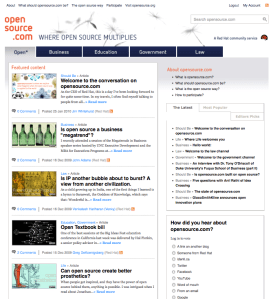 So what is opensource.com?
It is the beginning of a conversation about how the world can apply the lessons of the open source way broadly– in business, in government, in education, in the law, and generally in our lives. Unlike most other open source sites, it is not just about software. From the site:
The term open source began as a way to describe software source code and the collaborative model for how it’s developed. Red Hat used this model for developing technology and built a business model around open source and its principles: Openness. Transparency. Collaboration. Diversity. Rapid prototyping… The open source way is more than a development model; it defines the characteristics of a culture.
Although this site was started by Red Hat, it is not intended to be a Red Hat site, but rather a site where the open source conversation is extended to all companies and organizations, even beyond the technology industry. Red Hat CEO Jim Whitehurst states it really well in his introductory post:
Hey, I Wrote a Book!

Available now in print and electronic versions.
 Dark Matter Matters