Dark Matter Matters
The Ad-free Brand
The four questions your brand positioning research must answer
To create great brand positioning, you must do your homework. In a brand positioning project, this homework mostly consists of doing some research about the brand ahead of time. But how do you organize your research?
In this post, I’ll teach you a simple tip I learned from Dr. Kevin Keller that will help you frame your positioning research in a way that will ensure you find the answers you need.
When doing research to inform a brand positioning project, I am not satisfied until I can answer the following four questions:
1. What does the brand community currently believe about or value in the brand?
2. What might the brand community believe or value about the brand in the future?
3. What does the organization currently claim about the brand?
4. What would the organization like the brand to become down the road?
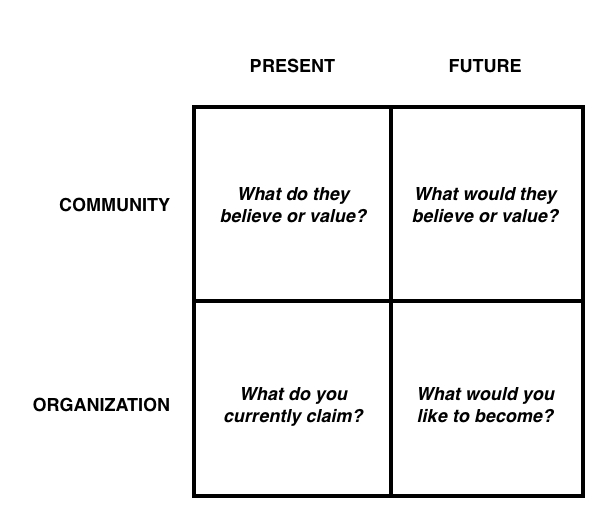 Why are the answers to these four questions so important?
Great brand positioning has one foot in the present and one foot in the future. The research we’re doing to answer these questions helps us understand exactly where each foot should be planted.
The Foot in the Present
By studying what your brand community members currently believe the brand stands for and what they value about it today, you’ll begin to understand their current experience of the brand. Yet your community’s experience of the brand can be very different than how you see or talk about the brand inside the organization. So the brand research should study the brand from both an internal and external perspective.
Often organizations will notice gaps or inconsistencies between the brand they claim to be and the brand their community sees or experiences—the brand promise-brand experience gap.
Once you deeply understand what your community currently believes or values about the brand and compare this to what you currently claim about the brand, you’ll have a complete picture of where your “foot in the present” is planted. You’ll see clearly how big the gap is between your brand promise and brand experience. Only then can you begin the work of building brand positioning that closely aligns the brand promise claimed with the brand experience delivered.
The Foot in the Future
But a brand that is only concerned with the present state of affairs is a brand in stagnation. You’ll want your brand to grow, prosper, and remain relevant down the road. So you should also try to understand what the brand community might believe or value about the brand in the future.
What directions might people give you permission to take the brand? Where do they not want you to take it? What would they value in the brand that you don’t provide today? What does the organization do today that people would rather not see you continue to do down the road?
Equally important is that you strongly consider where you want to take the brand. Remember the apocryphal Henry Ford quote, “If I had asked people what they wanted, they would have said faster horses.”
Sure, to remain relevant you should deeply understand what the community members want the brand to become, but do not become a slave to their vision. You might have entirely different and amazing places you’d like to take the brand that your customers or other community members can’t yet see.
So, in order to understand where your foot in the future is planted, you should seek to understand both what your community would believe or value in the brand and what you want the brand to become down the road.
Where Great Positioning Lives
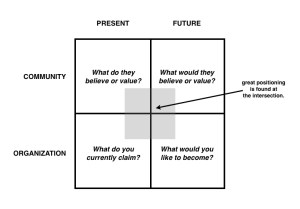
Great positioning lives where all four answers intersect. It is a bridge between your current brand experience and the brand you’d like to become in the future. It deeply reflects the brand you currently see while lighting the path to what it could become.
Great positioning lives in all four of these quadrants at once. It can be like the North Star, guiding the organization toward the future, while paying homage to the past and making clear connections between things that resonate about the brand with both your organization and your brand community.
So where should you look for data that will help you answer these four questions and start on the road to great brand positioning?
I’ll share some of the mostly likely sources of data in a followup post.
—
This is the third in a series of posts drawn from The Ad-Free Brand, which is available now.

Why does brand positioning matter and what must change?
I believe almost all great brands are built on a foundation of great positioning.
I feel so strongly about positioning that one of the core elements of this blog is a series of brand positioning tips I learned over the years as an eager student of classic brand positioning.
Sometimes great positioning is led by a branding genius such as Scott Bedbury (who helped grow the Nike and Starbucks brands); sometimes a great leader and communicator with a very clear vision (like Steve Jobs at Apple) drives it into the organization; sometimes people stumble on great positioning by pure luck; and more and more often, organizations are developing positioning by collaborating with the communities of people in and around the organization who care most passionately about the brand.
This last way is the ad-free brand way of developing brand positioning.
 Why does great positioning matter? In my view, there are four key reasons brands should care about positioning.
1. Great positioning helps people understand the brand
The best brand positioning is always simple and clear. The greatest product or organization in the world won’t be successful if people can’t or don’t bother to comprehend why they should care about it. Your story must be able to break through the clutter.
2. Great positioning helps people value the brand
Getting people to understand the brand is the first step, but no less important is ensuring they value the brand. The best brands stand for things people care about or desire.
3. Great positioning helps people identify with the brand
Once people understand and value the brand, they must also understand how they fit in and how they can engage with the brand. They need to see some of themselves in it.
4. Great brand positioning helps people take ownership over the brand
It may sound like a brand’s worst nightmare to lose control and have the brand community take over. But the most self-actualized brands of the twenty-first century allow the communities of people surrounding them to take some ownership of and responsibility for the brand. Essentially, the brand owners become in command and out of control of the brand.
In 1981, when Jack Trout and Al Ries wrote Positioning: The Battle for Your Mind (the book that really defined the discipline of brand positioning) traditional advertising was still a dominant force. In fact, as you glance through their book, you’ll notice that most of the examples they use to illustrate positioning concepts are classic advertisements or advertising campaigns like the Avis “We’re #2, so we try harder” or the 7-Up “Uncola” campaign.
In the book, Trout and Ries define positioning as follows:
“…positioning is not what you do to a product. Positioning is what you do to the mind of the prospect. That is, you position the product in the mind of the prospect.”
The Trout and Ries definition is a perfect way to achieve the first three of the four benefits above; it helps people understand, value, and identify with the brand.
Where the Trout and Ries model of positioning is all about what you do to the mind of the prospect, ad-free brands are less interested in creating meaning for a brand in people’s minds and more interested in creating meaning for a brand with the help of people’s minds.
By giving the communities of people who care about a brand some ownership over its future direction, we begin to build relationships based on trust, respect, and a mutual exchange of value.
Where 21st century brands will really shine is by mimicking the open, collaborative, meritocratic model of the open source software movement (and the Internet itself) in their positioning work. In my view, without beginning to engage the communities of people who care about a brand as co-owners, classic brand positioning by itself will continue to be less and less effective as traditional advertising and PR continue to be less and less effective.
The secret? Marrying those classic brand positioning principles to a 21st century way of collaborating with the communities of people who care about a brand. By doing both together, we’ll be able to build stronger, more resilient brands than ever before.
—
This is the second in a series of posts drawn from The Ad-Free Brand, which is available now.
Dark Matter Matters has a snazzy new look. ‘Bout time.
Over the past few weeks, I’ve spent some time toiling away in wordpress.com hell, updating the static content and look of this blog for the first time since I launched it at the beginning of 2009.
I’ve added some new sections, including one for my forthcoming book, The Ad-Free Brand (Did I mention I wrote a book? Oh yeah, like 1000 times. Sorry about that). Right now I’ve put a draft of the introduction up there, and I’d love any comments or suggestions– still time left to edit before the book comes out!
I also added pages featuring the key communities I’m working with right now, opensource.com and the Management Innovation Exchange. Other than that, it’s a spiffy new template, a few new graphics here and there and, hopefully, some more original articles featuring content from the book over the coming months.
I still have some additional changes I’d like to make, adding TypeKit fonts, customizing the stylesheet a bit, you know, blog nerd stuff. But I’m decently pleased with where it is right now, so I thought I’d point it out.
Thanks for taking a look!
The astrophysics of building a brand from the inside out
 It has been a while since I wrote an original post on this blog, so I thought over the next few months I’d try to make up for lost time by previewing some of the concepts from my new book The Ad-Free Brand: Secrets to Successful Brand Positioning in a Digital World, due out in August. If you like what you see, let me know. If not, well, I still have some time to make edits, so let me know that as well. But be gentle.
One of the key concepts in the book is that ad-free brands are brands built from the inside out. But what exactly does this mean?
Imagine for a second that a brand is a powerful star at the center of a solar system, maybe one like our Sun. For me, brand positioning is an attempt to describe the gravitational pull at the very center of that star.
Great brand positioning creates gravity that pulls people closer to the heart of the brand. As people move closer, the brand releases energy, in much the same way a star sends out heat and light.
So when beginning to roll out new brand positioning, one way to think of your work is as an attempt to mimic thermonuclear fusion within a star. No small feat, huh?
We want to pull people closer to the center of the brand using the brand positioning as a gravitational force. Then, just like with atoms in a star, once the core group of people at the center of the brand is sufficiently dense, a reaction occurs, resulting in a continuous stream of brand energy released over time. The denser you can make the core near the center of the brand, the more energy is released.
 If you aren’t the least bit interested in astrophysics, or that explanation above did not resonate with you, let me try another, simpler one:
At some point, if enough people begin to deeply understand and live the brand in their daily work, magic happens.
American showman and circus entrepreneur P.T. Barnum was no astrophysicist, but he understood the power of this magic moment. His explanation: “Nothing draws a crowd like a crowd.”
Aligning a core, closely aligned group of people around the brand positioning is the only way to set off this particular reaction. And there is no better place to start rolling out your positioning than with those people who already work for your organization and have a vested interest in its success.
Building a brand from the inside out means building the brand by creating energy with the community of the people closest to the brand—those who work for the organization—and using the gravitation force this group creates to pull even more people close to the center of the brand.
My book “The Ad-Free Brand” is available for presale on Amazon.com
 I was looking for a new book on Amazon.com today that I read about in the New York Times, and while I was there, I thought I’d do a quick search to see if my book was available for pre-sale yet. Lo and behold, there it was!
Kind of exciting for a first-time author.
Now I just need to finish it so I can meet that August publication date. I’ve written about 220 pages in the last three months, and am pretty close to being done. If all goes well, the final bits will be off to my editor by the end of the month.
I’ve been sneakily testing out some of the concepts I’ll cover in the book in recent blog posts for opensource.com, the MIX, and Fortune, but over the coming months I’ll be previewing even more of it right here on Dark Matter Matters.
Okay, enough with the blogging… must… finish… chapter… seven…
This one goes out to the fence painters
 I’m always looking for interesting new communities to highlight on opensource.com. Over the past year, I’ve covered everything from Wikipedia to OpenIDEO to The White House and am, frankly, overwhelmed by the sheer quantity of new community-building efforts going on out there.
Seems like every day I get an email or see something on Twitter or Facebook about a new community that sounds interesting and innovative. I’ve found some amazing people and visionary ideas. I hope to continue to highlight the best of these new communities here on the business channel.
But at the risk of sounding like a hater, I must admit I’m getting a touch of new-community fatigue.
I think I went over the edge a few weeks back when ex-advertising industry celebrity Alex Bogusky (yes, the same guy who did all of those weird chicken ads for Burger King and famously tried to make Microsoft cool) announced his new “Collaborative Community/Brand For Social Entrepreneurs.” He calls it Common. No offense to Alex, but when the advertising agency folks are hopping on the community brand bus, you have to wonder whether the seats are starting to get a tad bit full…
I also wonder if there is a bit too much Tom Sawyer-fence-painting going on in some of these new communities. In case it’s been a while since you read Tom Sawyer, here’s how Wikipedia summarizes the story of Tom Sawyer and the fence:
Is your brand out of control?
I’m lucky enough to have the opportunity to spend much of my time these days doing something I love—helping clients position and manage their brands. My experience helping build the Red Hat brand over ten years had a profound impact on the approach I take to brand positioning.
 In the past year, as I’ve applied open source principles I learned at Red Hat to brand positioning projects in many different types of organizations, I’ve started thinking a mashup of classic brand positioning concepts and tenets of the open source way might help provide some clues for how brands might be better managed in the future.
I’ve put my time where my mouth is, and am currently in the process of writing a book entitled The Ad-free Brand: Secrets to Successful Brand Positioning in a Digital World, which will be published this fall.
Rather than writing the book behind closed doors and only revealing the finished product, I thought I’d share some of my ideas with you along the way, taking a cue from the open source way and releasing early and often.
Today, I’d like to explore the traditional role of brand positioning, and share some ideas for how I believe it might change to remain relevant in a digital world.
Audience or Community?
Typical marketing experts would define positioning as the art of creating meaning for a brand that occupies a distinct, valued place in the minds of members of a target audience.
But is the idea of an audience for brand messages outdated? Certainly in the heyday of traditional advertising, brands had an audience. The brands spoke, consumers listened… or didn’t.
I’m writing a book
For my first post of 2011, I thought I’d share some interesting news: I’m writing a book.
The title is The Ad-free Brand: Secrets to Successful Brand Positioning in a Digital World. It is intended to be a hands-on guide to help organizations of any size in any industry effectively position their brands in a what I’d call a post-advertising world.
I’m writing it not just for marketing/communications types, but for anyone who is interested in learning more about how to effectively position their brand using 21st century tools and strategies, whether the brand is a product, a website, a small business, a non-profit, a person, or a Fortune 500 company.
As those who’ve read my brand positioning tips know, I’m a bit of a positioning junkie. But my frustration has been that I haven’t found a really good resource that helps people manage and grow brands that can’t afford (or choose not to do) big fancy advertising campaigns. If you read through the classic texts like Positioning: The Battle for Your Mind by Jack Trout and Al Ries, they are filled with examples of executing positioning through advertisements, taglines, and marketing campaigns.
But as good as the positioning concepts themselves are, I’m not sure the advertising-driven execution of these concepts is as relevant in 2011 as it was in the 20th century. My goal with The Ad-free Brand is to teach people the timeless principles of good brand positioning, then show them how to apply them a new kind of way using the lessons I’ve learned from the open source world and elsewhere.
As some of you know, I spent the first part of my career in book publishing, first as a literary agent then as an editor. Writing a book is something I’ve always wanted to do, so I’m kind of excited, but also pretty nervous. Yikes!
The Ad-free Brand will be published by Pearson/Que sometime in Fall, 2011. I’ll keep you up to date on my progress along the way. Finally, I just want to say thanks for coming by and reading some of my posts this past year. If you notice me writing a few less original posts during the next few months, now you know why:)
Happy new year!
Hey, I Wrote a Book!

Available now in print and electronic versions.
 Dark Matter Matters
