Dark Matter Matters
innovation
MIX: Gary Hamel’s experiment in reinventing management the open source way
Of all of the people talking or writing about the future of business right now, no one has more street cred than Gary Hamel. I’ve written about him many times before, and his book The Future of Management is one of the most inspiring and meaningful business books of the last 10 years.
 Last year at the World Business Forum, when Gary called open source one of the greatest management innovations of the 21st century, there was some serious high-fiving going on amongst us open source business types.
So I’ve been watching closely as Gary and a team of management superstars have launched an open innovation experiment called the Management Innovation Exchange, or MIX. In the video below, Gary explains a little bit about the goals of the MIX.
Here’s how they describe the MIX on the website:
“The Management Innovation eXchange (MIX) is an open innovation project aimed at reinventing management for the 21st century. The premise: while “modern” management is one of humankind’s most important inventions, it is now a mature technology that must be reinvented for a new age.”
From spending some time on the site, it clearly shares a lot of the same foundations as the open source way, even if the MIX folks prefer the term open innovation.
One of the most wonderful bits? The MIX is a meritocracy, where anyone can join, submit management hacks, stories, or barriers, and then collaborate with others to explore the ideas further.
[Read the rest of this post on opensource.com]
The open source way: designed for managing complexity?
This week I finally got a chance to sit down and digest IBM’s latest Global CEO Study, newly published last month and entitled Capitalizing on Complexity. This marks the fourth study IBM has done (they complete them once every two years), and I’ve personally found them to be really useful for getting out of the weeds and looking at the big picture.
 This report is based on the results of face-to-face meetings with over 1500 CEOs and other top leaders across 60 countries and 30+ industries. These leaders are asked all sorts of questions about their business challenges and goals, then IBM analyzes the answers and segments the respondents to isolate a group of high-performing organizations they call “standouts.” The standouts are then further analyzed to find out how they are addressing their challenges and goals differently than average organizations.
As a quick summary (but don’t just read my summary, go download the study for free), IBM found a big change this year. In the past three studies, leaders identified their biggest challenge as “coping with change.” This year, they identified a new top challenge: “complexity.”
If you’ve been reading marketing collateral or web copy from your vendors over the past year (someone must read that stuff…) this will come as no surprise to you. How many things have you read that start with something like: “In our increasingly complex world…” or “In the new deeply interconnected business landscape…” If the marketing folks are saying it, it must be true.
But I digress. Here’s IBM’s punch line:
[Read the rest of this post on opensource.com]
BusinessWeek turns an eye to open source beyond technology
On opensource.com, we aspire to take principles the open source software movement has applied to building better software faster and find more uses for them in business, education, government, the law, and generally in our lives.
 So a few weeks back, I was excited to see that BusinessWeek (now Bloomberg BusinessWeek) ran a special report called Eye on: Open Source that also embraced the wider usage of open source principles in technology and beyond.
My personal opinion? I think a few of the articles in the special report confuse true community-driven open source innovation with concepts like user-driven product design, crowdsourcing, and design competitions. But it was still neat to see BusinessWeek recognize the applicability of open source principles beyond software.
[Read the rest of this post on opensource.com]
Three tips for escaping the creativity peloton without giving up on collaboration
If you’ve ever watched a road bike race like the Tour de France, you know the peloton is the big group of riders that cluster together during the race to reduce drag. It’s a great example of collaboration in action. But let’s face it: the people in the middle of the peloton may go faster than they would otherwise, but they don’t win the race.
 When it comes to creating and innovating, most companies (and employees) are in the peloton. They are doing enough to survive, but they are stuck in the pack. And if they stay in the pack too long, they lose.
Escaping the peloton is tough. Often, you see a cyclist break away, sprint for a while, only to get sucked back into the main group over time as the pressures of making a go independently prove too much.
You’ve probably felt this way at work. You come up with an amazing idea, one that will change the company forever. But little by little, people—even the well-meaning ones—chip away at its soul, until the idea goes from being amazing to, well, average. You end up being sucked back into the peloton.
After this happens one too many times, you may feel like you want to stop collaborating and try to make things happen on your own. Don’t do it. Even Lance Armstrong could rarely break away from the peloton without his teammates’ help.
Instead, here are three tips to help you escape the creativity peloton without giving up on collaboration.
[Read the rest of this post on opensource.com]
What if politicians innovated the open source way?
In the discussions around some of my previous articles, I’ve noticed a trend: we seem to be focusing on cultural changes that need to be made for the open source way to be effective in contexts beyond technology. One cultural context I think could really use some help is politics.
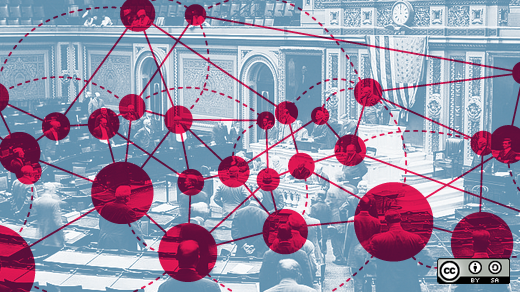 I read an interesting post last week by Morton Hansen (author of Collaboration: How Leaders Avoid the Traps, Create Unity, and Reap Big Results) entitled Obama’s Five Collaboration Mistakes. In the comments below the post, some folks interpreted his words as an attack on the Obama administration. Me? I’d probably interpret Hansen’s words more broadly. Perhaps something like:
Politicians are pretty darned bad at collaborating a lot of the time.
I think many folks would agree with this statement no matter where they sit politically. No matter where they live around the world.
In fact, the word “political” has become almost synonymous with anti-collaborative behavior in many contexts. Certainly in the business world.
But there is a lot a stake here. The economic downturn has hurt our businesses badly. And this has affected many of us in even more personal ways. Jobs. Homes. Security.
We need innovation in the political world to help solve the problems of the business world. Which means we are going to need better collaboration across political boundaries, both inside and between our countries.
Could we open source folks help?
[Read the rest of this article on opensource.com]
Is the traditional business world at war with creativity?
Earlier this week some colleagues and I attended a fantastic gathering of business and political leaders called the Emerging Issues Forum. The theme of the forum—interestingly enough for a bunch of business folks—was creativity, and speakers included some of my favorite thinkers/authors who analyze the future of business: 
- Roger Martin, Dean of the Rottman School of Management at the University of Toronto, and author of The Responsibility Virus, The Opposable Mind, and a new book on design thinking called The Design of Business.
- Tom Kelley, General Manager of legendary design firm IDEO, and author of The Art of Innovation and The Ten Faces of Innovation. IDEO’s CEO Tim Brown also has a book out on the subject on Design Thinking, called Change by Design, which my friend Jonathan Opp wrote a nice review of here.
- Daniel Pink, bestselling author of A Whole New Mind, a book that has been extremely influential in my thinking about how the left brain and right brain can play nice in the business world. Pink also has a new book out, called Drive: The Surprising Truth About What Motivates Us.
During their talks, I couldn’t help but notice all three touched on a similar thematic: the crucial role that inspiring creativity plays in driving innovation.
[Read the rest of this post over at opensource.com]
Reporting live from the front lines of the war on creativity
Today I spent a great day at the Emerging Issues Forum, where I’m proud to say my home state of North Carolina attracted some of the top business minds in the world (the Twitter stream is going crazy here). This morning featured two Dark Matter Matters all stars, Roger Martin and Tom Kelley (who I have written about previously here and here), but there was also an incredible lunch session where Charlie Rose interviewed husband and wife creative geniuses Nnenna Freelon (the 5-time Grammy nominated jazz vocalist) and Philip Freelon (architect extraordinaire), and plenty of other enlightening stuff.
 The theme of the conference is Creativity, Inc., and from what I can tell from many of the attendee and host comments, the theme of this year’s event is very different than years past. But the undercurrent of many of the comments from this morning seemed to take a clear point of view on this theme.
My interpretation? For years the business world has been waging a war against creativity… and creativity is beginning to fight back.
It’s about damn time.
Roger Martin is one of the most eloquent speakers in the world on the need for change in business. Some key points from his talk today:
Martin talked about two types of industries– clustered industries (where much of the industry is in one part of the world, Silicon Valley for high tech being one good example) and distributed industries (where the industry is dispersed all over, hair salons and pizza places being two examples).
Martin’s research shows that clustered industries have a higher percentage of the creative class of workers. The average salary for a creative worker in a clustered industry? About $70,000 per year. But for a creative worker in a dispersed industry? Only about $56,500 a year. Pretty big difference.
So what does it mean? According to Martin, income disparities will continue to grow unless we can figure out what to do with routine jobs in dispersed industries.
He calls this one of the greatest policy challenges of the 21st century: How can we increase the percentage of creativity we use in all jobs? How can we make use of the whole human being in work environments?
I love this thought of us figuring out how to use the whole human being– how many jobs do we see that leave tons of creative potential on the table, at the expense of not only innovation, but also employee happiness? Too many, in my experience. And at all levels in business, from executive on down.
Roger Martin and the new liberal arts MBA
This morning’s New York Times had a great article entitled Multicultural Critical Theory. At Business School? highlighting the changes many business schools are making in the way they teach their students. Probably the most visible leader of this movement has been Roger Martin, Dean of the Rotman School of Management at the University of Toronto, who is prominently featured in the article (and will be speaking here in Raleigh next month at the Institute for Emerging Issues Forum).
(VIDEO: a recent Roger Martin talk)
What kind of changes are the schools making? From the article:
“While few [business schools] talk explicitly about taking a liberal arts approach to business, many of the changes are moving business schools into territory more traditionally associated with the liberal arts; multi-disciplinary approaches, an understanding of global and historical context and perspectives, a great focus on leadership and social responsibility and, yes, learning how to think critically.”
Why? Look around you. In business, we are currently experiencing a double crisis of ethics and innovation. Take the results of a recent Gallup poll on Honesty and Ethics of Professions. Americans now trust the ethics and honesty of businessmen less than lawyers. Ouch.
Jim Whitehurst: How to create jobs the open source way
Fantastic blog post by Jim Whitehurst today on redhat.com called Creating jobs the open source way. As Matt Asay reported yesterday, Jim Whitehurst was one of only two technology CEOs present at President Obama’s Jobs and Economic Forum (the other was Eric Schmidt of Google) at the White House.

Red Hat CEO and President Jim Whitehurst
In his post, Jim makes a clear link from the open source way to innovation to jobs. I love the closing paragraph, which I’ve included below:
“Red Hat has built a successful, growing S&P 500 business on the power of open source, not just as a development model, but as a business and organizational model. While ours isn’t the only solution, I do believe business, government and society can unlock the value of information and create good, long-term jobs by sharing and working together.”
The White House has streaming video of all of yesterday’s events here.
I also found this article, which provides further information on a few of Jim’s points about national broadband infrastructure development, very interesting.
More proof that sharing is good, von Hippel style
Our video called the Red Hat Way starts:
“Your mother was right. It’s better to share.”
There’s more proof that your mom was right in the business world every day. Today in Orlando, experts from around the world are gathering for the inaugural Open Innovation Summit, highlighting companies like Proctor & Gamble, Mozilla, Xerox, and Johnson & Johnson who have seen success with collaborative innovation. My company, Red Hat, has also done pretty well with this approach.
Now, in a new working paper released yesterday entitled Modeling a Paradigm Shift: From Producer Innovation to User and Open Collaborative Innovation, Eric von Hippel and Carliss Baldwin examine the body of research to draw some conclusions about why more people are moving away from simple producer/consumer models to open collaborative innovation models.
You may have heard of Eric von Hippel, one of the world’s leading experts on open innovation. I like that he’s written about open source many times before, including in his 2005 book Democratizing Innovation and in his 2002 HBR paper Customers as Innovators.
In this paper, von Hippel and Baldwin argue that the number of places where traditional 20th century “producer” innovation (companies making products for users without collaborating with them) makes sense is rapidly shrinking. Why? From the paper:
Hey, I Wrote a Book!

Available now in print and electronic versions.
 Dark Matter Matters