Dark Matter Matters
community
Why does brand positioning matter and what must change?
I believe almost all great brands are built on a foundation of great positioning.
I feel so strongly about positioning that one of the core elements of this blog is a series of brand positioning tips I learned over the years as an eager student of classic brand positioning.
Sometimes great positioning is led by a branding genius such as Scott Bedbury (who helped grow the Nike and Starbucks brands); sometimes a great leader and communicator with a very clear vision (like Steve Jobs at Apple) drives it into the organization; sometimes people stumble on great positioning by pure luck; and more and more often, organizations are developing positioning by collaborating with the communities of people in and around the organization who care most passionately about the brand.
This last way is the ad-free brand way of developing brand positioning.
 Why does great positioning matter? In my view, there are four key reasons brands should care about positioning.
1. Great positioning helps people understand the brand
The best brand positioning is always simple and clear. The greatest product or organization in the world won’t be successful if people can’t or don’t bother to comprehend why they should care about it. Your story must be able to break through the clutter.
2. Great positioning helps people value the brand
Getting people to understand the brand is the first step, but no less important is ensuring they value the brand. The best brands stand for things people care about or desire.
3. Great positioning helps people identify with the brand
Once people understand and value the brand, they must also understand how they fit in and how they can engage with the brand. They need to see some of themselves in it.
4. Great brand positioning helps people take ownership over the brand
It may sound like a brand’s worst nightmare to lose control and have the brand community take over. But the most self-actualized brands of the twenty-first century allow the communities of people surrounding them to take some ownership of and responsibility for the brand. Essentially, the brand owners become in command and out of control of the brand.
In 1981, when Jack Trout and Al Ries wrote Positioning: The Battle for Your Mind (the book that really defined the discipline of brand positioning) traditional advertising was still a dominant force. In fact, as you glance through their book, you’ll notice that most of the examples they use to illustrate positioning concepts are classic advertisements or advertising campaigns like the Avis “We’re #2, so we try harder” or the 7-Up “Uncola” campaign.
In the book, Trout and Ries define positioning as follows:
“…positioning is not what you do to a product. Positioning is what you do to the mind of the prospect. That is, you position the product in the mind of the prospect.”
The Trout and Ries definition is a perfect way to achieve the first three of the four benefits above; it helps people understand, value, and identify with the brand.
Where the Trout and Ries model of positioning is all about what you do to the mind of the prospect, ad-free brands are less interested in creating meaning for a brand in people’s minds and more interested in creating meaning for a brand with the help of people’s minds.
By giving the communities of people who care about a brand some ownership over its future direction, we begin to build relationships based on trust, respect, and a mutual exchange of value.
Where 21st century brands will really shine is by mimicking the open, collaborative, meritocratic model of the open source software movement (and the Internet itself) in their positioning work. In my view, without beginning to engage the communities of people who care about a brand as co-owners, classic brand positioning by itself will continue to be less and less effective as traditional advertising and PR continue to be less and less effective.
The secret? Marrying those classic brand positioning principles to a 21st century way of collaborating with the communities of people who care about a brand. By doing both together, we’ll be able to build stronger, more resilient brands than ever before.
—
This is the second in a series of posts drawn from The Ad-Free Brand, which is available now.

Mitsubishi’s gift to the community of people affected by the Japan earthquake
 When corporations engage with communities, many make the mistake of focusing first on what the community can do for them. I encourage companies not to start with the benefit they get from the community (buy my stuff! design my products! give me feedback!), but instead with the benefits they give to the community.
What can corporations bring to the table that helps communities? Some examples:
• Funding: Companies can invest real money in projects that help the community achieve its goals.
• Gifts: Many communities are in need of assets that individuals can’t buy on their own. Are there assets the company already owns or could buy then give to the community as a gift?
• Time: The company probably has knowledgeable people who might have a lot to offer and could spend on-the-clock time helping on projects that further community goals.
• Connections: Who do people in the organization know and how might these relationships be of value to others in the community?
• Brand power: Could the company use the power of its brand to shine the light on important community efforts, drawing more attention and help to the cause?
This weekend, a story in The New York Times highlighted one example of a company that brought great value to a community in need with a well-timed gift.
After the March earthquake in Japan, many affected areas had electricity restored relatively quickly. Gasoline, however, still proved hard to come by.
So Mitsubishi president Osamu Masuko donated almost 100 of his company’s i-MiEV electric cars to help ensure people and supplies could keep moving in the affected areas.
This gift, which cost Mitsubishi relatively little, has provided a huge benefit for the affected communities. One story from the article:
“There was almost no gas at the time, so I was extremely thankful when I heard about the offer,” said Tetsuo Ishii, a division chief in the environmental department in Sendai, which also got four Nissan Leaf electric cars. “If we hadn’t received the cars, it would have been very difficult to do what we needed to.”
Mr. Ishii and other officials in Sendai assigned the cars strategically. Two were used to bring food and supplies to the 23 remaining refugee centers in the city, while two others served doctors. Education officials have been using another two vehicles to inspect schools for structural damage. Others helped deliver supplies to kindergartens around the city or were loaned to volunteer groups.
Most corporations would view a gift like this as simple corporate philanthropy. But I believe giving back to communities is much more than a “do good” strategy. I believe it can be good business as well.
Mitsubishi’s story is a case in point. Not only has Mitsubishi garnered goodwill from citizens appreciative of the gift, they have created a wonderful, emotionally-resonant proof point of the practicality and reliability of electric vehicles at a time when many are still questioning how effective they will actually be.
The people at Mitsubishi will not only be able to sleep at night knowing they provided a valuable gift to a community in need, but they will also have a powerful story that can be used for years down the road illustrating the effectiveness and practicality of the electric vehicle.
The community benefits. The company creates value for its shareholders at the same time. In my view, gifts like this where everyone wins are the best gifts of all.
[This article originally appeared on opensource.com]
How do you sell a community-based brand strategy to your executive team?
 One of my favorite regular blog subjects is how to use community-based strategies to build brands. In fact, I’m putting the finishing touches on a new book entitled The Ad-Free Brand: Secrets to Successful Brand Positioning in a Digital World which will be out this August and covers exactly that topic.
How does a community-based brand strategy work? Simple.
Rather than staying behind the curtain and developing a brand strategy inside your organization for your brand community, you step out from behind the curtain and develop the strategy with your brand community.
Many traditional executives will have a hard time with this approach. First, it means the organization will need to publicly admit it does not have all the answers already. Some folks (especially executives, in my experience) just have a hard time admitting they don’t know everything.
Second, it means ceding some control over the direction of your brand to people in the communities that care about it. The truth is that you probably already have lost absolute control of your brand because of the impact of Twitter, Facebook, blogs, and other user-controlled media. Some folks just aren’t ready to accept that fact yet.
If you are considering opening up your brand strategy to help from people outside the organization, how do you sell the approach to hesitant executives? Why is this new model not just good philosophy, but also good business?
Here are the five key benefits of a community-based brand strategy:
Some authenticity advice from the Avett Brothers
 I’m passionate about helping organizations develop more authentic, meaningful, and productive relationships with the communities around them. Last week, I suggested a few ideas for how to begin thinking about a less self-centered approach to community strategy that might help.
The evening after I wrote the post, I was taking a run around the neighborhood, listening to some tunes, when a song from the recent Avett Brothers live album came on. At the end of the song, someone in the audience must have screamed out “we love you” or something along those lines. The recording captures one of the two brothers (Seth, I think?) responding. Here’s what he said:
“We love you too. Sincerely. We’ve said it before. It’s real difficult to sound sincere on a microphone, but we love y’all too in a very big way.”
It’s real difficult to sound sincere on a microphone.
Man, isn’t that the truth.
In a few years, the Avett Brothers have gone from having a small fan base following them around here in my home state of North Carolina to selling out arenas around the world. In those words, you could almost sense the struggle. How do you broadcast a personal message to thousands of people while still remaining (and sounding) sincere.
Does your organization think like Ptolemy?
 Who is in your community? It seems like such a simple question.
In reality, your organization probably doesn’t just interact with one community, but a whole host of very different communities and sub-communities. The only thing these communities may share is that they are made up of individual human beings.
When asked to list the groups of people making up an organization’s community, most would probably end up with a list that looked something like this:
B Corps: new advancements in a community advancing our communities
 B Lab, the organization behind the growing community of B Corporations (companies using the power of business to solve social and environmental problems) or B Corps for short, recently released its 2011 annual report.
The report highlights some interesting progress over the last year, including a 75% increase in the number of certified B Corps, with larger businesses also joining the growing movement.
But the theme within the report I found particularly compelling is that the community of B Corps is now becoming large enough to exert a gravitational force of its own with the power to impact public policy while also creating opportunities for member corporations to help each other.
A few examples:
In 2010, with the encouragement of B Lab and the community of B Corps, legislation passed in both Maryland and Vermont creating a new type of “benefit corporation” with a legal responsibility to work for the good of the communities they serve, not just for the profit of their shareholders. Nine additional states in the US are set to move forward with similar legislation in 2011.
Interested in reinventing management? Come help me out.
 This week, the folks at the Management Innovation Exchange announced a new project called the Hackathon Pilot. The idea of this pilot is to test out a collaborative approach to building the source code of management, with people working together on hacks and stories using online collaboration tools.
I’ll be the guide for this pilot as the first task in my new role as the MIX Community Guide. We’ll specifically be tackling how to enable communities of passion in and around our organizations. I have lots of thoughts on the subject (you may have noticed), and I’m looking forward to having an opportunity to work with other smart folks and share ideas with them as well.
If this project sounds interesting to you, please consider joining. If you haven’t participated in the MIX yet, the pilot is a perfect opportunity to check it out. For the full details, read my post on the MIX website. Then send me an email and let me know you’re in: chris (at) newkind.com.
Of the community, not above the community
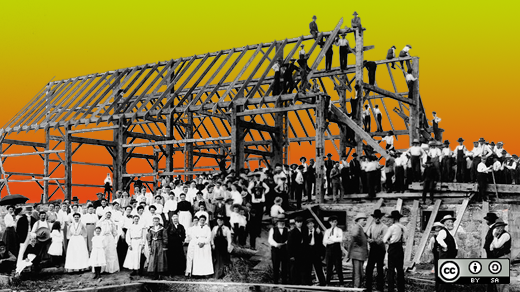 Since I’ve recently been on one of my Tom Sawyer rants again about the lack of humility I see in many community efforts, I thought I’d share a story that might help you visualize the role your organization could play in the communities it belongs to.
A few months ago, two of my business partners, David Burney and Matt Muñoz, were sitting in a meeting with a client of ours (The Redwoods Group, a very cool B Corporation), discussing the unique relationship that organization has with its customers, employees, and other communities. The conversation turned to the ideas of service and humility, which are so often ignored by big organizations attempting to engage with communities.
All of the sudden, Kevin Trapani, CEO of The Redwoods Group, encapsulated the entire conversation in a few short words:
“We should be of it, not above it,” he said.
Beautiful.
So many organizations, intentionally or not, approach things as if they are above a community. Sometimes this means taking the Tom Sawyer approach of using community strategies to get others to paint your fence for free. Sometimes this means creating a new community with your organization at the center rather than joining an existing community effort. Sometimes it simply means a lack of humility or selflessness shines through in the organization’s community interactions.
This one goes out to the fence painters
 I’m always looking for interesting new communities to highlight on opensource.com. Over the past year, I’ve covered everything from Wikipedia to OpenIDEO to The White House and am, frankly, overwhelmed by the sheer quantity of new community-building efforts going on out there.
Seems like every day I get an email or see something on Twitter or Facebook about a new community that sounds interesting and innovative. I’ve found some amazing people and visionary ideas. I hope to continue to highlight the best of these new communities here on the business channel.
But at the risk of sounding like a hater, I must admit I’m getting a touch of new-community fatigue.
I think I went over the edge a few weeks back when ex-advertising industry celebrity Alex Bogusky (yes, the same guy who did all of those weird chicken ads for Burger King and famously tried to make Microsoft cool) announced his new “Collaborative Community/Brand For Social Entrepreneurs.” He calls it Common. No offense to Alex, but when the advertising agency folks are hopping on the community brand bus, you have to wonder whether the seats are starting to get a tad bit full…
I also wonder if there is a bit too much Tom Sawyer-fence-painting going on in some of these new communities. In case it’s been a while since you read Tom Sawyer, here’s how Wikipedia summarizes the story of Tom Sawyer and the fence:
Five questions about open source and branding with Alina Wheeler
 A few years back, a good friend recommended I pick up a copy of Designing Brand Identity: an essential guide for the whole branding team by Alina Wheeler. Now in its 3rd edition, it’s a beautiful book, well designed and easy to read or to use as a reference. I recently caught up with Alina, who is finishing up work on a new book entitled Brand Atlas: Branding Intelligence Made Visible with designer Joel Katz. I asked her some questions about where branding and the open source way might be beginning to intersect.
CHRIS: I have heard that you often begin the continuum of branding with the 17,000 year old cave paintings in Lascaux, France. Now that’s historic branding! What are one or two key concepts in designing branding identity that have stayed constant and endured from a world of cave paintings to a world of Twitter, Facebook, and open source?
ALINA: Since the beginning of time, the need to communicate emerges from a universal set of questions: Who am I? Who needs to know? How will they find out? Why should they care? Whether you are on Facebook or in Shanghai or Charlotte, these questions are the same.
Mankind has always used symbols and stories to express individuality, pride, loyalty, and ownership. Individuals, communities and organizations express their uniqueness through their identity. Brand is identity. Competition for recognition is as ancient as the heraldic banners on a medieval battlefield. The battle for physical territory has evolved into competition for share of mind. The competition is fierce.
The power of symbols remains elusive and mysterious–a simple form can trigger recall and arouse emotion–whether it is emblazoned on a flag or embedded in an email. There is significant research about the purpose of the images in the caves of Lascaux. For me they are a reflection of what we are all thinking about now: communication, community, culture, meaning, survival, and navigation.
CHRIS: Now the opposite question: as we begin 2011, are there core branding principles you think have shifted significantly since you wrote the first edition of the book in 2003?
ALINA: The tools have changed. The fundamentals have not. Whether you are the CEO of a global consumer brand or a social entrepreneur, I believe that there is a universal set of principles that are fundamental to increasing awareness, attracting prospects/opportunities, transcending the clutter, and building customer loyalty.
The brand conversation has changed. We all know that now. The challenges have increased exponentially. The tools have become so provocative that they reduce our attention to the fundamentals: being customer centric, staying aligned with your vision and values, and staying differentiated in a world that is overwhelming in sameness and clutter.
The pressure to constantly update and innovate has polarized the world of brand builders. For some, it is an exhilarating time and for others a treadmill where you are running faster to stay in place. There are those who embrace marketplace dynamics and ignore brand fundamentals, and those who are stuck in their legacy infrastructures and business models refusing to embrace change and speed. Success requires embracing both.
CHRIS: Here on the opensource.com business channel, we often talk about how core open source principles like community, collaboration, meritocracy, and rapid prototyping can help businesses of any type–not just those building software. I love the detailed case studies you did in Designing Brand Identity. In your studies of leading brands, have you seen examples of these principles being applied in the branding world?
ALINA: I am eager to learn about new brands that are co-created with the customer or end-user. I believe that open source is the most meaningful and relevant methodology that will help us prepare for a new world: i.e. build communities that matter, collaborate more effectively toward outcomes that matter, and innovate because for survival, that matters.
Although open source is a fairly new idea to most brand managers that I know, it embodies the branding process ideal from an organizational development perspective. The biggest challenge on revitalizing an existing brand is frequently busting through the silos. How do we get IT to work with customer support and marketing to work together on behalf of the customer? How do we get different departments with radically different agendas to be part of the campfire around the brand? It is so powerful when there is a cross-departmental, cross-disciplinary collaboration to build the brand, and to deliver on the brand promise.
B Corporations are a new class of certification and classification for companies that want to collectively redefine success and to leverage the influence of their businesses to solve social and environmental problems. B Corps connect their executive teams with peers from mission-aligned companies.
The Charleston Parks Conservancy has a unique network of community volunteers called the Park Angels, who literally help care for Charleston’s 120 + parks. They have become the public face of the organization. The long-term benefits are for the entire city: building community and improving the quality of life, health and economic strength. Park Angel’s brand is visible on numerous platforms that connect people to people, people to the parks and to the bigger ideal of making a difference. This movement has instilled a sense of ownership and pride.
I believe that IDEO uses open source methodology in their product development work, although I don’t think they call it open source. They are renowned for letting customers/users be part of the product development process and routinely use rapid prototyping. Certainly their culture of creativity and innovation is a meritocracy. The Ripple Effect is a project done in partnership with the Acumen Fund and the Gates Foundation. IDEO collaborated with 22 organizations in India to develop new methods for safe transportation and storage of drinking water in India’s villages.
CHRIS: I can tell design means more to you than just a pretty logo. What is the strategic role of design in building brands today?
ALINA: Lou Danziger said it best, “Design is intelligence made visible.” The best design is a result of strategic imagination, an ability to understand and align business goals with creative strategy and expression. While brands are about emotional connection, brand identity is any tangible expression of the brand. We can see it, hear it, watch it move. Designers play an essential role in building brands and creating unique and memorable experiences. Designers work to fuel recognition across platforms, amplify differentiation, and make big ideas accessible and understandable.
The best designers have an ability to imagine what others can’t see and to show what it looks like and what it feels like. Design is often overlooked in brand strategy meetings where rapid prototyping could benefit and accelerate the decision making process. Having designers shoulder to shoulder with researchers examining user experiences could jumpstart new solutions.
CHRIS: One trend we discuss regularly here on opensource.com is the trend toward organizations giving up some control over the direction of their brands to the communities around them. I’d love to hear your thoughts. Is this a positive thing? Dangerous? Maybe both?
ALINA: Brands exist because there are customers. Although that might sound like a blinding flash of the obvious, it’s important to remember that ultimately the customer always decides whether a brand will flourish or die.
Just like in any conversation worth having, there is a time to talk and a time to listen. Listening to the aspirations, desires, needs, and challenges of your core stakeholders is the most critical brand building competency.
I do believe that control is critical to brand success whether you are a start-up venture, a non-profit or a consumer brand. Having values that don’t waiver. Being certain about why your organization exists. Being consistent about who you are and what you stand for. Taking the time to engage your entire organization in the vision and values. Creating places where conversations can happen. Building trust. Anticipating and fulfilling needs. Being transparent. Making certain that the brand experience is coherent and relevant. These maxims are intentional. As more brands in the future are co-created with end-users, perhaps this notion of control will evolve to a more collaborative model.
—
The third edition of Designing Brand Identity is available on Amazon now. Alina Wheeler’s new book Brand Atlas: Branding Intelligence Made Visible will be available in April, 2011 and is available for pre-sale now on Amazon.
[This post originally appeared on opensource.com]
Hey, I Wrote a Book!

Available now in print and electronic versions.
 Dark Matter Matters