Dark Matter Matters
business books
A Nobel Prize winner takes on Jim Collins and the business book industry
Over the holiday break, I finished up Daniel Kahneman’s new and much-praised book Thinking, Fast and Slow. I consider it quite an achievement, and by that I mean both the book itself (a deep, personal, and introspective look back at the career of one of the most important psychologists of our time) and my actually reading it (the book weighs in at almost 500 very dense pages).
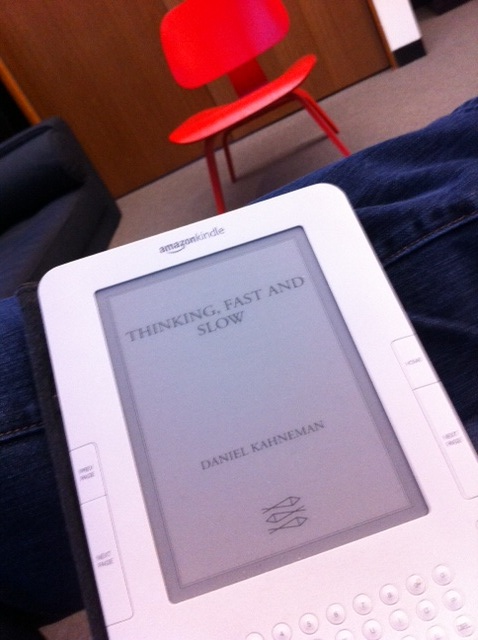
Here is me thinking fast, but reading slow.
One of the many interesting things about Dr. Kahneman is that, as a psychologist, he actually won his Nobel prize in economics. If you are interested in learning more about how that happened, go here.
Over the last few months, Kahneman’s book has been sitting near the new Jim Collins book Great by Choice in the rarefied air of Amazon.com’s top 100 books list (I reviewed Great by Choice a few months back here). So I thought it was interesting that Kahneman challenged Jim Collins and his book Built to Last in Chapter 19. It was a pointed attack not just on Collins but the entire genre of success story-inspired business books.
Since I spend quite a bit of time reading these sorts of books, I was really interested in his viewpoint. I mean, have I been wasting time reading that I could just as usefully spent watching reruns of Tosh.O or Arrested Development on TV? Is there real value in studying successful businesses and leaders or is it just an illusion?
Here’s what Kahneman says:
“The basic message of Built to Last and other similar books is that good managerial practices can be identified and that good practices will be rewarded by good results. Both messages are overstated. The comparison of firms that have been more or less successful is to a significant extent a comparison between firms that have been more or less lucky. Knowing the importance of luck, you should be particularly suspicious when highly consistent patterns emerge from the comparison of successful and less successful firms. In the presence of randomness, regular patterns can only be mirages.”
Ouch.
Kahneman cites Philip Rosenzweig’s book The Halo Effect (which is now on my reading list) and quickly jumps to the punchline of that book:
“[Rosenzweig] concludes that stories of success and failure consistently exaggerate the impact of leadership style and management practices on firm outcomes, and thus their message is rarely useful.”
So are we to believe Kahneman and Rosenzweig? Is there really no value in studying the leadership and management practices of great companies?
Even after reading the whole book Thinking, Fast and Slow and understanding the psychological principles that trick my brain into applying great importance to these sorts of success stories, I still find the conclusion a hard one to accept. And then Kahneman throws the knockout punch:
“Stories of how businesses rise and fall strike a chord with readers by offering what the human mind needs: a simple message of triumph and failure that identifies clear causes and ignores the determinative power of luck and the inevitability of regression. These stories induce and maintain an illusion of understanding, imparting lessons of little enduring value to readers who are all too eager to believe them.”
Okay, I get it. Kahneman views me as a sucker. And who am I to argue with a Nobel Prize-winning psychologist?
But I just can’t help it. I think there is plenty that we can learn from the lessons of innovative businesses like those that Collins profiles in Built to Last. Kahneman may be right that these books suffer from an illusion of academic rigor that breaks down under close study. And yes, they probably need a disclaimer (“The author makes no promise or guarantee that if you follow the principles outlined in this book you will become Google overnight. Individual results may vary.”).
But what these books lack in academic rigor they make up for in one simple area: they inspire people. To not settle for what they see today. To try something new. To learn. To grow. To believe.
They create the possibility of hope. “Others have done it. I could too!”
So in that sense, Kahneman’s critique is somewhat akin to an adult telling a three-year old child that there is no Santa Claus. My view? The analysis is technically correct, but emotionally bankrupt.
Where success story business books fail the analytical brain, they often are just what the emotional brain needs.
So I don’t know about you, but I’m going to keep on reading business books. By constantly refueling my head with new ideas, I’ll always have something to learn and try. I’ll continue to be inspired by authors like Jim Collins, by companies and leaders who have seen great success, and I’ll suspend my academic doubts in the hope of learning new lessons that might just work.
I’d love to hear what you think. If you believe Kahneman’s critique of Collins and the genre is on the money, or if you believe instead that there is still value in sharing and learning from business success stories, let me know in the comments section below.
Seven great books for people interested in branding their small businesses
I tend to read a lot of business and marketing books (stop laughing at me) and over the past few years, I’ve noticed one important group that I don’t think is being served well by the existing books out there: small business owners.
Some branding books are too theoretical or philosophical, with little in the way of practical tips or tangible projects. You end up nodding your head a lot, but have no idea what you should actually do when you are finished. Other brand books are too technical or jargon-y and require you to already have an MBA and twenty years of marketing experience to understand them.
Yet branding and positioning are critical tools for anyone with a small business to master. If there are 10 other dry cleaning chains in your town, how do you ensure yours stands out? If you are about to open the fifth Mexican restaurant on the street, what makes you different or better than your competitors?
I believe that the rise of Groupon and other deep-discount social coupon services are a direct result of small businesses grasping at straws because they are struggling in tough times, looking for answers, and don’t understand the basics of branding and positioning that could really help them stand out without destroying their margins.
The Ad-Free Brand was a direct response to this dearth of branding books that spoke to small business owners. My goal was to write a book that provided a clear, simple process that anyone could follow, filled with plenty of tips and the absolute bare minimum of marketing jargon. My hope was that it would be just as understandable and useful to someone with no marketing experience as it is to a brand professional (if you’ve read it, let me know how you thought I did).
Out of all of the branding books out there, I have seven that I recommend regularly to small business owners who are interested in going a little deeper into branding issues. I thought I’d share the list with you here.
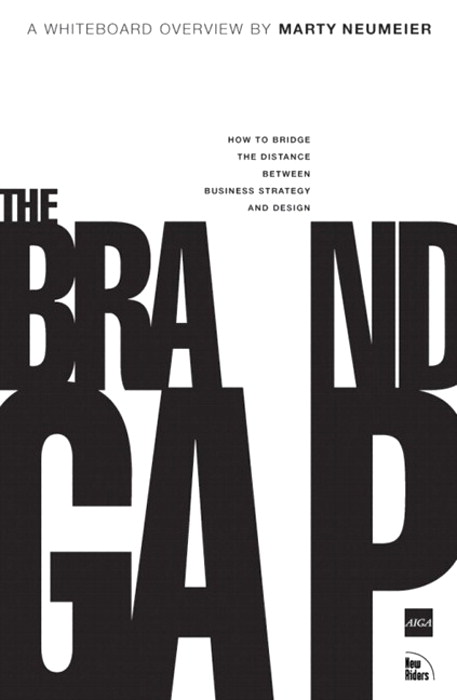 1. The Brand Gap by Marty Neumeier: This is probably my favorite simple branding book of all time. It is very visual, can be read in an hour, and is great for sharing and discussing with colleagues.
—
 2. Zag by Marty Neumeier: Another great book by Marty Neumeier, Zag is also a quick read with plenty of ideas that will help you think about how to differentiate your business from your competitors.
—
 3. Positioning: The Battle for Your Mind by Jack Trout and Al Ries: This is the book that defined the art of brand positioning, still just as relevant as it was when first published 30 years ago. In fact, in The Ad-Free Brand, I drew inspiration from the thinking of Trout and Ries, just updating the way positioning is implemented for a post-advertising era.
—
 4. Differentiate or Die by Jack Trout: Another classic, in my view the best of several other positioning-related books published by Jack Trout over the years. An easy read.
—
 5. Designing Brand Identity by Alina Wheeler: This is the guide to building out the brand identity for your business. It is an elegant and beautiful book, filled with useful case studies—you may be able to find an example in here that you’d like to emulate for your business.
—
 6. Brand Atlas by Alina Wheeler and Joel Katz: Alina Wheeler’s newest book is an overview of many of the most important issues in branding today. Simple descriptions of the key concepts, featuring quotes and insights from leading practitioners, are paired with simple, beautiful diagrams and illustrations by Joel Katz.
—
 7. Strategic Brand Management by Kevin Keller: When you are ready to move beyond the basics and want to attempt a graduate-level curriculum in branding, head directly for this book. It is the textbook used on college campuses around the world for brand management courses, and it is about as comprehensive a guide to brand management as I have ever encountered.
—
I’ve also compiled these books into a guide on Amazon here in case you want to buy the whole library (just for convenience, I don’t get any commission since Amazon doesn’t like North Carolina, my home state).
Happy reading!

Hey, I Wrote a Book!

Available now in print and electronic versions.
 Dark Matter Matters