Dark Matter Matters
opensource.com
Does your organization need a “no policy” policy?
Daniel Pink published an interesting piece over the weekend in The Telegraph about Netflix‘s innovative corporate policy of not having a vacation policy.
 Meaning, employees don’t have a set number of days they get off each year, but instead can take vacation whenever they want. From the article:
At Netflix, the vacation policy is audaciously simple and simply audacious. Salaried employees can take as much time off as they’d like, whenever they want to take it. Nobody – not employees themselves, not managers – tracks vacation days. In other words, Netflix’s holiday policy is to have no policy at all.
This may sound like a recipe for disaster to you, but it hasn’t turned out that way for Netflix. In fact, as the rest of article highlights, not having a lot of corporate policies may be a fantastic strategy for engaging 21st century workers.
[Read the rest of this post on opensource.com]
OpenIDEO: a new experiment in open innovation
This week, those smart folks over at IDEO launched a new project they are calling OpenIDEO. If you aren’t familiar with IDEO yet, you should be—they are the poster children for design thinking specifically and 21st century innovation more generally.
 IDEO has been responsible for groundbreaking designs of everything from computer mice to toothbrushes to brand experiences, and it is the home of superstar thinkers like Tim Brown (author of the recent book called Change By Design) and Tom Kelley (author of The Art of Innovation and The Ten Faces of Innovation).
What is OpenIDEO? Here’s what the website says:
OpenIDEO is a place where people design better, together for social good. It’s an online platform for creative thinkers: the veteran designer and the new guy who just signed on, the critic and the MBA, the active participant and the curious lurker.
So it is basically an experiment in open innovation, a place where IDEO can be the catalyst of a conversation among really smart folks from different disciplines that might lead to solutions for big, complex social problems.
If you are a skeptic, you might immediately wonder what’s in it for IDEO. One person asked whether IDEO planned to make money with the “crowd’s” ideas, and Tim Brown answered like this:
[Read the rest of this post on opensource.com]
Is your culture made of gold or fool’s gold?
When I hear people talk about how awesome their organizational culture is, I often find myself wondering what sort of “great” culture it is.
For me, great cultures fall into two categories: entitlement and mission-driven. Those “best places to work” lists don’t usually make a distinction, but I do. Here is the difference:
 Entitlement cultures
The surest sign of an entitlement culture? When someone tells you why they like their work, they give you an example of a benefit not related to the work itself. Some examples:
I get on-site daycare.
I get free snacks and drinks.
We have great health benefits.
We have a flexible work-from-home policy.
From what I’ve observed, entitlement-driven cultures resonate most with people who have a deeply held desire for safety, security, and quality of life.
Mission-driven cultures
It’s no secret that I believe organizations with a strong shared purpose, mission, or vision beyond the bottom line have a huge advantage over those that don’t. I was able to witness the power of a mission-driven culture first hand at Red Hat, and I see these cultures all of the time in the both the open source and design worlds.
Ask someone why they like working in a mission-driven organization, and they are likely to say things like these:
I believe in what we are doing.
I love coming to work every day.
I leave work each day with a sense of accomplishment.
I am changing the world.
My personal experience has been that mission-driven cultures resonate most with people who have a deeply held desire to find meaning in their work above all else.
Can companies have both cultures at once, and be both entitlement-driven and mission-driven? Absolutely!
And a culture where people believe in what they do and enjoy safety, security, and quality of life is the best kind, right? Let me be controversial:
I don’t think that is true.
[Read the rest of this post on opensource.com]
Managing clouds and the death of formality in business
I’ve been toying around with a new hypothesis. Here it is:
Formality in business is dying.
 Now I am not talking about Blue Jeans Friday and Bring Your Pet to Work Day all of the sudden cropping up everywhere. I’ve seen very formally-run businesses where people showed up in jeans with their dogs or whatever. So much superficial informality.
What I’m talking about is a fundamental shift of business culture and management practices from formal to informal in many innovative companies. What do I mean? Let’s take a step back.
Here are two of the ways Merriam-Webster defines the word formal.
– relating to or involving the outward form, structure, relationships, or arrangement of elements rather than content
– having the appearance without the substance
That first definition of formality stands out for me as a perfect description of almost every formal business practice I have ever encountered. “Relating to or involving the outward form, structure, relationship of arrangement of elements rather than the content” (emphasis mine).
Organizational charts. Job titles. Performance reviews. Operational reviews. Strategic planning projects.
In your experience, do these things usually reflect the man-on-the-street reality of the business? Or are they an attempt to impose structure on things that do their best to defy it?
The irony is that, while most formal business practices are attempts to manage the complexity of business by defining structure, they usually fail miserably to capture the true complexity of business. They focus on the structure rather than the real content—and they usually don’t even get that right.
In my experience, most business practices that attempt to formalize structure are about as successful as attempts to construct buildings out of clouds. By the time we finish the plan, everything has already changed beyond recognition.
[Read the rest of this post on opensource.com]
MIX: Gary Hamel’s experiment in reinventing management the open source way
Of all of the people talking or writing about the future of business right now, no one has more street cred than Gary Hamel. I’ve written about him many times before, and his book The Future of Management is one of the most inspiring and meaningful business books of the last 10 years.
 Last year at the World Business Forum, when Gary called open source one of the greatest management innovations of the 21st century, there was some serious high-fiving going on amongst us open source business types.
So I’ve been watching closely as Gary and a team of management superstars have launched an open innovation experiment called the Management Innovation Exchange, or MIX. In the video below, Gary explains a little bit about the goals of the MIX.
Here’s how they describe the MIX on the website:
“The Management Innovation eXchange (MIX) is an open innovation project aimed at reinventing management for the 21st century. The premise: while “modern” management is one of humankind’s most important inventions, it is now a mature technology that must be reinvented for a new age.”
From spending some time on the site, it clearly shares a lot of the same foundations as the open source way, even if the MIX folks prefer the term open innovation.
One of the most wonderful bits? The MIX is a meritocracy, where anyone can join, submit management hacks, stories, or barriers, and then collaborate with others to explore the ideas further.
[Read the rest of this post on opensource.com]
Do you aspire to build a brand community or a community brand?
In my day job at New Kind, I spend quite a bit of my time working on brand-related assignments, particularly for organizations interested in community-based approaches to building their brands.
 When marrying the art of community building to the art of brand building, it’s hard not to talk about building “brand communities.” It’s a convenient term, and brand experts love to trot out examples like Harley Davidson and Apple as examples of thriving communities built around brands.
The term “brand community” even has its own Wikipedia page (definition: “a community formed on the basis of attachment to a product or marque”). Harvard Business Review writes about brand communities. Guy Kawasaki writes about brand communities.
Yet almost every article I’ve read about building “brand communities” shares a common trait:
They are all written by brand people for brand people.
The result? Articles focusing on what’s in it for the brands (and the companies behind them), not what’s in it for the communities. Learn how to build a brand community so your company will succeed, not so a community will succeed.
Typical corporate thinking.
What if we turned things on their heads for a second and changed the words around? What if, instead of “brand community,” the phrase du jour was “community brand?”
[Read the rest of this post on opensource.com]
The open source way: designed for managing complexity?
This week I finally got a chance to sit down and digest IBM’s latest Global CEO Study, newly published last month and entitled Capitalizing on Complexity. This marks the fourth study IBM has done (they complete them once every two years), and I’ve personally found them to be really useful for getting out of the weeds and looking at the big picture.
 This report is based on the results of face-to-face meetings with over 1500 CEOs and other top leaders across 60 countries and 30+ industries. These leaders are asked all sorts of questions about their business challenges and goals, then IBM analyzes the answers and segments the respondents to isolate a group of high-performing organizations they call “standouts.” The standouts are then further analyzed to find out how they are addressing their challenges and goals differently than average organizations.
As a quick summary (but don’t just read my summary, go download the study for free), IBM found a big change this year. In the past three studies, leaders identified their biggest challenge as “coping with change.” This year, they identified a new top challenge: “complexity.”
If you’ve been reading marketing collateral or web copy from your vendors over the past year (someone must read that stuff…) this will come as no surprise to you. How many things have you read that start with something like: “In our increasingly complex world…” or “In the new deeply interconnected business landscape…” If the marketing folks are saying it, it must be true.
But I digress. Here’s IBM’s punch line:
[Read the rest of this post on opensource.com]
Two tips for meeting survival in an entrenched bureaucracy
It might be a better world if we all worked in open, collaborative organizations where the best ideas win. But unfortunately, the reality is that bureaucracy still rules in all but the most progressive companies. We have a long way to go. The reality doesn’t always match the dream.
 In the real world, we generate great ideas, propose elegant solutions, and then force them to run the bureaucratic gauntlet. “the best ideas win” becomes “the safest ideas win” (and then lose eventually) as they travel through the bureaucracy and its meetings.
These meetings are the favorite hiding place of two species of people I dread encountering. Learn to identify, manage, or avoid these bureaucrats, as they are the enemies of meritocracy.
Devil’s Advocates
The devil’s advocate was wonderfully defined by Tom Kelley in his book The Ten Faces of Innovation. Devil’s advocates make a habit of shooting down the ideas of others or offering critiques by starting with the phrase “Let me play devil’s advocate” (or something similar).
This phrase allows the bureaucrat to avoid taking personal accountability for the comments they are about to make. Because they are speaking for the devil rather than themselves, they can crush someone else’s idea without feeling guilty about it.
Professional Meeting Attendees
It is easy to spot the professional meeting attendee because they usually look or sound hurried and exhausted, complaining about how many meetings they have that day and how much they have to get done. Woe is them, for sure.
The reality is they often don’t actually do the hard work of creating and building, but instead sit in meetings all day long. They are happy to offer sage advice and wisdom, but usually avoid taking on work.
In small organizations and startups, the professional meeting attendee species is rare. But it breeds rapidly in large organizations where meetings are plentiful and there is always someone else to do the work.
So what should good open source-minded workers do to improve things when they can’t escape these meeting bureaucrats? A few tips from me:
[Read the rest of this post on opensource.com]
How to find a community’s cheeseheads when they aren’t wearing foam hats
The other day I was chatting with friend and digital strategy/social media expert Ken Burbary on the phone. He was advising a colleague on some good community-building techniques to consider when all of the sudden the following words came out:
 “You have to find your cheeseheads.”
What? I did a double-take (or at least the conference call equivalent) and asked him to repeat himself.
I had heard him correctly.
Ken lives in Michigan. Michigan is not far from Wisconsin. Wisconsin is where a lot of cheese is made. Wisconsin also has an (American) football team called the Green Bay Packers.
The biggest fans of the Green Bay Packers wear wedges of cheese made out of foam on their heads to show their support for the team. When someone will wear a big wedge of cheese on their head to show support for their team, that means they are a pretty big fan.
So Ken was saying that good community catalysts seek out and empower the biggest community supporters and advocates—the cheeseheads.
I found a fantastic blog post, written last fall by a colleague of Ken’s named Rachel Happe, entitled Cheeseheads. The post, which appears on The Community Roundtable website, explains in more detail the concept of how to engage your community’s cheeseheads. I won’t repeat Rachel’s advice here, but instead want to ask a follow-on question:
Sitting at a football game at Lambeau Field, it’s pretty easy to spot most of the biggest fans. They have foam cheese on their heads.
But what you do when a community isn’t the foam-hat-wearing kind? How do you find and empower the people who are the community’s energy source? Here are a few thoughts from me on how to find the biggest community advocates when they aren’t in plain view.
[Read the rest of this post on opensource.com]
Trust: the catalyst of the open source way
Let’s face it. There are tons of projects out there in the world being run the open source way today. While the great ones can accomplish unbelievable things, the bad ones, even the average ones, often fail to achieve their goals.
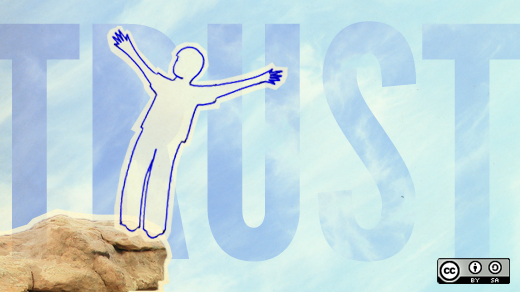 In many cases, the failed projects still used many of the tenets of the open source way, transparency, collaboration, meritocracy, etc. So why did they fail?
Some projects fail because the contributors just aren’t skilled enough at what they are trying to do. Projects also fail because people don’t have the dedication to see them through—folks give up when the going gets tough.
But in many cases, the contributors have the skills and the dedication, yet the projects still don’t work out. My view? Many of these projects fail because they are missing one simple thing.
Trust.
Collaboration works better when you trust the people with whom you are collaborating. Transparency is more believable when you trust those who are opening up to you. And it is much easier for the best ideas to win when there is a base level of trust in the community that everyone is competent and has the best interests of the project at heart.
A successful open source project needs a culture of trust much more than a project not being run the open source way. Why?
[Read the rest of this post on opensource.com]
Hey, I Wrote a Book!

Available now in print and electronic versions.
 Dark Matter Matters