Dark Matter Matters
culture
Does your organization need a “no policy” policy?
Daniel Pink published an interesting piece over the weekend in The Telegraph about Netflix‘s innovative corporate policy of not having a vacation policy.
 Meaning, employees don’t have a set number of days they get off each year, but instead can take vacation whenever they want. From the article:
At Netflix, the vacation policy is audaciously simple and simply audacious. Salaried employees can take as much time off as they’d like, whenever they want to take it. Nobody – not employees themselves, not managers – tracks vacation days. In other words, Netflix’s holiday policy is to have no policy at all.
This may sound like a recipe for disaster to you, but it hasn’t turned out that way for Netflix. In fact, as the rest of article highlights, not having a lot of corporate policies may be a fantastic strategy for engaging 21st century workers.
[Read the rest of this post on opensource.com]
Is your culture made of gold or fool’s gold?
When I hear people talk about how awesome their organizational culture is, I often find myself wondering what sort of “great” culture it is.
For me, great cultures fall into two categories: entitlement and mission-driven. Those “best places to work” lists don’t usually make a distinction, but I do. Here is the difference:
 Entitlement cultures
The surest sign of an entitlement culture? When someone tells you why they like their work, they give you an example of a benefit not related to the work itself. Some examples:
I get on-site daycare.
I get free snacks and drinks.
We have great health benefits.
We have a flexible work-from-home policy.
From what I’ve observed, entitlement-driven cultures resonate most with people who have a deeply held desire for safety, security, and quality of life.
Mission-driven cultures
It’s no secret that I believe organizations with a strong shared purpose, mission, or vision beyond the bottom line have a huge advantage over those that don’t. I was able to witness the power of a mission-driven culture first hand at Red Hat, and I see these cultures all of the time in the both the open source and design worlds.
Ask someone why they like working in a mission-driven organization, and they are likely to say things like these:
I believe in what we are doing.
I love coming to work every day.
I leave work each day with a sense of accomplishment.
I am changing the world.
My personal experience has been that mission-driven cultures resonate most with people who have a deeply held desire to find meaning in their work above all else.
Can companies have both cultures at once, and be both entitlement-driven and mission-driven? Absolutely!
And a culture where people believe in what they do and enjoy safety, security, and quality of life is the best kind, right? Let me be controversial:
I don’t think that is true.
[Read the rest of this post on opensource.com]
Managing clouds and the death of formality in business
I’ve been toying around with a new hypothesis. Here it is:
Formality in business is dying.
 Now I am not talking about Blue Jeans Friday and Bring Your Pet to Work Day all of the sudden cropping up everywhere. I’ve seen very formally-run businesses where people showed up in jeans with their dogs or whatever. So much superficial informality.
What I’m talking about is a fundamental shift of business culture and management practices from formal to informal in many innovative companies. What do I mean? Let’s take a step back.
Here are two of the ways Merriam-Webster defines the word formal.
– relating to or involving the outward form, structure, relationships, or arrangement of elements rather than content
– having the appearance without the substance
That first definition of formality stands out for me as a perfect description of almost every formal business practice I have ever encountered. “Relating to or involving the outward form, structure, relationship of arrangement of elements rather than the content” (emphasis mine).
Organizational charts. Job titles. Performance reviews. Operational reviews. Strategic planning projects.
In your experience, do these things usually reflect the man-on-the-street reality of the business? Or are they an attempt to impose structure on things that do their best to defy it?
The irony is that, while most formal business practices are attempts to manage the complexity of business by defining structure, they usually fail miserably to capture the true complexity of business. They focus on the structure rather than the real content—and they usually don’t even get that right.
In my experience, most business practices that attempt to formalize structure are about as successful as attempts to construct buildings out of clouds. By the time we finish the plan, everything has already changed beyond recognition.
[Read the rest of this post on opensource.com]
MIX: Gary Hamel’s experiment in reinventing management the open source way
Of all of the people talking or writing about the future of business right now, no one has more street cred than Gary Hamel. I’ve written about him many times before, and his book The Future of Management is one of the most inspiring and meaningful business books of the last 10 years.
 Last year at the World Business Forum, when Gary called open source one of the greatest management innovations of the 21st century, there was some serious high-fiving going on amongst us open source business types.
So I’ve been watching closely as Gary and a team of management superstars have launched an open innovation experiment called the Management Innovation Exchange, or MIX. In the video below, Gary explains a little bit about the goals of the MIX.
Here’s how they describe the MIX on the website:
“The Management Innovation eXchange (MIX) is an open innovation project aimed at reinventing management for the 21st century. The premise: while “modern” management is one of humankind’s most important inventions, it is now a mature technology that must be reinvented for a new age.”
From spending some time on the site, it clearly shares a lot of the same foundations as the open source way, even if the MIX folks prefer the term open innovation.
One of the most wonderful bits? The MIX is a meritocracy, where anyone can join, submit management hacks, stories, or barriers, and then collaborate with others to explore the ideas further.
[Read the rest of this post on opensource.com]
The open source way: designed for managing complexity?
This week I finally got a chance to sit down and digest IBM’s latest Global CEO Study, newly published last month and entitled Capitalizing on Complexity. This marks the fourth study IBM has done (they complete them once every two years), and I’ve personally found them to be really useful for getting out of the weeds and looking at the big picture.
 This report is based on the results of face-to-face meetings with over 1500 CEOs and other top leaders across 60 countries and 30+ industries. These leaders are asked all sorts of questions about their business challenges and goals, then IBM analyzes the answers and segments the respondents to isolate a group of high-performing organizations they call “standouts.” The standouts are then further analyzed to find out how they are addressing their challenges and goals differently than average organizations.
As a quick summary (but don’t just read my summary, go download the study for free), IBM found a big change this year. In the past three studies, leaders identified their biggest challenge as “coping with change.” This year, they identified a new top challenge: “complexity.”
If you’ve been reading marketing collateral or web copy from your vendors over the past year (someone must read that stuff…) this will come as no surprise to you. How many things have you read that start with something like: “In our increasingly complex world…” or “In the new deeply interconnected business landscape…” If the marketing folks are saying it, it must be true.
But I digress. Here’s IBM’s punch line:
[Read the rest of this post on opensource.com]
A modest proposal to save The New York Times
I love The New York Times, the best newspaper in the world. There is no greater pleasure than sitting out on the patio on a Sunday morning, reading The New York Times, and learning.
 I stress the word learning because there are so few places left in our world where true discovery happens. Most of the time, marketers, computers, and even our friends are showing us more of what we already know we like, rather than introducing us to things we have never seen or heard of before.
In the pages of The New York Times, I can be introduced to people, places, events, ideas I would have never found on my own. Every day I read The Times I learn something new. The paper expands my understanding of the world rather than reflecting back to me the understanding I already have.
This is an incredibly valuable service. It is a service that very few media companies in the world still provide (my local paper, the Raleigh News and Observer, rarely does these days, sadly).
Yet, the ongoing conversation about how to solve the financial issues of The New York Times revolves around fixing the business model for newspapers. Most experts say the model is fundamentally broken, and a report released last week by the Pew Research Center’s Project for Excellence in Journalism doesn’t have a lot of good news for the future of journalism as a whole.
From my vantage point, the answer to fixing The New York Times will not come from exploring a revolutionary business model. It will come from a revolutionary brand, culture, and community model. Let me explain.
Is Jaron Lanier just a hater, or should we be paying attention?
Last week, my friend Greg DeKoenigsberg posted an article about Jaron Lanier’s negative comments regarding open textbooks. At almost very same time, I happened to stumble upon an article Jaron wrote back in 2006 criticizing Wikipedia.
 The common theme is Jaron taking issue with what he calls “online collectivism,” “the hive mind,” and even “digital Maoism” (ouch!). You might call this same concept “crowdsourcing” or “the wisdom of crowds.” It’s all in the eye of the beholder, but the guy clearly does not have much love for wikis or the works of collective wisdom they create.
So I had to ask myself: Why so negative, Jaron?
Is Jaron really a hater of free culture, as Greg claims in his article? Is he an enemy of the open source way? Or is he just a smart dude warning us about the risks of taking the wisdom-of-crowds concept too far?
 Fortunately for us, Jaron published a book earlier this year entitled You Are Not A Gadget. So I took a few hours and read it last week to see if I could answer some of these questions.
At times, the book is scary smart, with precise analysis from a man who clearly questions everything, and is in a better intellectual position to do so than most (the section on social media and its redefinition of friendship is especially interesting).
At other times it read like a college philosophy term paper. And occassionally, especially toward then end, it devolved into nearly unintelligeble (at least by me) ravings about things like “postsymbolic communication” and “bachelardian neoteny” (Michael Agger’s review in Slate calls him out for this too).
But wait! Right near the beginning of the book, I found this paragraph:
“Emphasizing the crowd means deemphasizing individual humans in the design of society, and when you ask people not to be people, they revert to bad, moblike behaviors.”
Hey… I kinda agree with that…
[Read the rest of this post on opensource.com]
The Wikimedia Foundation: doing strategic planning the open source way
Earlier this week I wrote a post about some of the cultural challenges Wikipedia is facing as its contribution rate has slowed. The comments you made were fantastic, including one by Dr. Ed H Chi (the PARC scientist who published the study I referred to in the post) linking to a prototype dashboard his team created to showcase who is editing each Wikipedia page (totally fascinating—you have to go try it!)
 Another interesting comment was made by my good friend Paul Salazar, who pointed us to this page where the Wikimedia Foundation (the parent organization that runs Wikipedia, among other projects) is showcasing their exhaustive, happening-as-we-speak strategic planning process in all of its transparent, open glory.
From the main page, you can read the entire strategy memo that was presented to the Wikimedia Foundation board just last month. The memo itself is stunningly smart. Google must have thought so too, because they made a $2 million donation to the Wikimedia Foundation, announced a few weeks ago.
But it doesn’t stop at high-level strategy for the eyes of muckety-mucks. From this page you can find proposals (hundreds were submitted, and just like on Wikipedia, anyone could contribute), background research, and task forces that have come together to discuss some of the major strategic challenges outlined in the initial strategic plan.
[Read the rest of this post on opensource.com]
Love, hate, and the Wikipedia contributor culture problem
Last fall, a group of researchers at the Palo Alto Research Center (PARC) released a study showing an abrupt leveling off in the number of editors and edits to Wikipedia, starting in about 2007.
 There is a great summation of the findings in a set of posts by Dr. Ed H Chi, Lead Scientist at the PARC Augmented Social Cognition group here, here, here, and here.
I’ve been thinking a lot over the past few months about what might be causing the slowing rate of contributions, as have many others. I particularly liked Niel Robertson’s post last week on the Enterprise Irregulars site.
Niel’s thesis is that Wikipedia has failed to continue to develop innovative ways to motivate its community, falling behind as other communities and companies have implemented more creative new techniques. Niel goes on to identify seven types of motivation for crowdsourcing (yes, I still dislike that word) efforts, of which he says Wikipedia is only using a couple.
I think he is on to something. But Wikipedia is operating at a scale that dwarfs almost every other crowdsourcing effort in history. It takes a massive bureaucracy of editors and administrators to keep the whole thing going.
And if traditional bureaucracies (like those in governments and large companies) tend to stifle innovation, what happens in a bureaucracy where the bureaucrats aren’t getting paid and aren’t getting any recognition for their efforts?
From my point of view, this is Wikipedia’s next great challenge:
How does it convince the world to love and recognize its contributors?
[Read the rest of this article on opensource.com]
Three tips for escaping the creativity peloton without giving up on collaboration
If you’ve ever watched a road bike race like the Tour de France, you know the peloton is the big group of riders that cluster together during the race to reduce drag. It’s a great example of collaboration in action. But let’s face it: the people in the middle of the peloton may go faster than they would otherwise, but they don’t win the race.
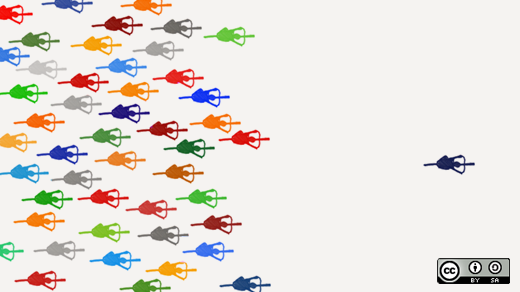 When it comes to creating and innovating, most companies (and employees) are in the peloton. They are doing enough to survive, but they are stuck in the pack. And if they stay in the pack too long, they lose.
Escaping the peloton is tough. Often, you see a cyclist break away, sprint for a while, only to get sucked back into the main group over time as the pressures of making a go independently prove too much.
You’ve probably felt this way at work. You come up with an amazing idea, one that will change the company forever. But little by little, people—even the well-meaning ones—chip away at its soul, until the idea goes from being amazing to, well, average. You end up being sucked back into the peloton.
After this happens one too many times, you may feel like you want to stop collaborating and try to make things happen on your own. Don’t do it. Even Lance Armstrong could rarely break away from the peloton without his teammates’ help.
Instead, here are three tips to help you escape the creativity peloton without giving up on collaboration.
[Read the rest of this post on opensource.com]
Hey, I Wrote a Book!

Available now in print and electronic versions.
 Dark Matter Matters