Dark Matter Matters
community
Interested in reinventing management? Come help me out.
 This week, the folks at the Management Innovation Exchange announced a new project called the Hackathon Pilot. The idea of this pilot is to test out a collaborative approach to building the source code of management, with people working together on hacks and stories using online collaboration tools.
I’ll be the guide for this pilot as the first task in my new role as the MIX Community Guide. We’ll specifically be tackling how to enable communities of passion in and around our organizations. I have lots of thoughts on the subject (you may have noticed), and I’m looking forward to having an opportunity to work with other smart folks and share ideas with them as well.
If this project sounds interesting to you, please consider joining. If you haven’t participated in the MIX yet, the pilot is a perfect opportunity to check it out. For the full details, read my post on the MIX website. Then send me an email and let me know you’re in: chris (at) newkind.com.
Of the community, not above the community
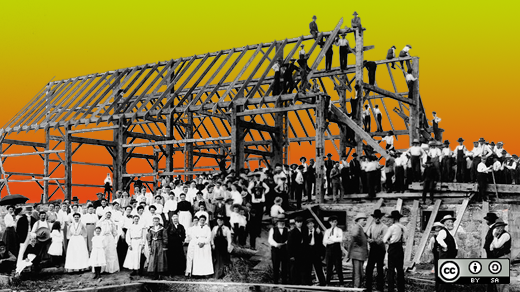 Since I’ve recently been on one of my Tom Sawyer rants again about the lack of humility I see in many community efforts, I thought I’d share a story that might help you visualize the role your organization could play in the communities it belongs to.
A few months ago, two of my business partners, David Burney and Matt Muñoz, were sitting in a meeting with a client of ours (The Redwoods Group, a very cool B Corporation), discussing the unique relationship that organization has with its customers, employees, and other communities. The conversation turned to the ideas of service and humility, which are so often ignored by big organizations attempting to engage with communities.
All of the sudden, Kevin Trapani, CEO of The Redwoods Group, encapsulated the entire conversation in a few short words:
“We should be of it, not above it,” he said.
Beautiful.
So many organizations, intentionally or not, approach things as if they are above a community. Sometimes this means taking the Tom Sawyer approach of using community strategies to get others to paint your fence for free. Sometimes this means creating a new community with your organization at the center rather than joining an existing community effort. Sometimes it simply means a lack of humility or selflessness shines through in the organization’s community interactions.
This one goes out to the fence painters
 I’m always looking for interesting new communities to highlight on opensource.com. Over the past year, I’ve covered everything from Wikipedia to OpenIDEO to The White House and am, frankly, overwhelmed by the sheer quantity of new community-building efforts going on out there.
Seems like every day I get an email or see something on Twitter or Facebook about a new community that sounds interesting and innovative. I’ve found some amazing people and visionary ideas. I hope to continue to highlight the best of these new communities here on the business channel.
But at the risk of sounding like a hater, I must admit I’m getting a touch of new-community fatigue.
I think I went over the edge a few weeks back when ex-advertising industry celebrity Alex Bogusky (yes, the same guy who did all of those weird chicken ads for Burger King and famously tried to make Microsoft cool) announced his new “Collaborative Community/Brand For Social Entrepreneurs.” He calls it Common. No offense to Alex, but when the advertising agency folks are hopping on the community brand bus, you have to wonder whether the seats are starting to get a tad bit full…
I also wonder if there is a bit too much Tom Sawyer-fence-painting going on in some of these new communities. In case it’s been a while since you read Tom Sawyer, here’s how Wikipedia summarizes the story of Tom Sawyer and the fence:
User-led innovation can’t create breakthroughs. Really?
 Earlier this week, Fast Company posted an article by Jens Martin Skibsted and Rasmus Bech Hansen (thanks to Gunnar Hellekson for sending it my way) that may be of interest to folks seeing success with their open source and open innovation efforts.
The article is entitled “User-Led Innovation Can’t Create Breakthroughs; Just Ask Apple and IKEA” and here’s how it starts:
Companies should lead their users, not the other way around.The user is king. It’s a phrase that’s repeated over and over again as a mantra: Companies must become user-centric. But there’s a problem: It doesn’t work. Here’s the truth: Great brands lead users, not the other way around.
Jens and Rasmus aren’t the first to preach this sermon, Henry Ford (apocryphally, at least) had a go at it about 100 years ago. And Steve Jobs has famously used Henry Ford’s “faster horse” quote to describe Apple’s philosophy about market research for years.
To make their case, Jens and Rasmus use Apple and IKEA as case studies of brands that have done very well by not listening to their users, and in the article they document conversations with insiders at each company.
Your open source management approach: Red Team or Blue Team?
 When I hear people in the technology industry talk about the benefits of open source software, one of things they mention often is their belief that open source software “gets better faster” than traditional software (David Wheeler has done a nice job collecting many of the proof points around the benefits of open source software here). While the speed of innovation in open source is in part due to the power of Linus’s Law (“Given enough eyes, all bugs are shallow”), I believe it also has a lot to do with the way open source projects are managed.
Many of the characteristics of this open source management style apply well beyond making software, and I’m always looking for examples showcasing this in action. A few weeks ago, I wrote briefly about the story in Malcolm Gladwell’s book Blink about (now retired) US General Paul Van Riper.
Gladwell tells the story of how, in an enormous military war game called the Millennium Challenge in 2002, Van Riper took command of the Red Team, playing the role of a rogue commander who broke away from the government of his Persian Gulf country and threatened US forces (the Blue Team). Rather than following standard military management protocol, Van Riper managed his team according to a philosophy he called “in command and out of control.” From the book:
By that, I mean that the overall guidance and the intent were provided by me and the senior leadership, but the forces in the field wouldn’t depend on intricate orders coming from the top. They were to use their own initiative and be innovative as they went forward.
A State of the Union address delivered the open source way?
 This evening, United States President Barack Obama will be delivering the annual State of the Union address at 9pm EST (if you want to learn more about the tradition of the State of the Union address in the United States, the White House has put together a nice video about the history and making of it here).
The president’s staff is trying out an interesting concept during tonight’s address. Here is an excerpt from an email sent out this afternoon with the details:
This year we’re trying something new. As President Obama addresses the Nation, we’ll offer a companion stream of visual aids, including charts and quick stats about what’s happening in the country. You can view this feature at WhiteHouse.gov/SOTU.
Immediately following the speech, stay tuned for our live Open for Questions event with policy experts from the White House answering your questions about key issues in the speech.
They’ve branded the event with the slogan “Watch & Engage” and have planned a whole week of events where citizens can participate in interactive sessions with government officials including President Obama, Vice President Joe Biden, Press Secretary Robert Gibbs, Secretary of Education Arne Duncan, Secretary of Health and Human Services Kathleen Sebellus, and many others.
I’ll be interested to see how this plays out. Over the past two years, I’ve been excited to see many attempts within the US government to increase transparency, improve sharing of information, and create better forums for citizen collaboration. I’ve also seen examples where transparency, openness, and engagement are more spin than substance.
Which will this be? I’ll have to stay by my computer tonight and find out. If you decide to do the same, please feel free to share your experiences and opinions.
[This article originally appeared on opensource.com]
Is your brand out of control?
I’m lucky enough to have the opportunity to spend much of my time these days doing something I love—helping clients position and manage their brands. My experience helping build the Red Hat brand over ten years had a profound impact on the approach I take to brand positioning.
 In the past year, as I’ve applied open source principles I learned at Red Hat to brand positioning projects in many different types of organizations, I’ve started thinking a mashup of classic brand positioning concepts and tenets of the open source way might help provide some clues for how brands might be better managed in the future.
I’ve put my time where my mouth is, and am currently in the process of writing a book entitled The Ad-free Brand: Secrets to Successful Brand Positioning in a Digital World, which will be published this fall.
Rather than writing the book behind closed doors and only revealing the finished product, I thought I’d share some of my ideas with you along the way, taking a cue from the open source way and releasing early and often.
Today, I’d like to explore the traditional role of brand positioning, and share some ideas for how I believe it might change to remain relevant in a digital world.
Audience or Community?
Typical marketing experts would define positioning as the art of creating meaning for a brand that occupies a distinct, valued place in the minds of members of a target audience.
But is the idea of an audience for brand messages outdated? Certainly in the heyday of traditional advertising, brands had an audience. The brands spoke, consumers listened… or didn’t.
Are you an expert in building communities? Prove it.
Over the past few months, I’ve started moonlighting as a contributor on the Management Innovation Exchange (MIX), which we’ve featured regularly on opensource.com. My posts on the MIX focus on how to enable communities of passion in and around organizations.
 A few months ago, the MIX announced a new contest, the Human Capital M-Prize, which is looking for the best ideas on how to unleash passion in our organizations.
Since this particular challenge is right in my stomping ground on the MIX, and because many people who regularly read and contribute to opensource.com probably know better how to enable communities of passion than almost anyone else in the world, I thought I should highlight the contest in the hopes that some of you might enter.
Details? From the MIX website:
The MIX and HCI are looking for the boldest thinking, most powerfully-developed vision, and the most cleverly-designed experiments for unleashing passion in our organizations. What is your bold new idea or radical solution to the lack of engagement and passion in our workforce? What game-changing story or hack can transform employees everywhere into more engaged, motivated and productive contributors?
If you have a story or hack you think might fit, go here to learn more or enter the contest.
The deadline for entries is January 20th—only about two weeks away.
The grand prize winner will get a chance to present their story or hack to a global audience at the HCI Human Capital Summit in Atlanta in March, and there are other interesting prizes as well. So if this sounds compelling to you, get on over to the MIX and submit your entry.
Make our community of passion at opensource.com proud and let’s show these future-of-management-types that we open source folks know a thing or two about building community.
Studio H: A real-world experiment in design-based education
 As 2010 comes to a close, I thought I’d write my last post of the year about a project that has really moved and inspired me. The project is called Studio H, and is the brainchild of two brilliant designers, Emily Pilloton and Matthew Miller, who have found a new calling as teachers in one of the poorest, most rural counties in my home state of North Carolina.
Even though Bertie County, where the experiment is taking place, is less than 2 hours away from where I live, I first heard about this project earlier this year from a good friend who showed me the TED Talk Emily had given at TEDGlobal 2010 in July. Here is her talk:
It’s a wonderful story. Two successful designers leave their San Francisco home to move to the poorest county in North Carolina and design a program to help public school kids (over 95% of who qualify for reduced-rate or free lunches) get a shot at a better future.
What makes the story particularly compelling is the non-traditional learning approach, utilizing design thinking and some other tools that will be very familiar to those of us who do things the open source way.
Watch the TED talk first, which will likely bring anyone but Scrooge himself close to tears, but don’t stop there.
This project is not just a theory. Studio H is underway, with the students now well into their second fall project, designing some really amazing chicken coops (chickens are a big part of the Bertie County economy).
I particularly love the ChickTopia coop, but you may prefer the compelling geometric design of the Coopus Maximus or the whimsical, industrial-chic Chicken Circus.
You can follow the students’ progress on the blog here.
The third and final project next spring will be to design and build a public farmers market in downtown Windsor, the county seat of Bertie County, population 2000.
If you like what you see so far, consider making a donation. After all, this could be what the future of education might look like.
I certainly hope so.
This post originally appeared on opensource.com.
De-bucketizing the org chart
Over the years, I’ve picked up an unhealthy understanding of the language of business. Years of sitting in big corporate meetings will do that to you, unfortunately.
 Here at New Kind, my business partners will still call me out for talking about “action items,” saying something is in our “wheelhouse,” or jumping straight to the “net-net.”
But perhaps the business term I love to hate the most is the word bucketize, which I’d translate as “to organize into broad categories.” Common usage might include statements like the following:
“I’m going to bucketize these requirements.”
or
“We’ve bucketized the skillsets we need for this project.”
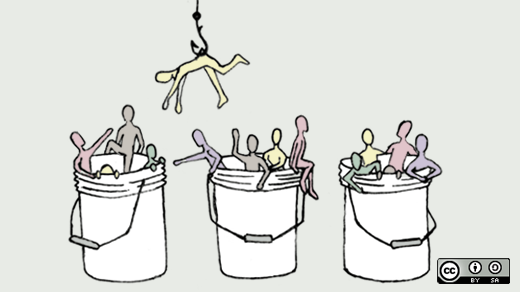
It’s not just the word that I dislike either, but the entire concept of bucketizing things, which often means taking complex relationships and oversimplifying them in order to fit into broad buckets designed to hold everything except much meaning. Bucketizing often puts things into silos (another favorite business word), destroying valuable connections between ideas, tasks, or people ending up in, well, different buckets.
Perhaps the most egregious example of corporate bucketizing for me is the typical corporate org chart, which looks something like this.

In most organizations, each person sitting at the executive table has their own employee bucket. As an executive, you are often motivated to fill your bucket with as many people as possible, because the more people you have working for you, the more power you control in the organization.
The problem? The org chart is an oversimplified, semi-fictional construct.
It rarely represents an accurate view of the complex web of working relationships found within an organization where people in different buckets communicate and work with each other all of the time. Yet, even though it is mostly fiction, the org chart often creates real power for executives to wield.
[Read the rest of this post on opensource.com]
Hey, I Wrote a Book!

Available now in print and electronic versions.
 Dark Matter Matters