Dark Matter Matters
Chris Grams
Thoughts from the HCI Engagement and Retention Conference in Chicago
Yesterday I had the privilege of participating in two panel discussions at the Human Capital Institute’s Engagement and Retention Conference in Chicago.
I moderated the first panel on behalf of my friends at the Management Innovation Exchange. This panel featured the winners of the first Human Capital M-Prize: Lisa Haneberg of MPI, Joris Luijke of Atlassian, and Doug Solomon of IDEO. The Human Capital M-Prize competition, run jointly by HCI and the MIX, was designed to find bold ideas, stories, and innovations highlighting ways to unleash the passion of people within our organizations.
Lisa began by presenting her winning hack, entitled Start with a better question to create a better talent management system: the Talent Management Cloud. She made the case that the “old kind” model where engagement and retention are owned within the HR function is fundamentally broken. Because there are so many factors well beyond the control and influence of HR alone, responsibility for talent management must be the responsibility of the whole organization. I’d encourage you to go take a look at Lisa’s winning hack if you are interested in learning how to put her more holistic model into practice.
Next, Joris, who came in all the way from Sydney for the conference, took on the performance review– something he described (accurately in my book) as universally hated by both employees and HR people around the world. Joris shared his story of how Atlassian designed a kinder, gentler, more humane performance review system and rolled it out within the organization. You can read Joris’s original story Atlassian’s Big Experiment with Performance Reviews on the MIX.
Finally, since I make no secret of being an IDEO fanboy, I was excited to share the stage with Doug Solomon, CTO of IDEO. Doug shared his winning story, entitled The Tube: IDEO Builds a Collaboration System That Inspires Through Passion. Frustrated by so-called collaboration systems that IDEO found desperately lacking, they took on the challenge of designing their own, using a model based on facilitating person-to-person interaction more akin to Facebook than your typical knowledgebase or database-driven collaboration system. Doug also shared that a company called Moxiesoft has taken The Tube and turned it into a product, which I can’t wait to go check out.
At the end of the session HCI announced a new M-Prize, which will run from now through December 9th. This M-Prize is called “Encouraging the Gift of Leadership” and will be an effort to discover innovative ideas for how we can stimulate and support the development of “natural” hierarchies, where influence comes from the ability to lead, rather than from positional power within organizations. Have a great idea? You should go enter it on the MIX.
Later that afternoon, I participated in another panel where Katie Ratkiewicz of HCI shared the results of a recent survey regarding the relationship between career development efforts within organizations and overall employee engagement. I was joined on the panel by Stuart Crabb, Head of Learning and Development at Facebook, Russell Lobsenz, Director of Talent Development at Orbitz, and Cathy Welsh, SVP of Leadership Consulting at Lee Hecht Harrison.
I was particularly interested to hear Stuart’s comments regarding Facebook’s approach to career development. Basically, his thinking is that career development is primarily the employee’s responsibility (not the company’s) to drive, something that I expect was fairly controversial to many in the room (judging from the data shared in the survey), but which I couldn’t agree with more fully.
While I was excited to hear him say it out loud (because I wasn’t sure whether I’d be driven from the room tarred and feathered if I’d done it on my own), I did acknowledge that there were prerequisites for an approach where employees are accountable for their own career development to work. In my view, there has to be an entrepreneurial culture in place in the organization where employees have the freedom to explore new opportunities. I certainly felt we had those sort of opportunities while I was at Red Hat and it sounds like there is a culture based on freedom and personal accountability at Facebook as well.
I want to thank my new friends at the Human Capital Institute for a great day and some wonderful hospitality. Also thanks to my friends in the MIX community and especially Lisa, Joris, and Doug for participating on the panel. I’ll see all of you again soon!
Our story about the Wikimedia strategic planning project is on Harvard Business Review’s blog today
 Polly LaBarre wrote a nice piece that was published on the Harvard Business Review blog today in which she highlighted the story that Philippe Beaudette, Eugene Eric Kim, and I wrote for the Management Innovation Exchange about the Wikimedia Foundation strategic planning project.
Basically, Eugene and Philippe organized and ran a strategic planning project that democratized what is usually a fairly aristocratic process, involving a community of 1000+ Wikimedia volunteers in helping craft strategy for the next five years.
Their story blew my mind when I first heard about it, and I hope it blows your mind too (but in a good way).
You can read Polly’s post here, then go check out the full story on the MIX.
An interview about communities of passion, the MIX, and HCI
The other day, Peter Clayton of Total Picture Radio interviewed me in preparation for the panel I’ll me moderating at the HCI Engagement and Retention Conference in Chicago in July.
We talked about the Management Innovation Exchange and I shared some ideas from the winning hacks and stories of the folks that will be on the panel: Lisa Haneberg, Joris Luijke, and Doug Solomon. In addition, we talked more broadly about communities of passion, employee engagement, and social media, among other things.
You can listen to the podcast here.
The low-cost, high-value approach to brand positioning research
In my last positioning post, I discussed the four key questions you must answer if you want your positioning research to lead you to effective brand positioning. So how exactly do you discover the answers to the four key questions? Do you need to hire an expensive market research firm and spend hundreds of thousands of dollars on surveys and focus groups?
Here is how I think ad-free brands should answer the question “how much should I spend on research?”
I always answer that question with an astoundingly simple approach that became the backbone of our entire brand strategy during my time at Red Hat. I call it the low-cost, high-value approach, and if you were to illustrate it, it’d look something like this.
 The low-cost, high-value approach means that you always analyze potential strategies in terms of their cost and value. You then default to choosing strategies first that are inexpensive in terms of time and money yet bring you a lot of potential value, before selecting strategies that cost more, even if they bring you great value.
Pretty simple, huh?
For example, hiring a research company to set up a brand tracking study with 10,000 potential customers for your brand might provide you with a lot of useful information (high value). But the study can also cost you a lot of money and take up a lot of your team’s valuable time (high cost).
If you have the time and money, you might still decide to field the high-value brand tracking study, but only after you have exhausted all of the low-cost, high-value strategies that might help answer those questions more inexpensively.
So, the essence of the low-cost, high-value approach is to default to spending as little time and money as you can and consider high-cost strategies only when there are no other options that will get you the information you need.
You’d be surprised how many organizations are essentially blind to an entire category of low-cost, high-value research options because they prefer to stick to practices they used in the years before better options became available.
The reality is that the last 10 years have given us a variety of low-cost, high-value digital media tools and resources that are perfect for doing brand positioning research and for rolling out positioning effectively. We now have low-cost, high-value alternatives that can provide data that helps us effectively position brands, many of which were not available before the Internet.
Doing research for positioning a brand is less expensive than it has ever been in history. Some people just haven’t received the memo.
So how much should you spend on research?
When you keep the low-cost, high-value approach in mind, the answer to this question should be clear: balance the amount of time and money you put into the research with the value of the brand you are positioning.
If you are trying to position a small web-based business just getting off the ground, you might attempt to answer the four questions with data you already have at your disposal. Perhaps you’ve already done some customer surveys; you’ve just completed a formal business plan; or you and your team even have strong, well-informed ideas about the direction you want to take the brand. You can use all of this preexisting information to answer the four critical questions I listed in the previous post.
But if you are attempting to position or reposition a brand where the stakes are high, especially if the brand is already generating significant amounts of revenue, the information you have at your disposal might not be enough.
If the stakes are high, but your time or money is short, don’t despair. The ad-free brand positioning approach really shines in low-budget situations because you can always take advantage of the “release early, release often” principle that this open, transparent positioning process embraces.
Don’t have any money to invest in research? You can still create a starting brand position by answering the four questions with the best information you have at your disposal. Then immediately start testing the positioning with others in the organization and potentially even in communities outside the organization. Incorporate the feedback, revise the positioning, and try again.
So if you are positioning a small brand, please don’t feel like you need to break the bank doing research. If you consider the low-cost, high value approach while always keeping the investment you are making in line with the value of the brand you are trying to position, you’ll be nicely set up for long-term positioning success.
—
—
This is the fourth in a series of posts drawn from The Ad-Free Brand, which is available now.

Are the “Best Companies to Work For” really the best companies to work for?
 The other day I noticed that the application deadline to be considered for the Fortune 100 Best Companies to Work For list is this week. My company is too small to be considered for this honor (you must have at least 1000 employees), but I always pay close attention when the rankings come out, and I’m sure many of you do as well. On the 2011 list, the #1 company was SAS, followed by Boston Consulting Group and Wegmans (see all 100 here).
The organization that does the ranking, The Great Place to Work Institute, has been running this competition for years and has a rigorous process for selecting the final list.
Yet when I read the articles written about the top companies or browse the list in Fortune, I always feel like something is missing. I finally put my finger on it:
I believe the evaluation process is benefit-heavy and mission-light.
What do I mean? When I read about the top companies, most of the emphasis seems to be on the salary and benefits offered to employees; which companies pay the most and have the best or most unusual employee perks (life coaches, wine bars, or Botox anyone?).
But the section of the report I want to see is nowhere to be found:
Which companies are doing things that matter?
- Which companies have a noble mission or purpose and are helping make the world a better place?
- Which companies have a bold vision and are leading innovation that is changing the world?
- Which companies are doing such amazing or interesting stuff that they are attracting the world’s top talent?
You see, I’m not someone who would find a company a great place to work because it offers a big paycheck and fantastic benefits. I need my work to be personally fulfilling. I need to feel like I have a chance to make a difference, to do something great.
I don’t think I’m alone.
Previously, I’ve written about something I call cultural fool’s gold, my term for an organizational culture built exclusively on entitlements.
If you want to test whether you work in an entitlement-driven culture, just ask a few people what they like most about working at your company. If they immediately jump to things like free snacks and drinks, the work-from-home policy, or the employee game room, you may have a culture made of fool’s gold, an entitlement-driven culture.
If instead they say things like these:
- I believe in what we are doing.
- I love coming to work every day.
- I leave work each day with a sense of accomplishment.
- I am changing the world.
you probably work in the only type of organization I’d personally ever consider—a mission-driven organization.
So the big question I’d pose to the folks at the Great Place to Work Institute:
Should there be a “best places” list for those of us who not only want to work someplace great, but want to do something great?
Maybe the Institute should consider a new list for those of us who demand more from our workplaces than big salaries, comfortable benefits, and free Botox injections?
Perhaps it could be called Best Places To Do Great Work or Workplaces with Purpose for People With Purpose or something like that?
The world has changed. I think many of the people graduating for our universities today will demand more than just great benefits from their employers. They’ll want to do meaningful work and be a part of a community of others looking for the same.
Personally, I hope to see the way we rate “the best places to work” in the future change to accommodate people like me.
What do you think?
[This post originally appeared on opensource.com]
Three tired marketing words you should stop using
 Over the years, I’ve had many people label me as a marketing guy just because I help build brands. I don’t like being labelled, but I particularly don’t like that marketing label. Why?
In my view, traditional marketing sets up an adversarial relationship, a battle of wills pitting seller vs. buyer.
The seller begins the relationship with a goal to convince the buyer to buy something. The buyer begins the relationship wary of believing what the seller is saying (often with good reason). It is an unhealthy connection that is doomed to fail most of the time.
What’s the alternative? I believe companies should stop trying to build relationships with those interested in their brands using a marketing-based approach and instead move to a community-based approach where the culmination of the relationship is not always a transaction, but instead a meaningful partnership or friendship that may create multiple valuable outcomes for both sides.
How do you do this? Consider beginning by eradicating three of the most common words in the marketing vocabulary: audience, message, and market.
So you better understand what I mean, let me attempt to use all three of these words in a typical sentence you might hear coming out of a marketer’s mouth:
We need to develop some key messages we can use to market to our target audience.
Yikes. So much not to like in there. Let me break this one down.
Audience
You hear companies talk about their “target audiences” all the time. So what’s wrong with that?
The word audience implies that the company is talking and the people on the other end are listening. This sort of binary, transactional description of the relationship seems so dated to me.
Certainly in the glory days of advertising where companies had the podium of TV, magazine, and newspaper ads, the word audience was more appropriate. After all, no one ever got far talking back to the TV set.
But in the age of Twitter and Facebook, companies must respect that everyone has the podium. Everyone is talking, everyone is listening.
Where most marketing folks would use the word audience, I often substitute the word community. By thinking of those who surround your brand as members of communities rather than simply as ears listening to you, you’ll already be on your way to a healthier, deeper relationship with the people who engage with your company.
Message
The word message bothers me for the same reason. It is such an antiquated, transactional term. When a company talks about “creating messaging” or “delivering targeted messages” I start thinking we should call the Pony Express.
I believe the move to a community-based approach begins when you quit worrying about “delivering messages” and begin thinking about sharing stories, joining conversations, or sparking dialogue.
These are much better ways to communicate authentically in a collaborative world.
Market
Perhaps the word that bugs me most is market (used as a noun or a verb) and its related friend consumer. Companies that think of people interested in them as consumers or markets take what could become a multi-dimensional relationship and whittle it down to one dimension: a transaction.
If you think of someone as part of your “target market” or a “consumer” you are making your interest in them abundantly clear. You want them to consume something. You want their money.
But what if there were more that people who are interested in your brand could share besides just their money? Perhaps they have valuable ideas that might make your company better? Perhaps they’d be willing to volunteer to help you achieve your mission in other ways?
When you stop thinking of the people that care about your company as consumers or a market, you can begin to see opportunities that you would have been blind to before.
Want an example? Look anywhere in the open source world. Sure there are buyers and sellers, but there are also lots of people bringing value in other ways. Developing code. Hosting projects. Writing documentation. The list goes on.
So let me be the first to admit these three words are the tip of the iceberg. Moving a company from a marketing-based to a community-based approach to building relationships will take more than changing a few words. It will require you to embrace new media, new skill sets, and a totally new way of thinking.
But you have to start somewhere.
Do you see other things that may need to change as we move from a marketing-based to community-based approach to building brands and companies?
I’d love to hear your ideas.
[This post originally appeared on opensource.com]
The four questions your brand positioning research must answer
To create great brand positioning, you must do your homework. In a brand positioning project, this homework mostly consists of doing some research about the brand ahead of time. But how do you organize your research?
In this post, I’ll teach you a simple tip I learned from Dr. Kevin Keller that will help you frame your positioning research in a way that will ensure you find the answers you need.
When doing research to inform a brand positioning project, I am not satisfied until I can answer the following four questions:
1. What does the brand community currently believe about or value in the brand?
2. What might the brand community believe or value about the brand in the future?
3. What does the organization currently claim about the brand?
4. What would the organization like the brand to become down the road?
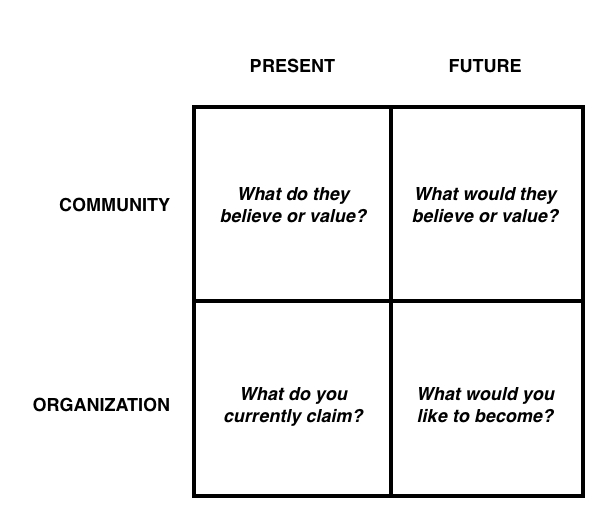 Why are the answers to these four questions so important?
Great brand positioning has one foot in the present and one foot in the future. The research we’re doing to answer these questions helps us understand exactly where each foot should be planted.
The Foot in the Present
By studying what your brand community members currently believe the brand stands for and what they value about it today, you’ll begin to understand their current experience of the brand. Yet your community’s experience of the brand can be very different than how you see or talk about the brand inside the organization. So the brand research should study the brand from both an internal and external perspective.
Often organizations will notice gaps or inconsistencies between the brand they claim to be and the brand their community sees or experiences—the brand promise-brand experience gap.
Once you deeply understand what your community currently believes or values about the brand and compare this to what you currently claim about the brand, you’ll have a complete picture of where your “foot in the present” is planted. You’ll see clearly how big the gap is between your brand promise and brand experience. Only then can you begin the work of building brand positioning that closely aligns the brand promise claimed with the brand experience delivered.
The Foot in the Future
But a brand that is only concerned with the present state of affairs is a brand in stagnation. You’ll want your brand to grow, prosper, and remain relevant down the road. So you should also try to understand what the brand community might believe or value about the brand in the future.
What directions might people give you permission to take the brand? Where do they not want you to take it? What would they value in the brand that you don’t provide today? What does the organization do today that people would rather not see you continue to do down the road?
Equally important is that you strongly consider where you want to take the brand. Remember the apocryphal Henry Ford quote, “If I had asked people what they wanted, they would have said faster horses.”
Sure, to remain relevant you should deeply understand what the community members want the brand to become, but do not become a slave to their vision. You might have entirely different and amazing places you’d like to take the brand that your customers or other community members can’t yet see.
So, in order to understand where your foot in the future is planted, you should seek to understand both what your community would believe or value in the brand and what you want the brand to become down the road.
Where Great Positioning Lives
Great positioning lives where all four answers intersect. It is a bridge between your current brand experience and the brand you’d like to become in the future. It deeply reflects the brand you currently see while lighting the path to what it could become.
Great positioning lives in all four of these quadrants at once. It can be like the North Star, guiding the organization toward the future, while paying homage to the past and making clear connections between things that resonate about the brand with both your organization and your brand community.
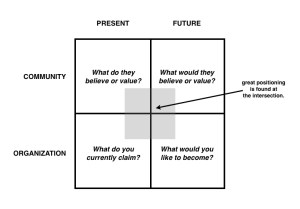
So where should you look for data that will help you answer these four questions and start on the road to great brand positioning?
I’ll share some of the mostly likely sources of data in a followup post.
—
This is the third in a series of posts drawn from The Ad-Free Brand, which is available now.
Want people to embrace the open source way? Don’t talk, do.
 The June issue of Harvard Business Review features an interesting article by Roger Martin (one of the leading management minds of our time and author of the just published book Fixing The Game). The article tells the story of how Scott Cook, founder and current Chairman of Intuit, kicked off an effort to reinvent Intuit as a design-driven company.
I’ll leave it to Roger and HBR to share the story of how this initiative played out (hint: a very good case study of how to embed design thinking in the corporate world), but one particular lesson stood out for me that I’d like to highlight here.
When Cook kicked off the initiative, he did so by hosting two-day offsite event for the company’s top 300 managers. As part of this event, Cook gave a five-hour (wow!) PowerPoint presentation, during which he “laid out the wonders of design and how it could entice Intuit’s customers.”
As you might expect, the PowerPoint marathon didn’t go so well. From the article:
“But although the main event fell flat, the one that followed did not. Cook had met a young consulting associate professor at Stanford named Alex Kazaks, whom he’d invited to present for an hour at the offsite. Like Cook, Kazaks began with a PowerPoint presentation, but he ended his after 10 minutes and used the rest of the time for a participatory exercise: The managers worked through a design challenge, creating prototypes, getting feedback, iterating, and refining.
The group was mesmerized…”
This story illustrates something I saw over and over during my time at Red Hat and in many of the projects I’ve worked on since:
No matter how eager you are to get people to embrace the open source way fully—running projects in an open, collaborative, meritocratic way—you’ll have more success convincing people to try doing things the open source way when you stop showing slides and instead get them to experience the benefits in action.
The best way to learn about collaboration is to collaborate.
The best way to learn how to operate openly is to participate in a project run openly.
And the best way to see the power of meritocracy is to participate in a project where the ideas actually do come from everywhere.
So before you spend two weeks preparing a detailed PowerPoint (or OpenOffice) presentation to convince your management team to embrace the open source way, stop and think.
Is there a way you could show the benefits of the open source way in action? Could you run a hands on-project the open source way and invite those you are attempting to sway to participate?
In my experience, people will nod their heads at a presentation espousing philosophy. But you won’t really have their minds until they’ve experienced the open source way in action, and you won’t have their hearts until they’ve thoroughly enjoyed the journey as well.
[This post originally appeared on opensource.com]
Why does brand positioning matter and what must change?
I believe almost all great brands are built on a foundation of great positioning.
I feel so strongly about positioning that one of the core elements of this blog is a series of brand positioning tips I learned over the years as an eager student of classic brand positioning.
Sometimes great positioning is led by a branding genius such as Scott Bedbury (who helped grow the Nike and Starbucks brands); sometimes a great leader and communicator with a very clear vision (like Steve Jobs at Apple) drives it into the organization; sometimes people stumble on great positioning by pure luck; and more and more often, organizations are developing positioning by collaborating with the communities of people in and around the organization who care most passionately about the brand.
This last way is the ad-free brand way of developing brand positioning.
 Why does great positioning matter? In my view, there are four key reasons brands should care about positioning.
1. Great positioning helps people understand the brand
The best brand positioning is always simple and clear. The greatest product or organization in the world won’t be successful if people can’t or don’t bother to comprehend why they should care about it. Your story must be able to break through the clutter.
2. Great positioning helps people value the brand
Getting people to understand the brand is the first step, but no less important is ensuring they value the brand. The best brands stand for things people care about or desire.
3. Great positioning helps people identify with the brand
Once people understand and value the brand, they must also understand how they fit in and how they can engage with the brand. They need to see some of themselves in it.
4. Great brand positioning helps people take ownership over the brand
It may sound like a brand’s worst nightmare to lose control and have the brand community take over. But the most self-actualized brands of the twenty-first century allow the communities of people surrounding them to take some ownership of and responsibility for the brand. Essentially, the brand owners become in command and out of control of the brand.
In 1981, when Jack Trout and Al Ries wrote Positioning: The Battle for Your Mind (the book that really defined the discipline of brand positioning) traditional advertising was still a dominant force. In fact, as you glance through their book, you’ll notice that most of the examples they use to illustrate positioning concepts are classic advertisements or advertising campaigns like the Avis “We’re #2, so we try harder” or the 7-Up “Uncola” campaign.
In the book, Trout and Ries define positioning as follows:
“…positioning is not what you do to a product. Positioning is what you do to the mind of the prospect. That is, you position the product in the mind of the prospect.”
The Trout and Ries definition is a perfect way to achieve the first three of the four benefits above; it helps people understand, value, and identify with the brand.
Where the Trout and Ries model of positioning is all about what you do to the mind of the prospect, ad-free brands are less interested in creating meaning for a brand in people’s minds and more interested in creating meaning for a brand with the help of people’s minds.
By giving the communities of people who care about a brand some ownership over its future direction, we begin to build relationships based on trust, respect, and a mutual exchange of value.
Where 21st century brands will really shine is by mimicking the open, collaborative, meritocratic model of the open source software movement (and the Internet itself) in their positioning work. In my view, without beginning to engage the communities of people who care about a brand as co-owners, classic brand positioning by itself will continue to be less and less effective as traditional advertising and PR continue to be less and less effective.
The secret? Marrying those classic brand positioning principles to a 21st century way of collaborating with the communities of people who care about a brand. By doing both together, we’ll be able to build stronger, more resilient brands than ever before.
—
This is the second in a series of posts drawn from The Ad-Free Brand, which is available now.
Mitsubishi’s gift to the community of people affected by the Japan earthquake
 When corporations engage with communities, many make the mistake of focusing first on what the community can do for them. I encourage companies not to start with the benefit they get from the community (buy my stuff! design my products! give me feedback!), but instead with the benefits they give to the community.
What can corporations bring to the table that helps communities? Some examples:
• Funding: Companies can invest real money in projects that help the community achieve its goals.
• Gifts: Many communities are in need of assets that individuals can’t buy on their own. Are there assets the company already owns or could buy then give to the community as a gift?
• Time: The company probably has knowledgeable people who might have a lot to offer and could spend on-the-clock time helping on projects that further community goals.
• Connections: Who do people in the organization know and how might these relationships be of value to others in the community?
• Brand power: Could the company use the power of its brand to shine the light on important community efforts, drawing more attention and help to the cause?
This weekend, a story in The New York Times highlighted one example of a company that brought great value to a community in need with a well-timed gift.
After the March earthquake in Japan, many affected areas had electricity restored relatively quickly. Gasoline, however, still proved hard to come by.
So Mitsubishi president Osamu Masuko donated almost 100 of his company’s i-MiEV electric cars to help ensure people and supplies could keep moving in the affected areas.
This gift, which cost Mitsubishi relatively little, has provided a huge benefit for the affected communities. One story from the article:
“There was almost no gas at the time, so I was extremely thankful when I heard about the offer,” said Tetsuo Ishii, a division chief in the environmental department in Sendai, which also got four Nissan Leaf electric cars. “If we hadn’t received the cars, it would have been very difficult to do what we needed to.”
Mr. Ishii and other officials in Sendai assigned the cars strategically. Two were used to bring food and supplies to the 23 remaining refugee centers in the city, while two others served doctors. Education officials have been using another two vehicles to inspect schools for structural damage. Others helped deliver supplies to kindergartens around the city or were loaned to volunteer groups.
Most corporations would view a gift like this as simple corporate philanthropy. But I believe giving back to communities is much more than a “do good” strategy. I believe it can be good business as well.
Mitsubishi’s story is a case in point. Not only has Mitsubishi garnered goodwill from citizens appreciative of the gift, they have created a wonderful, emotionally-resonant proof point of the practicality and reliability of electric vehicles at a time when many are still questioning how effective they will actually be.
The people at Mitsubishi will not only be able to sleep at night knowing they provided a valuable gift to a community in need, but they will also have a powerful story that can be used for years down the road illustrating the effectiveness and practicality of the electric vehicle.
The community benefits. The company creates value for its shareholders at the same time. In my view, gifts like this where everyone wins are the best gifts of all.
[This article originally appeared on opensource.com]
Hey, I Wrote a Book!

Available now in print and electronic versions.
 Dark Matter Matters