Dark Matter Matters
Chris Grams
How to test your brand positioning: is it desirable, deliverable, and differentiated?
 Once you and your positioning team have determined what the positioning for your brand should be and identified the points of difference, points of parity, and maybe even a brand mantra, consider checking your work with the following approach I learned from branding expert Kevin Keller.
Write up your key points of difference and points of parity (and your brand mantra if you have it) where you can see them together, representing the sum of your positioning. When you look at these pieces as a whole, does your chosen positioning pass the following three-question test?
1. Is this positioning desirable to your brand community?
Does the positioning reflect characteristics your brand community would want? It isn’t enough just to be different—the positioning should show that you are different in a way that people would value.
2. Is this positioning deliverable by the brand?
Does your brand experience already deliver on this positioning? If not, and if you’ve identified aspirational points of parity or points of difference, can you make changes to the organizational strategy that will ensure this positioning will reflect the actual brand experience at some point in the near future? If your brand can’t deliver on the positioning, it won’t feel authentic to your brand community and may actually do some damage if people perceive it as false or misleading.
3. Is this positioning differentiated from your competitors?
Does this positioning distinguish your brand from everyone else in the competitive frame of reference? Even if the positioning is desirable and deliverable, if it is indistinguishable from the positioning of your competitors it won’t be effective.
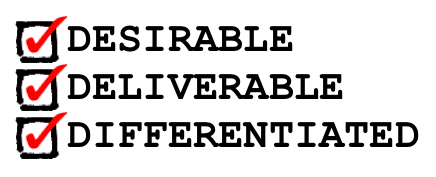
Desirable, deliverable, and differentiated: great positioning will be all three at once.

Sighting: The Ad-Free Brand in Singapore
Thanks to my friend Jesslyn Koh for sharing this picture from the from the Kinokuniya Bookstore in Singapore. If you happen to be in the neighborhood and haven’t yet picked up a copy of the book, looks like they have a few available!

12 design thinking rules from David Burney
One of my business partners at New Kind, David Burney, is an exceptional facilitator of design thinking sessions. David introduced me to design thinking and the work of IDEO (where many of the concepts behind design thinking were developed and applied to the business world). David taught me everything I know about facilitating projects and sessions using a design thinking approach.
At the beginning of any design thinking project, David shares a set of rules that help get every participant on the same page. The rules apply to everyone (including executives) and help create an optimal environment for creativity. If you are planning to run a project using a design thinking approach, you might want to consider sharing these rules with your group before you get started. I’ve used this list many times, and I promise, it really helps keep things on track.
1. Avoid the devil’s advocate: The devil’s advocate is someone who (purposely or accidentally) shoots down the ideas of others without taking any personal responsibility for his actions. The devil’s advocate often begins his objection with the phrase “Let me be the devil’s advocate for a second…”. The devil’s advocate often intends to be helpful by pointing out flaws in an idea, but ultimately this focuses people’s attention on what won’t work rather than exploring unexpected ways that it might work.
2. Make agendas transparent: Every participant should make their personal agendas as clear as possible.
3. Leave titles at the door: No one person’s ideas are worth more than anyone else’s.
4. Generate as many ideas as possible: During ideation, you are not trying to generate the best ideas; you are trying to generate the most ideas.
5. Build on the ideas of others rather than judging them: If someone else has an idea you like, build on it. If you don’t like an idea, share another one rather than critiquing.
6. Stay on time: Don’t let your ideation session spiral out of control. Each ideation session should be timed and should have a clear ending point.
7. State the obvious: Sometimes things that can seem obvious reveal great insight from their simplicity.
8. Don’t sell or debate ideas: Selling and debating ideas takes time away from generating new ideas.
9. Stupid and wild ideas are good: Sometimes the craziest ideas lead to the best ideas.
10. DTA stands for death to acronyms: Avoid acronyms—they are exclusionary because people who don’t know what they stand for will quickly be lost. If you must use an acronym, write what it stands for somewhere everyone can see it. Keep a running list of all acronyms used during the project or session.
11. Always understand in which stage of the process you are: When you are ideating, you are not critiquing ideas. But when ideation is over and you begin the process of selecting the best ideas, you’ll need to discuss the merits of each idea in a more traditional, analytical way.
12. Play is good, have fun: The more fun you are having as a group, the more creative ideas you’ll generate.
If you’d like to learn more about design thinking and how you can use it in your projects, I recommend any of the following books.
From the amazing team at IDEO:
– The Art of Innovation by Tom Kelley
– Ten Faces of Innovation by Tom Kelley
– Change by Design: How Design Thinking Transforms Organizations and Inspires Innovation by Tim Brown
Other great books to consider:
– The Design of Business: Why Design Thinking is the Next Competitive Advantage by Roger Martin
– Design Thinking: Integrating Innovation, Customer Experience, and Brand Value by Thomas Lockwood
—
 Was this post helpful?
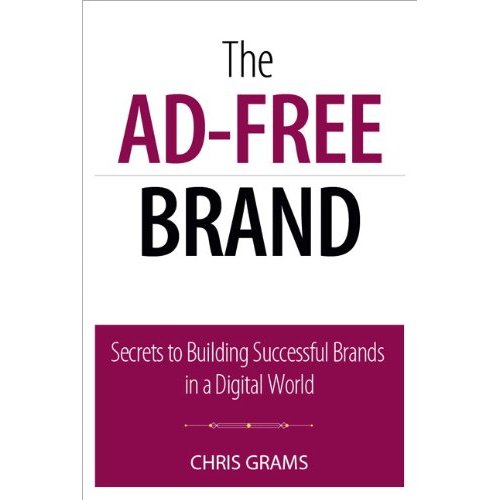
If so, you can find more tips about how to employ a collaborative approach to building brands in my book, The Ad-Free Brand (not an advertisement, mind you, just a friendly suggestion:).
Only $9.99 for the Kindle, but available in each of these formats:
Book | Kindle | Nook | EPUB/PDF
Google PR team: I salute you for defaulting to open
It’s been a week now since Steve Yegge of Google fired the shot heard ’round the tech industry. In case you missed it, Steve wrote a thoughtful, yet highly charged rant intended to begin an internal conversation about Google’s failures in learning how to build platforms (as opposed to products).
In the post, he eviscerates his former  employer, Amazon, and in particular CEO Jeff Bezos (who he refers to as the Dread Pirate Bezos), but doesn’t pull any punches with his current employer either. It is an extremely passionate, well-written piece which, my guess is, will change the conversation internally at Google in a positive way.
But there was one problem:
When posting it to Google+ (which he was admittedly new to), Steve accidentally made his rant public, where the whole world could see it.
And over the past week, pretty much everyone has.
This prominent re-post (Steve took his original piece down, which I’ll get to in a second) has generated, as of this writing, 487 comments and over 11,000 +1s on Google+.
The comments are spectacular and largely supportive. Some have referred to this as Steve Yegge’s Jerry McGuire moment.
But my post isn’t about Steve. He’s received plenty of attention in the past week, poor guy.
It’s about the Google PR team that, in a time of crisis, made the tough decision to stay true to the spirit of openness that Google Senior VP of People Operations Laszlo Bock described in his recent piece in Think Quarterly. From Laszlo’s piece:
“And if you think about it, if you’re an organization that says ‘our people are our greatest asset,’ you must default to open. It’s the only way to demonstrate to your employees that you believe they are trustworthy adults and have good judgment. And giving them more context about what is happening (and how, and why) will enable them to do their jobs more effectively and contribute in ways a top-down manager couldn’t anticipate.”
So if “default to open” is the overall philosophy at Google, how does it play out in practice? As it turns out, Steve Yegge’s rant provides a pretty good data point.
In a Google+ message explaining his decision to take down the original post, Steve described the reaction of the Google PR team this way:
“I’ve taken the post down at my own discretion. It was kind of a tough call, since obviously there will be copies. And everyone who commented was nice and supportive.
I contacted our internal PR folks and asked what to do, and they were also nice and supportive. But they didn’t want me to think that they were even hinting at censoring me — they went out of their way to help me understand that we’re an opinionated company, and not one of the kinds of companies that censors their employees.”
This is not, in my experience, the kind of support that most PR folks would have given Steve in this situation:) And because of it, this episode, however traumatic, serves as one piece of proof showing that Google’s “default to open” approach is not just aspirational bullshit.
I’m sure there are plenty of places where people could argue that Google is not being open enough, or could stand to be more open than they are today.
But in this particular case, in a moment of crisis—where many weaker leaders would have given in to the frightened urge to attempt a cover up—Google stood by its core beliefs and defaulted to open.
While openness is sometimes ugly and painful (as it certainly is in this case), it often allows great opportunities to emerge that would otherwise never see the light of day.
I suspect that when the waters recede, this authentic, beautiful, and raw piece of communication might be the starting point toward something better, not just within Google, but in the tech industry as a whole.
And for supporting openness, even in its most painful form, Google PR team, I salute you.
Sighting: The Ad-Free Brand in Malaysia
Thanks to Pip Kasim, an MBA student in Kuala Lumpur, Malaysia, for sharing this picture of her friend Jojo Ds and the book!

Ally Bank shows there’s a right time for even ad-free brands to advertise
 Even though I wrote a book called The Ad-Free Brand, I don’t hate all traditional advertising. In fact, sometimes, I absolutely love it. Today is one of those days.
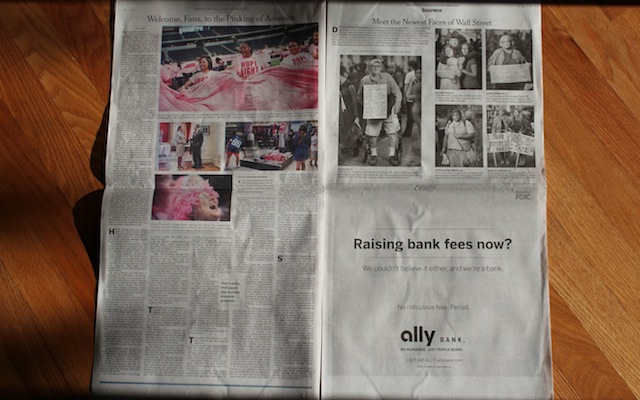
This morning I opened the New York Times, reading, among other things, stories about the Occupy Wall Street protests. In the business section, on page 7, the top of the page featured a series of images of the protesters, from an 87 year-old man in a walker to a woman carrying a sign that says “Logic of capitalism: you cannot be rich without making others poor.”
Right beneath these photos was a half-page ad from Ally Bank. I’ve been keeping an eye on Ally for the past few years because they seem to be a fantastic example of a Zag approach—a bank that is going one way when every other bank is going the other (in my view, wrong) way. Here is a story that will give you some background on Ally’s approach, but essentially their mission is to re-humanize banking. According to their website, the bank was founded on three simple principles: 1) talk straight 2) do right 3) be obviously better.
That sounds pretty good for a bank.
Here is a close up of the ad that appeared beneath the protester photos:
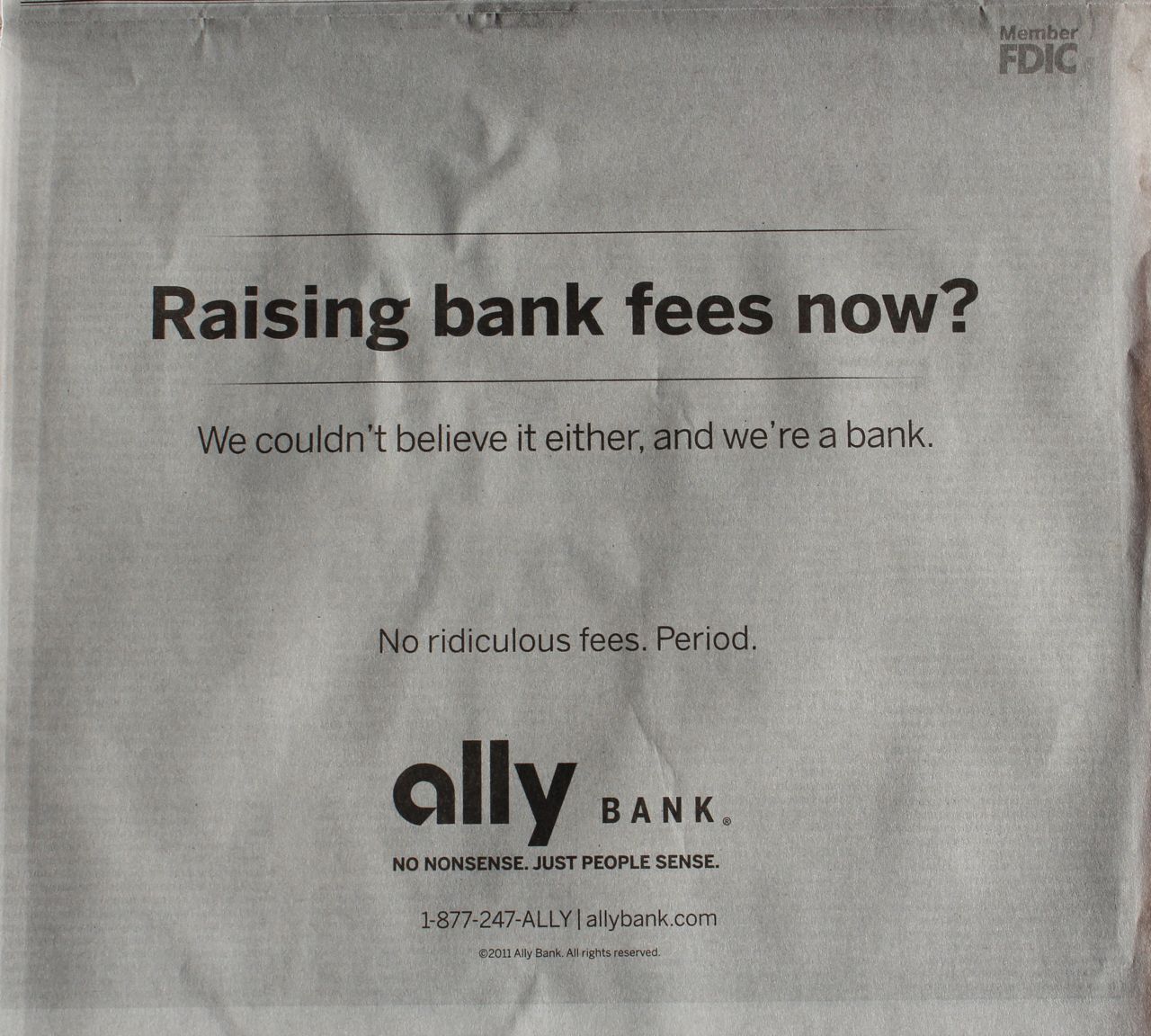 In The Ad-Free Brand, I answer a question I’m often asked: Can ad-free brands ever advertise?
The answer?
Absolutely.
But rather than building their brands exclusively through traditional advertising, ad-free brands build their brand by following the principle of esse quam videri, “To be rather than to seem to be.”
Rather than talking about what the brand is through the language of advertising, they live the brand and design it into the DNA of the organization so that the brand comes through in every interaction with it.
But sometimes there is a moment in history when a brand story resonates especially well on a broad scale.
For Ally Bank, this is that time.
For the last few years, Ally has been building a brand as a different type of bank from the inside out, by being a more human bank rather than just seeming to be a more human bank. Even though Ally isn’t exactly an ad-free brand (they do regularly spend money on traditional advertising), they are investing much more money and effort getting the brand experience right than they are in spouting endless marketing messages.
Now, with a growing movement increasingly dissatisfied with the financial industry, it is a perfect time for them to dial up the volume with a few well-placed advertisements. And with a pitch-perfect, authentically-articulated message, this particular ad not only differentiates Ally from its banking competition, it serves as an olive branch—one bank willing to break with its brethren and show sympathy to the pain being expressed by a growing movement.
I mean, come on. Are the banks really arrogant enough to believe it is OK for them to screw the very consumers who bailed them out and have seen none of the benefits from that investment trickle back to them? Ally Bank doesn’t think so.
I don’t either.
—
Was this post helpful?
If so, you can find more thoughts about how to build your brand effectively in my book, The Ad-Free Brand (not an advertisement, mind you, just a friendly suggestion:).
Only $9.99 for the Kindle, but available in each of these formats:
Book | Kindle | Nook | EPUB/PDF
Kevin Keller’s five favorite classic brand mantras
If you’ve read any of the previous brand positioning tips here on my blog, you’ve heard me mention Dr. Kevin Keller, author of Strategic Brand Management (the classic textbook on building brands) and professor of marketing at the Tuck School of Business at Dartmouth.

Kevin Lane Keller, E. B. Osborn Professor of Marketing at the Tuck School of Business at Dartmouth College and author of Strategic Brand Management
For The Ad-Free Brand, I asked Kevin if he’d share his five favorite examples of real brand mantras. He not only provided the mantras, but also included a few sentences describing why each works so well. Here are his choices:
1. Nike: Authentic Athletic Performance
One of the best brand mantras of all time, developed by Nike’s marketing guru Scott Bedbury in the late 1980s (he would later become Starbucks’ marketing guru). Bedbury actually coined the phrase brand mantra. It did everything you would want a brand mantra to do—it kept the Nike brand on track, it differentiated the brand from its main competitor at the time (Reebok), and it genuinely inspired Nike employees.
2. Disney: Fun Family Entertainment
Adding the word magical would have probably made it even better, but this brand mantra—also created in the late 1980s—was crucial in ensuring the powerful Disney marketing machine didn’t overextend the brand. Establishing an office of brand management at that same time with a mission to “inform and enforce” the brand mantra gave it real teeth.
3. Ritz-Carlton: Ladies & Gentlemen Serving Ladies & Gentlemen
The Ritz-Carlton brand mantra has a clear internal and external message, an especially important consideration for services brands. It is simple but universally applicable in all that Ritz-Carlton does and highly aspirational.
4. BMW: Ultimate Driving Machine
BMW’s brand mantra is noteworthy in two ways. One, it reveals the power of a straddle branding strategy by combining two seemingly incompatible sets of attributes or benefits. When launched in North America, there were cars that offered either luxury or performance, but not both. Two, it is also a good example of how a brand mantra can be used as a slogan if its descriptive nature is compelling enough as is.
5. Betty Crocker: Homemade Made Easy
Another example of a brand mantra that was effective as a descriptive ad tag line, Betty Crocker’s brand mantra remarkably staked out three points of difference (“quality,” “family,” and a “rewarding baking experience”) as well as a crucial point of parity (“convenience”) at the same time.
Thanks to Kevin for providing these awesome brand mantras for The Ad-Free Brand. If you want to learn more about brand mantras, please see this post (or check out Kevin’s book Strategic Brand Management).
Hey, writing is fun again!

Here is a picture my dad took in Antarctica last year. I think he's not only happy to have been there, but also enjoyed the journey too. I promise those two sentences will make more sense after you read the post.
Over the last few months, I’ve started posting more frequently here on the blog. And I just noticed that I actually enjoy writing again.
For the first two thirds of this year, I was writing a book. As it turns out, this is not the easiest thing to do on top of working a full-time job at a company that is still in startup mode. Who knew?
According to our New Kind time-tracking system, it took 138 hours for me to write 300 pages. And another 130 hours to edit. So, add in a few other book-related tasks, and I spent roughly 300 hours of 2011 working on The Ad-Free Brand.
To put it in perspective, 300 hours is almost eight weeks of a full time job. Or enough time to fly back and forth to Singapore sixteen times. I could have watched 100 major league baseball games or had 100 practices with my band. I could have taken a lot more bike rides. I could have breathed more fresh air. I could have written more blog posts.
But I didn’t, I wrote a book instead.
And, while, I’m glad I did, I can’t say it was an entirely fun experience. Looking back, I feel the same way about the book as I feel about going to Antarctica. I’d really like to have been there… but I’m not so interested in the actual experience of going there. Sounds cold, difficult, and I’d probably get seasick.
So I like having written a book, but the writing itself?
That part sucked.
Writing a blog post is like running a sprint. You go really fast for a few seconds, then you can relax and eat snacks. Writing a book is more like running a marathon (or what I expect that might be like, anyway, I haven’t done it). You write for hours and hours then, when you are starting to get really, really tired of it, you look up, see a mile marker, and realize you still aren’t even half way to the finish line. Writing books is an endurance sport, and I think I’m more of a sprinter.
While I’ve written throughout my life because I love the process of writing, I noticed because of the book I no longer got up early in the morning to write blog posts or stayed up late at night getting a thought exactly right. It just felt too much like work. But just the other evening, writing this post about Netflix, Apple, and Facebook, I realized I was actually enjoying it again.
So that’s why I have been blogging more often. I’m enjoying it, and hope that comes through in what you read here.
The origins of the beefy miracle
Last night I received a message via Twitter from a hot dog.
This hot dog, calling itself The Beefy Miracle, informed me that the latest version of the Fedora operating system, Fedora 17, was going to be named after it. The voting was close, but Beefy Miracle ended up winning by almost 150 votes.
Now I wasn’t involved in the naming or voting, but I was deeply involved in the original creation of this hot dog, so I thought I’d fill in some of the blanks regarding how it came to be in the first place. And for those of you who were also involved, if you remember additional details, please pass them on and I’ll share them here.
Way, way back in the pre-Fedora days, soon after the turn of the century, we were working on the release of a new version of Red Hat Linux (I’m guessing it was version 7.1, 7.2 or 7.3, but let me know if you remember the exact version…). At the time, most companies were beginning to fill up their software installer screens with advertisements for their other products and services. The hope was that, while you were sitting there bored waiting for the software to install, you’d see one of these ads and instantly make the decision to buy something else. Instant revenues! Instant riches!
I’m not sure how well this sort of installer advertising actually worked, but Red Hat was on the bandwagon too, and this sort of corporate stuff was beginning to sneak in to the company. Mind you, Red Hat also had a history of installer hijinks, dating back to the original option to set up “redneck” as your language of choice in the install process (which I think stayed in there until Red Hat Linux 5.1, but was gone by the time I started working there—Donnie or Mike, do you remember?).
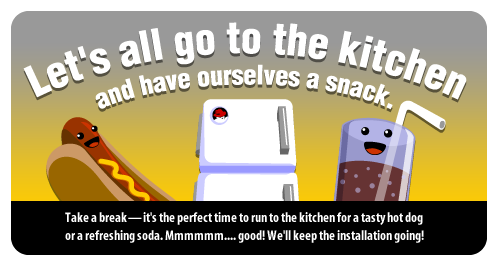
So faced with an increasingly corporate installation experience, we decided to bring some of the fun back into the installer and had our designer at the time, Kyle Hoyt, a brilliant illustrator, create some installer screens that evoked the experience of the interstitials at the movie theater. Here is the result:

 For us, they were love at first sight, and they actually made it into the installer. But as you can imagine, not everyone inside Red Hat loved them. Some thought the images were not “enterprise enough” for our rapidly growing company (it is hard to argue that a dancing hot dog is “enterprise,” but we tried). I remember more than one heated conversation about turning the Shadowman logo into a comic book character, about dancing hot dogs, and about what we were “doing” to the product with this strategy.
By the next release, the dancing refreshments were gone, I thought forever, until I received the tweet from a hot dog last night. It was nice to see them again, it had a been a long time.
And to know that Kyle’s dancing hot dog was the inspiration for the name of Fedora 17? It truly is a beefy miracle.
Thanks to those of you who played a part in bringing these images back to life. And my congratulations to The Beefy Miracle on your new job!
Netflix, Facebook, Apple and the brand community karma bank
By now I’m sure you’ve seen that, in a tersely-worded blog post, Reed Hastings of Netflix today rolled back the controversial decision to split the company into two separate services: a DVD-by-mail service that would have been named Qwikster and the on-demand streaming service that would have retained the Netflix name.
You may have also seen the announcement that Apple pre-sold 1 million units of its new iPhone 4S on the first day it was available, blowing away previous records. This positive news comes after many people (especially those in the media), expecting a completely new iPhone 5, greeted last week’s iPhone 4S announcement with disappointment.
Meanwhile, over at Facebook, privacy concerns continue to mount as the latest site enhancements caused some to question the addition of cookies that would supposedly allow Facebook to track users’ movements even once they log off the service.
I put these three events together because they showcase how three of the most successful and powerful brands of our time interact with their brand communities as they innovate quickly and aggressively.
What do all three companies share? First, confidence. They can see their destiny, they have a plan in place to control it, and no one—not even their customers—is allowed to slow their innovation engines down. What else do all three share? They all also have passionate communities of people who care deeply about them and watch every move they make closely.
In each case, these two forces—the company’s own self confidence and the pressure and expectations that a deeply engaged and passionate brand community brings—can lead to highly-charged, high-risk announcements, communications, and interactions.
So why is Apple so successful at keeping the relationship with its brand community healthy? Why is Netflix stumbling so badly? And why is Facebook in a dangerous spot?
In my view it comes down to a difference in the way each company approaches the give and take transactions with their brand community, the way they manage their community karma.
Creating a healthy brand community is a lot like managing a bank account. In order to remain in good standing, you must make more deposits in the karma bank than withdrawals. And this is where Apple, Facebook, and Netflix begin to differ.
On one end of the spectrum is Apple. The company showers us with delightful new products and innovations. Apple surprises us. Apple entertains us. But most of all, we’ve come to expect that almost every product Apple makes is going to fundamentally change the way we work and play. By creating great, impactful stuff that really does improve our lives in meaningful ways (I haven’t used a computer that runs Microsoft Windows in more than a decade… but I still remember EXACTLY how it felt), Apple is constantly making deposits in the community karma bank.
And while many folks were upset that Apple didn’t launch an iPhone 5 last week, I’ll point out that it was a stronger karma decision to launch an upgraded version of the iPhone 4 and call it a 4S than to launch an upgraded iPhone 4 and call it an iPhone 5 (as many other companies would have done). When an iPhone 5 is ready, we will know it, I’m sure.
That’s not to say that Apple doesn’t make karma withdrawals too. It does. Apple, you annoy me with your crappy restrictions on what I can do with music I download from you. I dislike your anti-competitive app store practices, and you scare me every time I have to click through a new version of your license agreement.
But when it comes right down to it, you give me more than you take, Apple, so I must admit I still love you.
On the other end of the spectrum we have our friends at Netflix. For years, Netflix was a dutiful investor in the karma bank. The company made their site elegant and easy to use, the social functionality and ratings were helpful, and, when streaming came along, it was like Christmas.
Personally, I loved Netflix. I loved it so much that I even bought a new TV last year on the strength of one feature—I could seamlessly stream Netflix movies directly to it.
But something changed. Over the last six months, I’ve noticed that Netflix has started making more karma withdrawals than deposits.
First, the Netflix site quit getting better. I don’t know about you, but I found it harder and harder to search for new movies. Netflix has always tried to push you toward the backlist titles and older movies, and I get why that made sense with the DVD-by-mail system. But why not make it easy for me to find your newest on-demand titles? I got frustrated and quit using it as much because it seemed like the site was actually losing searching/browsing functionality rather than getting better (was that my imagination?).
Then Netflix hit me with the price increase. Now I don’t mind paying more when I’m getting more, but at the time the price increase was announced it had become clear that Netflix’s agreements with distributors were souring and that they might even lose access to many on-demand films. This on top of my frustrations with the site, created my first negative Netflix experiences.
Still, Netflix had enough positive karma with me, built up over years, that we remained buddies.
Then, on September 19th, Reed Hastings sent me an email (under cover of night, at 3:31 AM, mind you) that started as an apology and quickly turned from mea culpa into double down. If you got the email, you were likely either A) angry or B) wondering if Reed might soon have an opening to hire you to help with his communications strategy.
Not only was Netflix going to keep the price increase, they were going to significantly degrade the customer experience by splitting the business in two and forcing their customers to log in to two completely different sites if they wanted to stay a customer of both the streaming and DVD-by-mail businesses. I understood the business strategy and why it made sense… but the communications strategy and the way the whole thing was positioned was just plain terrible. As someone in the communications business myself, I felt the need to look away.
And that was the moment Netflix made one more karma withdrawal than I could take. In the weeks since I received that email I have 1) bought a Roku box so I can stream on my TV from someone other than Netflix if I want to 2) started using the free streaming I get as a member of Amazon Prime and 3) made the decision to go on a break from Netflix until it gets its karma account back in order.
Apparently, I’m not alone. Since the announcement, the Netflix stock has fallen off a cliff, down from just over $200 to around $110 a share (and it was at $300 a share this summer). The announcement today may not have come soon enough, only time will tell.
Netflix, I still think we might have a future together, but man do you have some work to do.
Which brings us to Facebook. Now Facebook is a very interesting case to look at because of one thing that makes it very different than the other two companies: it doesn’t charge me any real money.
Facebook is a free service, and typically our expectations of a free service are very low. Investments in the karma bank add up quickly when the service is free. For years, Facebook has earned our love by helping us reconnect with long lost friends and relatives, while allowing us to actively keep in touch with more people at once than we ever could with a pen, phone, or email.
The real price of using Facebook—our privacy and personal data—was one that was originally only too high for a fringe group of digital conspiracy theorists. But over the past year, Facebook has become more and more intrusive, less respectful of what little privacy it still allows us, and has at the same time claimed more ownership of our personal data, using it in ways that are less clearly in our own interests.
The double whammy is that at the same time, the service is becoming incrementally less valuable to many people. Now that you are connected to all of these folks that you haven’t seen in 20 years and know what their kids are having for breakfast… then what?
I’ve noticed more and more of my friends on Facebook are going largely silent. It is good to have the network there when you need it and want to reach out to someone. But my perception is that the regular updates are decreasing, the number of times I’m tempted to click the “like” buttons has gone way down as I wonder how Facebook intends to exploit my click, and I’m unlikely to upload any personal photos or videos until I am 100% positive they aren’t going to show up in some banner ad for deodorant.
I wonder if Facebook is nearing a critical juncture. Because the service is free, I think Facebook will likely be able to avoid the rapid depletion of the karma reserve that Netflix has seen over the past few months. But as more people become aware of the true costs of using Facebook—in terms of loss of control of our privacy and personal data—and the incremental value of Facebook begins to level off, could the karma bank for Facebook go negative, even as a free service?
I don’t know. But if I were at Facebook, I’d certainly be starting to worry about it. Especially if I had a competitor like Google (with its own karma stumbles, but an overall better track record of respecting personal data) lurking, waiting for Facebook to make one too many withdrawals.
I’m sure many of you have strong views about these three brands. If you do, and either agree or disagree with my analysis, I’d love to hear your thoughts.
Hey, I Wrote a Book!

Available now in print and electronic versions.
 Dark Matter Matters