Dark Matter Matters
Chris Grams
The top 10 books behind Dark Matter Matters
Books are important to me. Growing up, almost every free wall in my parents’ house was lined with bookshelves, some of them stacked two deep. I spent most of my pre- Red Hat career in book publishing, first working during college at The University of North Carolina Press. After college, I went to work for a literary agent named Rafe Sagalyn in Washington DC. Working for Rafe was a great experience because he built his reputation on big think/idea books and business books.
His first big book was the huge bestseller Megatrends by John Naisbitt back in the early 80s. When I was there, I personally got to work with, among others, Bill Strauss and Neil Howe on their great books about generational patterns in society (check out The Fourth Turning… very prophetic these days) and Don Peppers, author of some books back in the 90s like The 1:1 Future about relationship marketing that were the grandparents of today’s books on social media marketing.
I also got to play agent and author myself too. As an agent, I represented some of Tom Bodett’s work (yes, he is the Motel 6 guy, but was also a commentator on NPR) and sold a wonderful novel called The Frequency of Souls to FSG. As author, I helped Rafe write two “cutting edge” books about getting free and open access to government information (they have not aged well, I’m afraid).
Fast forwarding to today, Rafe actually was the agent for two recent big think books that I love, Authenticity and A Whole New Mind, so he is still making things happen.
After I left book publishing, reading became fun again. I read novels and travel literature for a while, nothing that made me think too much. But when I got to Red Hat, I relapsed and started reading the big think books like the ones I used to work on with Rafe. I thought it might be worth taking a few minutes to try to remember the books that have been the biggest influences on my thinking, and get them all down in one place, so here goes:
Top 10 Dark Matter Matters books
Without these ten books, Dark Matter might not even matter to me.
The Swingin’ Johnsons: Poor branding? Probably.
A good friend told me a few weeks ago that I should write more about music here, since music is such an important part of my life. So I thought I’d give it a go.
I play bass in a band called The Swingin’ Johnsons. Yes, that’s right.
Occasionally, we call ourselves a Lyndon Johnson tribute band, when we need to water down the story, and most of our show posters have pictures of Lyndon Johnson on them. I don’t know exactly how we are paying “tribute” to Lyndon Johnson by what we do, but there it is.
Are you a creative in a corporate world? You are not alone.
Last weekend I read a book that Jonathan Opp recommended called In-House Design in Practice. It’s a bible for people who work as part of an internal creative agency within a larger corporation, which is one of the key roles of our Brand Communications + Design group at Red Hat.

In some ways, this a self help book, maybe even a support group, for creative types. I learned many things about what others in internal agency roles go through, but if I was to sum it up, I’d say I learned that I am not alone. There are others out there operating in internal agencies at corporations all around the world, and they have the same issues and opportunities we have. While the book is focused on graphic design, many of the lessons apply to other internal agency roles– editorial, web, video, you name it.
The book starts with what the authors call a “jaded” definition of an in-house designer:
…a creative person who finds him- or herself–by choice or circumstance– in an alien world ruled by left-brain-thinkers who undervalue, misunderstand, and in general, do not take full advantage of the benefit design can bring to business.
Ok, I’m listening…
As a creative person lodged firmly in a business world, you are a unique character. It can be a lonely post, but you have exactly the same goal as the people who so often disrespect, misunderstand, or step all over your work; you all want the larger organization to succeed.
Yes! (maybe ratchet down the empathy a bit though, people.)
And then comes the key theme of the book:
Chances are… you are never going to transform those people into the same kind of creative person that you are. But you can transform yourself into the kind of businessperson who can very adeptly speak their language.
What a perfect way to start a book about creative work! With some humility.
Why did I just write a post about Viking Longships?
 A great brand can seem from the outside to be an awesome speedboat, like the kind they rode around on Miami Vice… Just grab the wheel, hit the throttle, and send it screaming through the water to wherever you want to go. He who controls the brand has all of the power to steer and go wherever he wants… right?
I’ve always envied those brand managers (kind of…) who have a marketing budget of millions and can go out and “buy” an image for their brand using advertising. They are driving the speedboats. If they want, they can associate their brand with skydivers and bungee jumping (Do the Dew, man!) or whatever they choose.
But the reality is that a brand like Red Hat is more like a Viking longship. Here’s what Wikipedia says about how longships moved:
Customer-driven innovation in the White House?
This week, the White House is holding a two day experiment at www.whitehouse.gov where Americans can ask Barack Obama any question they have regarding the economy. People can enter their own questions or vote on the questions of others. Later this week, Obama will address many of the most popular questions in a national town hall meeting.

In the video on the site, Barack Obama says:
One of my goals as president is opening up the White House to the American people so that folks can understand what we’re up to and have a chance to participate themselves.
In the open source world, we often talk about the idea of user or customer-driven innovation. We make the process of creating open source software transparent and collaborative. Customers can easily contribute their ideas, and we both share in the value that is created– we make better software faster, our customers get better, more relevant software faster. Everybody wins.
How cool is it to see the same principle applied to government? By opening the feedback loop to us regular Americans– the “customers” of our government– might we be able to create a better government faster? Could the old open source adage, “Given enough eyes, all bugs are shallow” apply to governing the American people as well?
As of when I wrote this post, about 40,000 people had voted 1.5 million times times on over 40,000 questions. The site is open through Thursday morning at 9.30 AM, so go ask your questions and vote!
One note… the people from the “Legalize it!” lobby and the “show us your birth certificate” lobby both found this site before you… But don’t worry, in the meritocracy of whitehouse.gov, the best ideas seem to still be winning:)
Brand and human resources in one department? Are you nuts?
A few months back, Red Hat rearranged a few organizational boxes, as companies tend to do from time to time. One result of this was the creation of a new department called People & Brand, a combination of the existing Red Hat Human Capital team and our Brand Communications + Design team.
When some folks hear that, their faces crinkle all up in confusion and they say something akin to “That doesn’t make any sense… brand is a marketing function, not an HR function!”
It’s true that brand is traditionally thought of as a tool of marketing, but in the 21st century company, we are going to have to rethink some things. One thing the 21st century company is going to have to do is resist the urge to put things into silos so quickly. One former boss of mine who loved to do this called it “bucketizing”– a beautiful markepoetry term.
Look at the statement above again: “Brand is a marketing function, not an HR function.”
I disagree.
Brand is an HR function. And a marketing function. And a sales function. And a service and support function. And a finance function. Brand should be deeply embedded in everything a company does.
The organizational structures of the 20th century “bucketize” by default. One box at the top. A bunch of boxes connected to that one. And each of those boxes has a bunch of boxes connected to it. We tend to spend most of our time worrying about which box is connected above us rather than which boxes might be connected beside us.
Markepoetry Part 4: Harness the power of social media
Got a piece of spam in my inbox the other day that was good enough to inspire a piece of markepoetry all by itself. This short piece takes the form of a haiku, entitled “Harness the power of social media.” Sometimes art shows up when you least expect it.
—
Harness the power of social media
Use the sheer power
You’ll grow like never before
social media.
—
Markepoetry is the language of marketing, made beautiful.
Conversational Capital: I’m totally not wearing any pants
On a recommendation from Michael Tiemann, I got the book Conversational Capital: How to Create Stuff People Love to Talk About by the folks at Sid Lee, who have done work for brands like Cirque du Soleil, Adidas, and Red Bull.
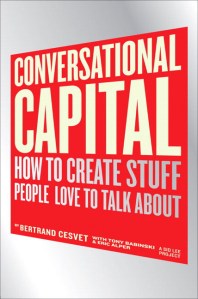 Michael had sent a note at Red Hat a few months back where he said this book helped him understand the “x-factors” that had allowed Red Hat to create a strong brand position at such a small, young company. Thought I should check it out.
In case you were wondering, that headline above is an example of Relevant Sensory Oddity, one of the topics they cover in the book. I thought I’d try it and see if it works:) I actually am wearing pants. Today.
The main thesis of Conversational Capital is that there is a more powerful way to get consumers engaged with your brand by “making your story part of their story,” creating stories or experiences that are meaningful to them. The authors turn their noses up at “buzz marketing,” equating it to style over substance, with no depth or continuity, all sizzle and no steak.
Fedora, Red Hat, and open brands
A Twitter friend asked me the other day if I had been doing any more thinking about open brands. Turns out I have. Two weeks ago, she and I had a conversation where we discussed how Red Hat had opened up the Fedora brand and the positives (tons!) and negatives (some) of doing so.
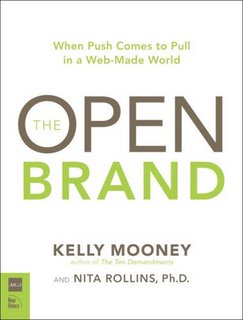 This week, on an plane ride up to Boston, I read the book The Open Brand by Kelly Mooney, which another friend had handed to me a while back.
The book is a eulogy for brands that are not willing to open themselves up, and an instruction manual for those that are considering becoming more open.
It was particularly interesting to read as a Red Hat guy, because the book is based on the idea that today’s single most powerful technology is “a mashup of the World Wide Web and the open source movement.”
The book opens with the question… “are you dangerously CLOSED?”
Whew… passed that one. But the book did make me think some about where the Red Hat brands fall on the spectrum of closed to open.
David Burney in BusinessWeek, Obama the first design thinking president?
David Burney’s blog post about Obama being the first “design thinking” president just got picked up by Bruce Nussbaum of BusinessWeek. Nussbaum is another one of those guys who gets it– he’s been writing about design thinking and innovation in business for quite some time.
Read the full text of Nussbaum’s article, entitled President Obama Goes Optimistic: Obama Is The Design President.
Hey, I Wrote a Book!

Available now in print and electronic versions.
 Dark Matter Matters