Dark Matter Matters
Chris Grams
What I’ll miss most about Red Hat
Today is my last day at Red Hat. What will I miss most? Seeing my friends every day.
In the Polaroids below are some of the people who’ve made the last 10 years a lot of fun. All pictures (except one that she is in) taken by Ruth Suehle at my going away party last Thursday with an old skool Polaroid OneStep 600 camera. I’m the guy in the white shirt.
This is one awesome group of folks. Thanks for all you have done for me.
2 reasons why the term “crowdsourcing” bugs me
Interesting article in Forbes the other day about the way Threadless, the awesome t-shirt company, thinks about community-building. For those of you who aren’t familiar with Threadless, they do about $30 million in revenues with a unique cultural/business model that merges a community of t-shirt creators and consumers into one happy family (you can read more about them in the Forbes article).

We are a crowd. We are ready to "source" something.
This quote from Cam Balzer, the Threadless VP of Marketing, in particular, caught my eye:
“Crowdsourcing is antithetical to what we’re doing. That’s because crowdsourcing involves random sets of people who suddenly have a say in how the business works, but that’s not how Threadless operates. We’ve got a close-knit group of loyal customers and have worked hard to build that. The people who submit ideas to us, vote and buy our products aren’t random people, and they aren’t producing random work. We work closely with our consumers and give them a place on our site, the Threadless forum, where they can exchange ideas with one another–ideas that go beyond designing T-shirts. We have consumers who have voted on 150,000 designs, which means they’ve spent hours interacting on our site. People who do that aren’t jumping into a random crowd. They’re part of the community we’ve cultivated.”
This really hit the nail on the head for me. I often see the word crowdsourcing being used in the same sentence with open source or community building. But the word crowdsourcing doesn’t describe the type of community I like to be involved in. Here’s why:
Roger Martin and the new liberal arts MBA
This morning’s New York Times had a great article entitled Multicultural Critical Theory. At Business School? highlighting the changes many business schools are making in the way they teach their students. Probably the most visible leader of this movement has been Roger Martin, Dean of the Rotman School of Management at the University of Toronto, who is prominently featured in the article (and will be speaking here in Raleigh next month at the Institute for Emerging Issues Forum).
(VIDEO: a recent Roger Martin talk)
What kind of changes are the schools making? From the article:
“While few [business schools] talk explicitly about taking a liberal arts approach to business, many of the changes are moving business schools into territory more traditionally associated with the liberal arts; multi-disciplinary approaches, an understanding of global and historical context and perspectives, a great focus on leadership and social responsibility and, yes, learning how to think critically.”
Why? Look around you. In business, we are currently experiencing a double crisis of ethics and innovation. Take the results of a recent Gallup poll on Honesty and Ethics of Professions. Americans now trust the ethics and honesty of businessmen less than lawyers. Ouch.
The lo-fi communications revolution is not being televised
I have a decent (and still growing) LP collection, and my turntable gets almost daily use. In fact, I often buy music on vinyl rather than downloading it or buying CDs.
 One of my recent vinyl purchases was Pet Sounds by the Beach Boys. Probably one of the greatest albums of all time, but it wasn’t until I heard it on LP that I really felt like I started to get it. There was something about listening to it in the way it would have been listened to when it came out in 1966. Pops, crackles, and Brian Wilson just felt right together.
But as I’ve made my way around music stores, I’ve noticed the number of brand new releases coming out on vinyl seems to be increasing. And I’ve also seen many bands going (on purpose) for a lower fidelity sound.
I remember the lead singer of a local group here in NC, The Love Language, was quoted on why he liked low fidelity in Spin Magazine a while back:
“I’m a real lo-fi junkie,” [Stuart McLamb] says. “I like the [Band’s] Big Pink philosophy — you should have a dog on the floor of a basement while you’re recording. That’s where the best stuff happens.”
A dog on the floor, man! Not some fancy studio in New York City run by rich guys in suits named Hunter and Cody. The places where the dog is invited is where the best stuff happens.
Where am I going with this? I believe that there is a lo-fi movement not only in music but in communications more broadly that continues to gain momentum. Communications that are too high fidelity may not be viewed as trustworthy anymore. Take this quote from the Wikipedia page for “Low fidelity”:
2010: New year, new job, New Kind
Well folks, there are gonna be some changes around here in 2010. So let me cut to the chase.
After 10 1/2 years, I’m leaving my full-time position with the greatest open source company in the world later this month.
This was no easy call. Red Hat has been a fantastic ride. I’ll spare you the trip down memory lane, but Red Hat has been the defining job of my career.
 I certainly wouldn’t leave Red Hat to join another big company. In fact, thanks to DeLisa Alexander, my wonderful boss, and Jeff Mackanic, my long-time partner in running the Brand Communications + Design group, I’m going to continue to work with Red Hat– just in a different capacity. More on this later.
I’ve always wanted to start my own company, see how entrepreneurship fits, and have never had a good opportunity before. In 2010 I believe we are entering one of the most exciting opportunities for entrepreneurs in decades. I aim to give it a go.
As folks who’ve been reading Dark Matter Matters know, I have a deep interest in seeing how the lessons of open source might be applied to companies outside of the technology industry. I’m excited about taking some of the principles we’ve used to build brand, culture, and community the open source way at Red Hat and finding other companies who could use them too.
To that end, the news that won’t be a surprise to folks who know me well: I’ve decided to join up with two of my best friends, David Burney and Matt Munoz, who have spent the last year building a new kind of communications firm– New Kind.
David and I have worked together for almost 10 years, first when he owned Burney Design and was Red Hat’s creative agency partner, then as my boss at Red Hat for 4+ years. And, of course, he and I still play together in our band The Swingin’ Johnsons.
Matt and I first met while he was working on the Red Hat account at CapStrat. He was an early architect of the modern Red Hat brand identity, leading projects like the Red Hat brand book and the Fedora logo design.
As for New Kind, we have a lot of ideas.
So rather than stretching this post too long, I’ll promise to continue to share my ideas here at Dark Matter Matters if you promise to continue to read.
Thanks to my amazing Red Hat family, especially my brothers and sisters in the Brand Communications + Design team, for 10 great years. The hardest part of this decision was knowing I would no longer be sitting beside you five days a week.
Happy new year, and thanks to each of you for making the first year of Dark Matter Matters a special one.
A New Kind awaits!
Top 10 Dark Matter Matters posts of 2009

Benjamin sez you all deserve some props!
Ah, late December. The time when bloggers get lazy and start reposting their old crap rather than writing new material. We here at Dark Matter Matters are no exception. For the Dark Matter Matters top 10 posts of 2009, I’ve split the list into two categories. First we have 5 posts that were popular with readers, followed by 5 posts that were popular with, well, me.
Five posts popular with readers:
- Brand positioning tip #1: points of parity and points of difference: Perhaps it’s the combination of analyzing Mexican food and brand positioning, but this post, the first in a series of tips that I wrote starting in June, is the most read post I’ve done yet on the blog.
- Tom Sawyer, whitewashing fences, and building communities online: Written in September, this post was the first in a series about community-building where I talk about the difference between creating communities to do your work for you and being a humble member of a community larger than just you.
- Brand positioning tip #3: the brand mantra: A short post explaining Scott Bedbury’s concept of a brand mantra.
- Maslow’s hierarchy of (community) needs: Comparing a company’s community motivations to Maslow’s hierarchy of needs, introduces the Iain Gray hierarchy of community needs.
- The top 10 books behind Dark Matter Matters: Exactly what it says it is. Books that inspire me.
Five posts that hardly anyone read. Give them a chance, people:
- Tom Sawyer Part 2: where can your company pitch in?: As usual, the sequel isn’t as good as the original, but I still like this post, which has really helped me focus some of my ideas on corporate humility.
- How to conduct a symphony of communications: Compares the role of a 21st century communications professional to a conductor in a symphony.
- Sharing your brand story (and here’s ours): Introduced the Red Hat Story book (including a downloadable copy).
- Why did I just write a post about Viking longships: Compares the job of brand manager to the guy at the front of a Viking longship. Yeah, I wouldn’t read it from that bobo article title either, but this is the kind of post that makes me happy.
- Markepoetry Part 2: It turns out I have needs: Talking about making (only) myself happy, no list of the Dark Matter Matters posts that no one reads would be complete without including one of my pieces of markepoetry– the language of marketing, made beautiful. Basically, I take real statements that I find in marketing copy and transform them from ugly marketing-ese into poetry. I thought this one was nice.
So as we close out 2009, I just want to say thanks for everything.
I’m approaching one one year of writing this blog, and it sure has been a lot of fun. I still can’t believe I’ve written over 100 posts. What has made it the most fun for me is getting to meet lots of new people, while also becoming closer to people I already know.
I’m looking forward to 2010. I’m sure we’ll have lots to talk about.
The story of how we uncovered the Red Hat values
One of the first things many new employees notice when they step inside Red Hat is how deeply held our corporate values are within our walls and how much they impact behavior within the company. The values aren’t just words to most Red Hat folks, and they show up in conversations and in actions on a daily basis. Today we probably take for granted that it has always been that way.
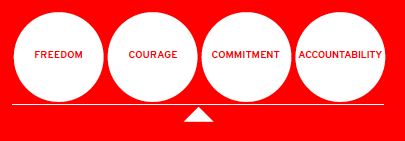
The four Red Hat values, in balance.
But it wasn’t. Back in 2002, I was one member of a team tasked with figuring out Red Hat’s corporate values. At that time, the company was still pretty small– about 500-600 employees.
I must admit at first I was pretty jaded about the whole corporate values business. The concept of corporate values made me think of those Successories motivational posters with a photo of a bear in the middle of a stream with a fish in his mouth and a word like “ACHIEVEMENT” in all caps at the bottom. Or whatever. Most corporate values systems didn’t seem authentic to me or were just plain lame.
The values team was made up of a cross section of folks from across Red Hat: Sean Witty, who did biz dev and M&A; Mark Cox, a security guru who is still at Red Hat; Jeremy Hogan, one of the original Red Hat community managers but who at the time was working in support; Paul Salazar, who I’ve written about before in this blog here; Jonathan Opp, who is still in the Red Hat brand team and did a lot of the original writing of the values descriptions; and myself.
We quickly decided we didn’t want Red Hat to end up with just some lame words to put on posters. We wanted to do this values stuff right.
Paul Salazar knew Jim Collins from Stanford, and encouraged each of us to read Collins’s book Built to Last (which is one of the Top 10 Books behind Dark Matter Matters). In it, Collins talks about the characteristics common to great, enduring corporations. According to him, the most important thing great companies shared was having deeply held values and core purpose. From the book:
Jim Whitehurst video: Competing as a 21st century enterprise among 20th century giants

The Duke Fuqua School of Business just posted Jim Whitehurst’s presentation from their Coach K Leadership Conference entitled “Competing as a 21st Century Enterprise Among 20th Century Giants.” I referred to it a while back in a post entitled Jim Whitehurst: 5 tips for competing in the 21st century.
Watch a stream of the whole talk here or click on the image above.
I think it is fantastic, but would love to hear what you think.
Pollan’s potatoes and the spread of ideas
Last weekend I watched The Botany of Desire. In this PBS documentary I streamed off Netflix, Micheal Pollan (the foodie hero who brought us The Omnivore’s Dilemma, a book also called The Botany of Desire, and the documentary Food, Inc.) examines the natural history of the spread of four plants: apples, tulips, potatoes, and marijuana, but with a twist– he tells the story from the plants’ point of view.
 Man, I love stuff like that. By switching the perspective, Pollan is able to show how each of these plants has manipulated humans into propagating it far and wide throughout the world. For example, apples are indigenous to the mountains of Kazakhstan and potatoes to Peru, but now both can be found pretty much everywhere. And wait ’til you watch the section about marijuana, a plant that has managed to get many humans to raise it better than their own children.
I thought it might be interesting to take Pollan’s trick, but rather than apply it to plants, apply it to ideas. Get all anthromorphic and consider how ideas get us to spread them.
There are tons of people out there looking at how ideas spread, probably most famously/recently Malcolm Gladwell in The Tipping Point. But what if, for a second, we take the perspective that the ideas might be using us the same way flowers use bees.
Early in human history, ideas weren’t particularly good at getting us to do their bidding. Heck, the idea for inventing paper first showed up in Egypt over 5000 years ago, and it couldn’t even get humans to take it one continent away to Asia. The idea for inventing paper appeared in China independently about 3500 years after it appeared in Egypt, according to what Wikipedia tells me.
Is open source creating jobs?
On the heels of last week’s White House Jobs and Economic Forum, President Barack Obama announced a series of job creation ideas today in a speech at the Brookings Institution.
As I mentioned in my last post, Red Hat’s Jim Whitehurst was one of two technology industry CEOs who attended the White House forum last week, the other was Eric Schmidt from Google. Two things Red Hat and Google have in common? We are both strong supporters of open source and we are both hiring.
But this morning I had another thought– beyond the jobs at Google and Red Hat, are we– and other companies in the open source community– helping create jobs at a broader level? Meaning, are the products, services, and innovations of open source companies creating job opportunities for people who use what we make?
To find some data, I turned to Indeed.com, a search engine for job seekers that also has a fascinating job trends tool you can use to search on how often a particular term appears in job listings.
As a baseline data point, I looked at the chart for “receptionist,” a common job that might be a decent bellwether for job trends. The chart looks pretty much like you might expect:

Not great news for any receptionist looking for work. This term had once appeared in almost 2% of job postings, now it is hovering right below 0.8%.
Next, for some overall industry perspective, I looked at their page on Information Technology job trends. Not a lot of good news here either, unfortunately. These two pieces of information were disturbing:
Hey, I Wrote a Book!

Available now in print and electronic versions.
 Dark Matter Matters